 Skip to content







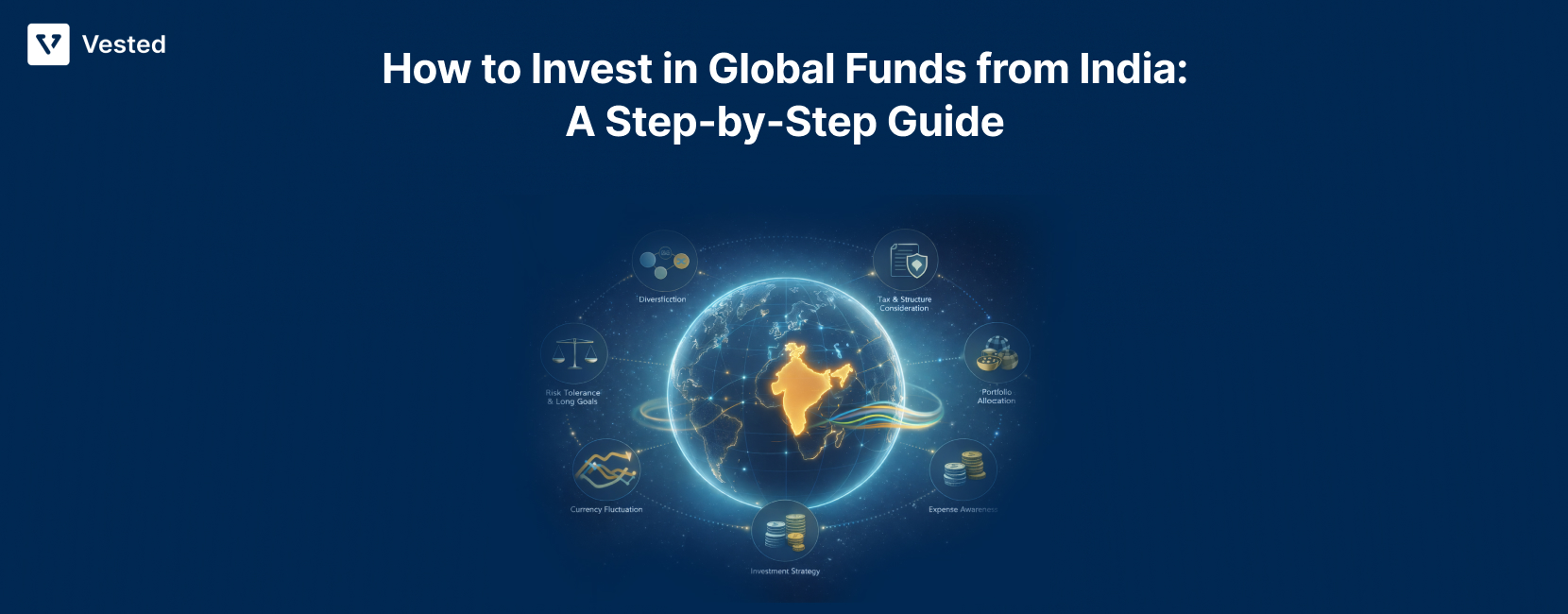
Over the past decade, global markets, particularly in developed economies, have delivered strong returns compared to many domestic indices. Themes such as artificial intelligence, cloud computing, biotechnology, and clean energy have played a key role in driving growth across global markets. That’s why holding around 10–30% of your portfolio in global funds to diversify, cut risk, and steady long-term returns is ideal. But the question is, what are global funds, and how can you invest in them? Let’s break it down.
What are Global Funds?
Global funds are mutual funds or exchange-traded funds (ETFs) that invest across multiple countries, including both domestic and international markets. Unlike pure international funds, global funds may also allocate a portion of assets to the investor’s home country.
They provide exposure to global equities, bonds, or other assets, helping investors diversify across geographies, currencies, and economies.
Benefits of Global Funds
Need one reason to invest in global funds? Here are five:
- Geographical Diversification: Global funds spread your investments across companies and markets worldwide. They reduce reliance on one country’s economy, helping lower portfolio risk.
- Currency Diversification: Global fund investments involve foreign currencies. If a foreign currency appreciates against your home currency, your returns can increase when converted back.
- Innovative Themes: Global funds provide access to industries at the forefront of innovation, such as artificial intelligence, renewable energy, biotechnology, and advanced technologies.
- Uncorrelated Markets: Different markets often don’t move in sync. Downturns in one region might be offset by gains in another, helping to balance risk.
- Hedge Against Slowdown: When your local market slows, global investments can help keep your portfolio growing by tapping into other expanding regions.
How to Start Investing in Global Funds from India
See how investors in India can invest in global funds:
Step 1: Identify Your Investment Goal and Time Horizon
Know whether you are investing for short-term goals, such as a vacation or a car purchase. If not, be specific about your long-term investment goals, such as building a retirement corpus or saving for a down payment on a house.
For short-term goals, liquidity is important, but volatility is a big no. For the long term, funds should be able to weather market cycles.
Step 2: Choose the Right Global Fund
There are two broad types of global equity funds you will encounter: active and passive. Active funds are managed by fund managers who aim to outperform a benchmark; however, they come with higher expense ratios.
On the other hand, passive funds aim to track an index such as the S&P 500 or the MSCI World. Since passive funds are not rebalanced frequently, lower administrative effort results in a lower expense ratio.
Step 3: Understand the Investment Route
You have two options for gaining global exposure through mutual funds. Fund of Funds (FoFs) is the most common option. Offered by Indian asset managers, these funds invest in underlying overseas mutual funds or ETFs. You can invest in them using Indian rupees through regular Indian platforms and AMCs. The AMC then handles currency conversion and overseas investing on your behalf.
Another route is to invest via the International Financial Services Centre (IFSC) at GIFT City, which provides access to a wider basket of global instruments, such as offshore funds and select ETFs, within RBI’s Liberalised Remittance Scheme (LRS) limits.
GIFT City investments typically require a distinct account with an IFSC-registered broker and access to a foreign-currency bank account.
Step 4: Complete KYC and Investment Setup
To invest in a global fund from India, complete your KYC (Know Your Customer) by submitting your identity proof, such as a PAN card; address proof, such as Aadhaar or passport; and a recent photograph.
Under SEBI’s current regulations, KYC must be fully validated by a KYC Registration Agency (KRA).
Once KYC is complete, decide whether to invest a lump sum or use a Systematic Investment Plan (SIP).
A lump sum is suitable if you have a clear amount ready to deploy, whereas SIPs spread investments over time, averaging out market volatility. For long-term goals, especially, SIPs can be a disciplined way to gradually build global exposure.
Step 5: Monitor and Review Your Global Fund Investment
After you have invested, the journey doesn’t end there. Track performance regularly relative to your goals and benchmark returns.
If required, rebalance your portfolio by adjusting the allocation between domestic and global assets. For example, if global markets outperform and become a larger share of your overall portfolio than intended, you might rebalance by trimming some positions or shifting future SIPs to other categories.
Taxation of Global Funds in India
In India, global funds are not treated as domestic equity funds. The reason? They do not meet the 65% domestic equity threshold. Effective April 1, 2025, these funds are treated as non-equity/other capital assets under the Income-tax Act, 1961, and are taxed accordingly.
Tax is triggered only when you sell or redeem units for profit, not when you hold them. Here is the insight into the tax rate:
- If you hold global fund units for less than 24 months, the gains are added to your income and taxed at your normal slab rate.
- If you hold them for 24 months or more, the profit is categorised as long-term gains and is taxed at a flat 12.5% plus applicable surcharge and cess without indexation.
Dividends distributed by global funds or received from foreign underlying securities are taxed as ‘Income from Other Sources’ at your regular slab rate for residents. There is no dividend distribution tax (DDT) at the fund level since its abolition in 2020.
However, TDS on dividends applies only if the total dividend exceeds ₹5,000 in a financial year for residents (Section 194), and the rate is 10% for residents and 20% (plus surcharge and cess) for non-residents.
Common Mistakes to Avoid While Investing in Global Funds
When investing in a global fund, beware of the following blunders:
No Goals
Before investing, many people don’t set specific financial goals, such as retirement or education. Avoid this blunder: without clear goals, asset allocation becomes inconsistent and reactive, leading to poor long‑term results.
Currency Risk
If the rupee strengthens against foreign currencies, your returns can drop even when overseas markets do well.
Suppose you invest ₹1,00,000 in a global fund. At an exchange rate of ₹83 per US dollar, this converts to about $1,204. Over a year, the fund grows by 10%, taking your investment to roughly $1,325. If the exchange rate had remained at ₹83, your investment would now be worth about ₹1,09,000. However, if the rupee strengthens to ₹75 per dollar, your $1,325 is now worth only about ₹99,400. Even though the US market performs strongly, currency fluctuations eat into your returns.
Over-diversifying
Suppose you invest in three different global equity funds. All three might hold major US tech companies, such as Apple, Microsoft, and Google. Even though you think your investments are spread across multiple funds, a large portion of your portfolio is still concentrated in the same stocks. If US tech underperforms, your portfolio may drop more than you thought, limiting diversification’s purpose.
Market Timing
When you try to wait for the “perfect” time to invest in global funds, you are attempting to time the market. Different economies move in cycles affected by global interest rates, inflation, and geopolitical events. Predicting these perfectly is nearly impossible.
For example, suppose you wait to invest in a US technology-focused global fund with an expectation that interest rates will fall next year. But opposite to your prediction, the fund rises steadily over the next six months. By waiting, you miss out on those gains, and your potential returns are lower than if you had invested earlier.
Chasing Returns
Many investors jump into global funds after seeing strong recent performance. That’s risky.
For example, suppose a US technology-focused global fund gave 35% returns last year. Seeing this, you invest now, expecting similar gains. However, if technology stocks slow down and other regions start doing better, that fund can lag. That’s because returns keep shifting across countries and sectors, and last year’s winners don’t always stay on top.
Who Should Invest in Global Funds?
Global funds are ideal for you if you fall into any of the following categories:
- If you want exposure beyond your home market to reduce risk tied to a single economy, you can add global funds to your portfolio.
- If you have a minimum investment horizon of 5–7+ years, you can invest in global funds. The reason is that currency and market cycles can be volatile in the short term.
- Turn to global funds if you want ownership in world-class companies and industries not widely available domestically.
- This investment option is beneficial for those who already have a well-diversified domestic portfolio and want an additional layer of growth potential and risk mitigation.
- If you are a moderate-to- high-risk investor and are comfortable with currency fluctuations and the geopolitical risks that come with international markets.
Conclusion
Investing in global funds from India lets you tap into top global companies, fast-growing sectors, and markets beyond India. Pick the right fund, learn about FoFs and GIFT City, complete your KYC, and keep tracking your investments to build a strong global portfolio.
Although currency ups and downs can happen, with smart planning, steady SIPs, and a long-term mindset, you can comfortably ride global growth while strengthening your portfolio alongside domestic investments.
Frequently Asked Questions
What is the Liberalised Remittance Scheme (LRS)?
As per the LRS, if you are an Indian resident, you can remit up to USD 250,000 per financial year abroad for investments, including global funds and stocks.
Do global funds in India require a special account?
If you want to make a GIFT City investment, you will need a designated global investment account. For offshore foreign funds via LRS, you need to link your regular bank account for remittance, not a separate foreign currency account.
What documents are needed to invest in global funds?
To invest in a global fund, you will need a PAN, Aadhaar, KYC proof, bank details, and an LRS declaration.
What are the risks of global fund investing from India?
When you invest in a global fund, you will face risks, such as currency fluctuations, international market volatility, fund expense ratios, and regulatory changes in overseas markets; diversification may reduce, but not eliminate, these risks.
How can NRIs invest in global funds from India?
If you are an NRI, you can invest in Indian global funds or GIFT City international options through your NRE or NRO account. Just ensure your KYC is done and remember compliance rules, like FATCA, that apply to some countries.
