 Skip to content





We are pleased to introduce our Monthly Market Wrap, a research-driven publication designed to provide a structured perspective on market developments, portfolio positioning, and key themes shaping the investment landscape. In an environment increasingly defined by macro uncertainty and rapid shifts across asset classes, our objective is to distill what matters, cut through the noise, and offer clear insights.
March 2026 was one of the most volatile months in recent years in the stock markets. US equities declined sharply in March as geopolitical tensions in the Middle East rose – leading to a surge in crude oil prices. Macro uncertainty combined with disinflation factors led to the major indices ending in red for the month.
-
- S&P 500- 7.78%
- Nasdaq- 8.59%
- Dow- 7.54%
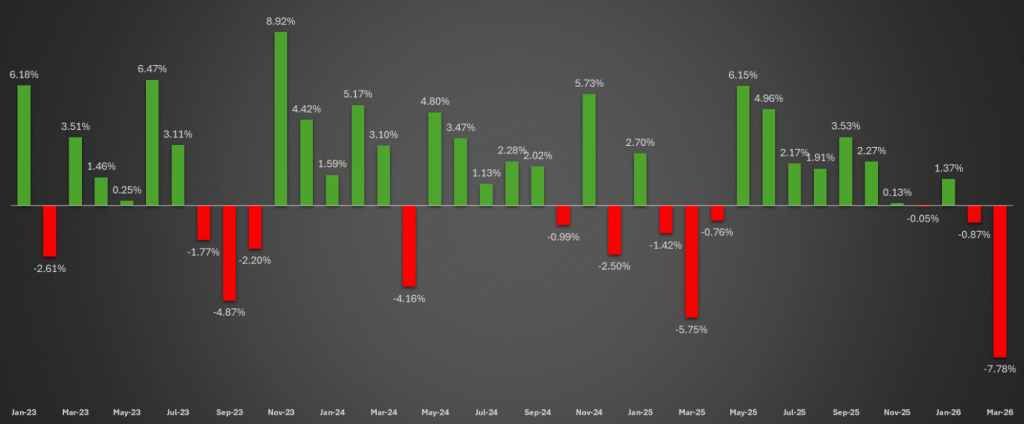
SnP 500 monthly returns (Jan-2023 to Mar-2026)
Let us understand what caused the markets to behave the way they did in March.
Inflation Risk:
The month began with an escalation in tensions involving the US, Iran, and Israel, which quickly translated into a global energy shock. At the center of this disruption is the Strait of Hormuz, a critical chokepoint that facilitates the passage of nearly 20-25% of global energy supply. Concerns around Iran asserting greater control over the Strait, effectively turning it into a supply bottleneck, led to a sharp spike in crude oil prices, with Brent crude rising by nearly 36% during the month.
A surge in crude oil prices typically has negative implications for equity markets. Higher energy costs increase transportation and production expenses, which are often passed on to consumers in the form of higher prices. This, in turn, feeds into broader inflationary pressures and weighs on both corporate margins and consumer demand.
Another key driver of market performance in March was the shift in the inflation narrative. Prior to the escalation, markets were increasingly confident that inflation was moderating and had priced in two rate cuts for 2026. However, the oil-driven shock disrupted this view. Headline CPI rose by 0.3%, while Core CPI (excluding food and energy) increased by 0.2%, reinforcing concerns that inflation could remain persistent.
As a result, market expectations adjusted meaningfully, with the outlook shifting from anticipated rate cuts to a scenario where there was nearly a 50% probability of a rate hike over the same period. Reflecting this uncertainty, the Federal Reserve, at its March 18 meeting, held interest rates steady at 3.50% – 3.75% and signaled a wait-and-watch approach.
At the same time, signs of a moderation in economic momentum began to emerge. Total nonfarm payroll employment increased by 178,000 in March but the unemployment rate
changed little at 4.3 percent. This raised concerns that growth could soften even as inflation risks persist, creating a more complex macro environment for policymakers.
Sectoral Behavior:
A key development in March was the significant shift in market leadership. Technology and high-growth stocks, which had delivered strong returns through 2025 and into early 2026, became the primary drivers of the broader market decline.
High-growth companies – particularly in the technology sector – derive a substantial portion of their valuation from future earnings expectations. The sharp rise in crude oil prices reignited inflation concerns, which in turn led to a reassessment of interest rate expectations. As the likelihood of higher rates increased, future cash flows were discounted more heavily, resulting in a compression in valuations for these long-duration assets.
Another factor contributing to the tech sell-off was the scale of capital expenditure being deployed toward AI infrastructure. As companies committed significant resources to AI buildouts, investors began to question the near-term earnings impact and the timeline for returns on these investments, leading to increased scrutiny of valuations.
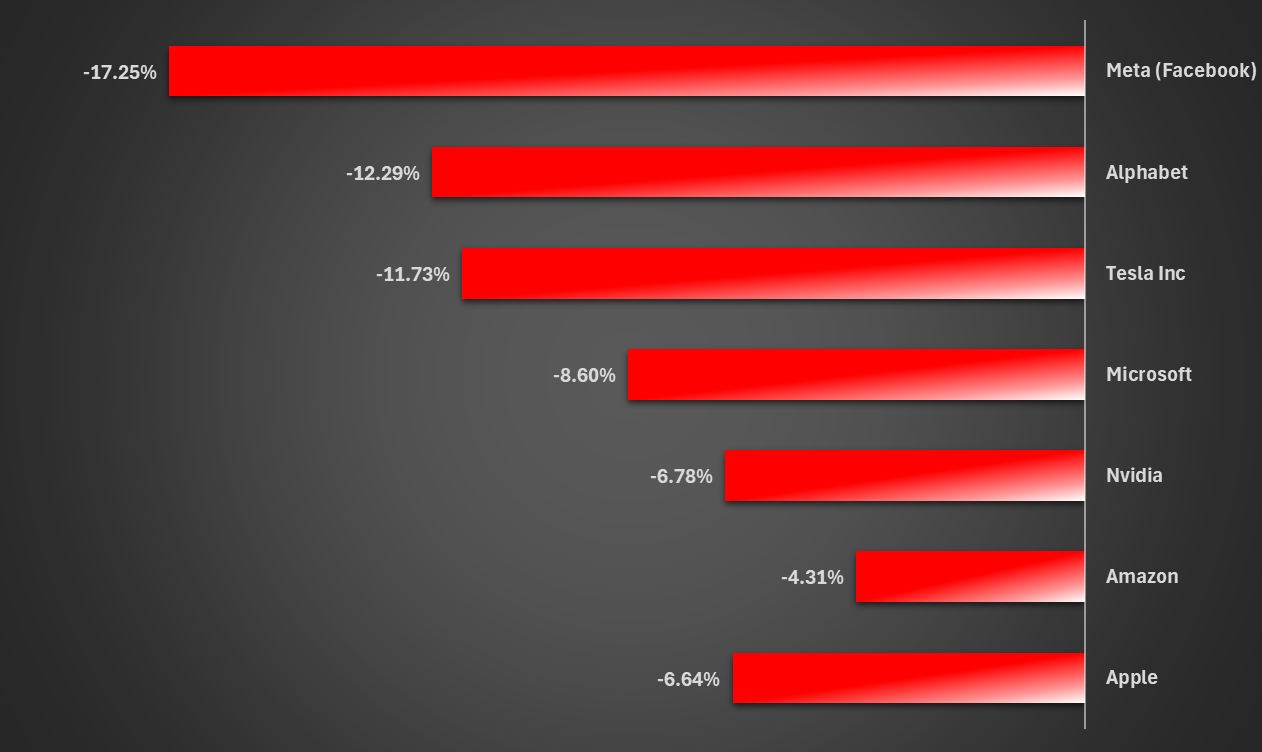
Magnificent 7 March returns
As uncertainty rose, market sentiment shifted decisively toward risk-off. Investors rotated away from technology and other high-growth segments toward sectors with more immediate earnings visibility and macro tailwinds, including energy, defense, financials, and industrials.
The Magnificent Seven refers to a cohort of dominant U.S. technology companies – Apple Inc., Microsoft Corporation, Alphabet Inc., Amazon.com Inc., NVIDIA Corporation, Meta Platforms Inc., and Tesla Inc. – that have been key drivers of equity market returns, supported by strong earnings growth, scale advantages, and leadership in AI, cloud computing, and digital platforms.
Key Themes that Shaped Markets in March:
In March, the three key themes shaped market dynamics were Deglobalization, Electric Vehicles, and Space Tech.
Deglobalization continued to gain traction amid ongoing shifts in trade policy, with renewed tariff actions reinforcing supply chain localization and the move toward strategic self-reliance.
The Electric Vehicle segment faced near-term pressure following the rollback of federal subsidies, leading to softer demand and pricing adjustments, although strength in the secondary market, particularly used EVs, provided some offset.
Meanwhile, Space Tech emerged as a strong theme, supported by rising geopolitical tensions and increased defense spending, with growing investor interest in companies tied to government contracts and anticipation around developments such as a potential SpaceX IPO.
Managed Portfolios – March Review
As part of our monthly review process, we assess portfolio positioning in the context of evolving market conditions and make adjustments where necessary to maintain alignment with our underlying investment theses. Before outlining these changes, we briefly introduce our Managed Portfolios.
Our Managed Portfolios are designed to provide investors with structured exposure across key themes and asset classes, supported by ongoing monitoring and disciplined rebalancing. Each portfolio is aligned to a specific investment objective – ranging from long-term structural trends to diversified multi-asset allocation – ensuring consistency in approach across market cycles.
Blockchain Ecosystem (Previously Cryptocurrency) – We renamed the Cryptocurrency Portfolio to Blockchain Ecosystem to better reflect the portfolio’s approach: gaining exposure to the crypto and blockchain theme through publicly traded stocks, not through direct cryptocurrency holdings.
We exited positions in HIVE Digital Technologies (HIVE), Bit Digital (BTBT), and Canaan Inc. (CAN) as the economics of crypto mining continued to deteriorate, with rising energy costs and the need for continual investment in advanced hardware significantly compressing profitability. This led to margin pressure for mining operators such as HIVE and BTBT, while Canaan experienced weakening demand for its mining equipment. In addition, we divested from Bakkt Holdings (BKKT) and Exodus Movement (EXOD), as both faced intensifying competitive pressures – Bakkt from larger, lower-cost exchanges offering similar trading services, and Exodus from an increasingly crowded wallet ecosystem where users gravitated toward integrated, low-cost solutions provided by major platforms.
We added Bitmine Immersion Technologies (BMNR) as it stood to benefit directly from its significant holdings of Ethereum, effectively acting as a digital asset reserve that appreciated alongside the cryptocurrency. Additionally, its strategy of staking its crypto to earn yield provided a steady stream of income without the heavy borrowing and equipment costs typically associated with traditional mining operations.
Global Multi-Asset (Previously Core) – We renamed our Core Portfolios to Global Multi-Asset Portfolios to better reflect their diversified exposure across geographies and asset classes.
We updated the Global Multi-Asset Portfolios to incorporate these sources of diversification.
Strategic Inflation Hedges (GLDM, PDBC): We added Gold (GLDM) and Commodities (PDBC) to better position the portfolio for persistent inflation, given their ability to hold value during periods when both equities and bonds face pressure.
Smart Cash Management (SGOV): Within fixed income, we introduced short-term U.S. Treasuries (SGOV) to capture attractive front-end yields, providing capital stability, steady income, and flexibility amid a more data-dependent monetary policy environment.
Outlook for April:
The aggressive shift we saw in March is a powerful reminder that relying on yesterday’s winners is rarely a good strategy for tomorrow’s growth.
April is shaping up to be a defining month for markets, with several major data releases landing in quick succession. The March jobs report came out on Good Friday while markets were closed. Total nonfarm payroll employment increased by 178,000 in March but the unemployment rate changed little at 4.3 percent. Then on April 10, the inflation report arrives, which is very important as crude oil prices surged through March due to the Middle East conflict, and if that shows up sharply in the numbers, it could most likely impact chances of any rate cut this year, which would be bad news particularly for tech stocks. Finally, the Federal Reserve meets on April 28-29, and its view on what lies ahead for rates would have the most impact on markets.
The biggest uncertainty sitting above all of this is the Iran conflict. A ceasefire or even a meaningful step toward de-escalation could be the single biggest positive surprise for markets as it would bring oil prices down, ease inflation worries, and likely spark a strong rally in stocks that have been hit hard over the past few weeks. On the flip side, if the conflict escalates further or continues to drag on, the pressure on markets will only grow. Several major banks have now raised their recession probability estimates. The U.S. economy is not in a recession, and corporate earnings remain solid, but the margin for error is thin. The markets will test whether the inflation shock we saw in March is a temporary shock or a more sustained shift.
We will be right here next month to unpack April’s developments and separate the noise from the signal.
Disclaimer – This article draws from sources such as the Financial Times, Bloomberg,and other reputed media houses. Please note, this blog post is intended for general educational purposes only and does not serve as an offer, recommendation, or solicitation to buy or sell any securities. It may contain forward-looking statements, and actual outcomes can vary due to numerous factors. Past performance of any security does not guarantee future results.This blog is for informational purposes only. Neither the information contained herein, nor any opinion expressed, should be construed or deemed to be construed as solicitation or as offering advice for the purposes of the purchase or sale of any security, investment, or derivatives.The information and opinions contained in the report were considered by VF Securities, Inc.to be valid when published. Any person placing reliance on the blog does so entirely at his or her own risk, and does not accept any liability as a result.Securities markets may be subject to rapid and unexpected price movements, and past performance is not necessarily an indication of future performance. Investors must undertake independent analysis with their own legal, tax, and financial advisors and reach their own conclusions regarding investment in securities markets.Past performance is not a guarantee of future results.
