 Skip to content





When you look at a company’s balance sheet, one simple question matters most. How does it fund its growth? Some companies borrow money, while others rely on their own capital. This choice affects how resilient the business is during slowdowns and how safely it can grow over time.
The debt to equity ratio helps answer this by showing how much a company depends on debt compared to its own funds.
What is the Debt-to-Equity Ratio?
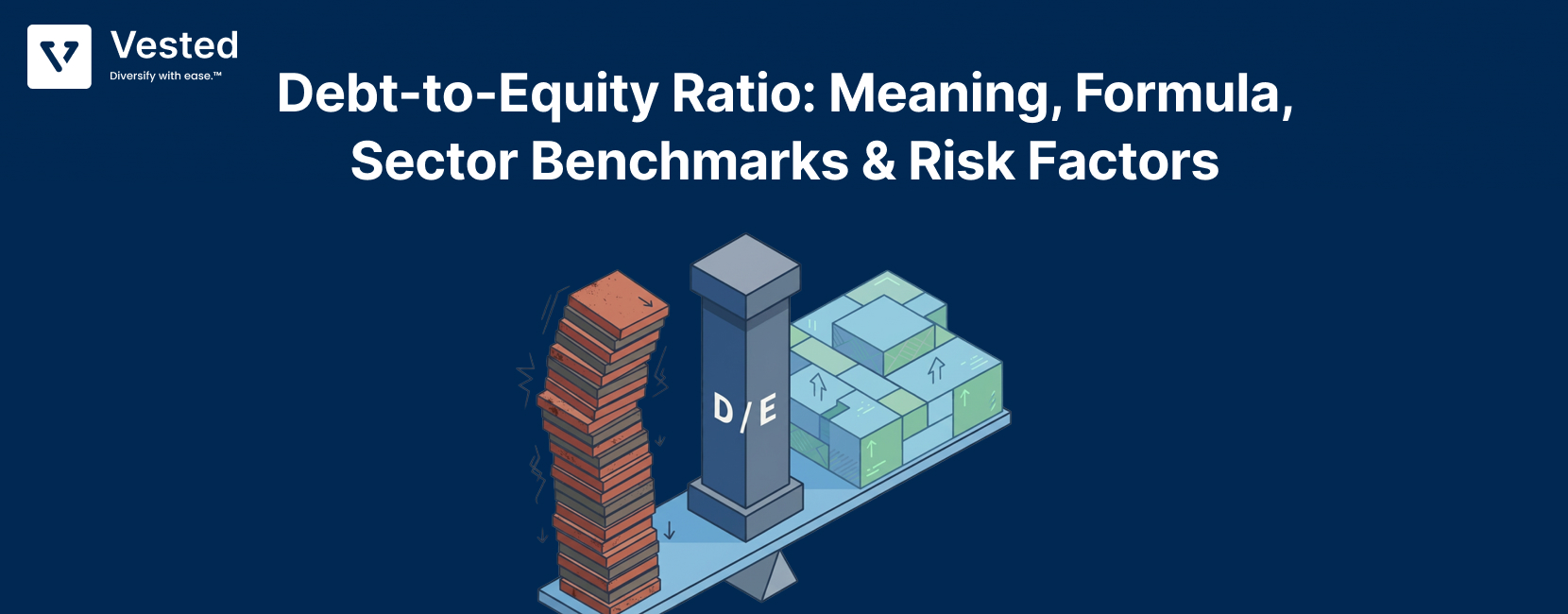
The debt-to-equity ratio is a financial metric that shows how much a company depends on borrowed funds versus shareholder capital to operate. To compute this ratio, divide total debt by shareholders’ equity.
The higher ratio means that the company relies more on borrowed funds. This increases financial risk because the firm must service debt obligations that include both interest and the principal amount.
On the other hand, a lower ratio means the company relies more on shareholders’ equity. This generally indicates lower financial risk but possibly slower growth if the firm avoids leverage.
How to Calculate Debt-to-Equity Ratio
To get the debt-to-equity ratio, you can use the following formula:
Debt-to-Equity Ratio = Total Debt ÷ Shareholders’ Equity
Assume the balance sheet of XYZ company shows total borrowings of ₹40,00,000. The given figures include short-term and long-term loans such as bank borrowings, debentures, and bonds. The shareholders’ equity, representing the owners’ funds, consists of share capital and retained earnings and amounts to ₹20,00,000.
Using the formula:
Debt-to-Equity Ratio = ₹40,00,000 ÷ ₹20,00,000 = 2.0
The output means that the company uses ₹2 of debt for every ₹1 of its own funds. A ratio of 2.0 shows that the company is using a higher financial leverage. That means the business depends more on borrowed money than equity to fund operations.
In contrast, if another company has total debt of ₹15,00,000 and equity of ₹30,00,000, the ratio would be 0.5, indicating a more conservative capital structure with lower risk.
Drawbacks of Debt-to-Equity Ratio
Here are the key downsides of a debt-to-equity ratio:
Industry Variance
You cannot judge a company’s financial risk in isolation without looking at its industry. Different industries follow different funding patterns. For example, a power company may take large loans to build plants and equipment, so a higher debt ratio is normal.
An IT services firm whose operations depend on skilled employees needs better office space. Considering this, they operate with much lower debt and higher equity.
Therefore, what seems risky in one industry may be standard practice in another.
Accounting Differences
Accounting practices can differ from one company to another, which can affect how financial ratios appear. For example, Company A uses the straight-line depreciation method, while Company B uses an accelerated depreciation method. Faster depreciation reduces asset values and lowers profits, which in turn reduces retained earnings and equity.
Even if both companies have the same level of borrowing, Company B may show a higher debt-to-equity ratio solely because of its accounting method. In this case, the ratio reflects accounting treatment rather than the company’s actual debt use or its real financial risk.
No Cashflow View
The ratio does not show whether the company can actually repay its debt. For example, take an example of Company X and Company Y. They both have a debt-to-equity ratio of 1.0. But Company X earns steady cash from operations every month, while Company Y struggles to collect payments from customers and faces irregular cash inflows.
Even though their ratios look the same, Company X can easily service its interest and repay its loans, whereas Company Y may miss payments. This shows that the ratio does not reflect a company’s real ability to meet debt obligations, which depends on cash flow rather than balance sheet numbers alone.
Equity Reduction Effects
The debt-to-equity ratio does not always reflect new borrowing. For example, if a company has total debt of ₹20 lakh and equity of ₹20 lakh, it would give a ratio of 1.
If the company incurs losses or pays large dividends, equity may fall to ₹10 lakh while debt remains the same. The ratio then increases to 2, even though no additional debt was taken. In this case, the higher ratio results from reduced equity and not from increased financial leverage, making the company appear riskier than it actually is.
Lack of Time Value Consideration
The debt-to-equity ratio treats all debt equally, whether it is due next year or in 10 years. For example, suppose there is a Company A with ₹10 lakh in short-term loans payable within one year, and a Company B with the same ₹10 lakh as a long-term loan repayable after ten years.
Both companies will show the same debt-to-equity ratio, but Company A faces much higher immediate repayment pressure. This example shows that the ratio ignores when cash outflows actually occur, which affects real financial risk.
Treatment of Preferred Stocks
Some companies classify preferred shares as equity, while others treat them as debt because of their fixed dividend payments.
Take an example of a hypothetical Company X, which has a debt of ₹20 lakh, equity of ₹20 lakh, and ₹10 lakh in preferred shares.
If preferred stock is treated as equity, the ratio stays at 1.0. If it is treated as debt, borrowings increase to ₹30 lakh, equity remains unchanged at ₹20 lakh, and the ratio rises to 1.5. This variation is due to accounting classification, not a real increase in financial risk.
Ideal Debt-to-Equity Ratio for Different Sectors
Here is what a healthy D/E ratio looks like in different industries:
Banks
In banking and financial services, the usual D/E ratio does not tell the full story because customer deposits are counted as liabilities, which inflates debt numbers. That’s why banks are judged using regulatory measures like the CET1 ratio and leverage ratios under the Basel Committee on Banking Supervision rules.
Technology
If a company operates in the tech sector, a low D/E ratio of 0.2–0.6 is considered suitable to support equity- or cash-funded growth. A lower D/E helps preserve flexibility for R&D, hiring, and M&A, while also avoiding high interest costs during periods of slower growth.
Pharmaceuticals & Healthcare
In the pharma and biotech sector, a good D/E ratio usually stays between 0.3 and 0.8, which is considered moderate. These companies need funds for research, clinical trials, and manufacturing plants.
Utility Sector
A higher D/E ratio between 0.5 and 2.0 is common in the utility sector. The reason being companies in this sector need substantial upfront investment in power plants, grids, pipelines, or water networks. However, regulators and analysts closely track debt repayment ability and future investment plans.
Energy
In the energy sector, a moderate D/E ratio of 0.4–1.5 is considered healthy. For example, if an oil company funds a new offshore drilling project, it may borrow funds as projects require significant upfront spending and repayments over the years. If oil prices fall sharply, companies with lower debt can still manage interest payments.
Upstream firms, which depend directly on oil prices, usually have lower debt. In contrast, downstream ones, such as refineries, can manage slightly higher leverage due to regular income flow.
Consumer Staples
If the consumer staple company has a D/E of low to moderate, it will be considered good. The reason? Even when the economy slows down, people do not stop buying essentials. That steady demand keeps cash coming in, which allows companies to cover daily expenses, marketing, and distribution costs.
Consumer Discretionary & Retail
If the company is in the consumer discretionary and retail sector, a D/E ratio of 0.5–1.5 is generally considered healthy. These businesses usually borrow to fund inventory, new stores, and expansion.
However, you can go with a higher D/E only if the company has established chains with a predictable cash flow. If the company has an online-only presence and operates at low margins, it should keep its leverage conservative.
Industrials & Manufacturing
In the industrial and manufacturing sector, a moderate D/E ratio of 0.4–1.0 is considered healthy, as these businesses need capital to buy machinery, build factories, and upgrade technology.
Healthy firms should balance debt for investment with cash buffers. However, those with heavy cyclical exposure should consider modest leverage to survive downturns.
Telecommunications
In telecommunications, a higher D/E ratio of around 1.0–3.0 is common. These companies need heavy funding support to build networks and buy spectrum licences. With debt on their side, they can spread the costs over many years.
Note: The DTI figures mentioned above are generic and broad. They may differ based on company size and various other parameters.
Financial Ratios to Check Alongside Debt-to-Equity Before Investing
Here are the key metrics to use alongside the D/E ratio for a clearer view of a company’s financial health:
Interest Coverage Ratio
You can use this metric to understand how easily a company can pay interest on its debt using its operating profit. A higher ratio shows that the business generates sufficient earnings to service its debt comfortably.
Debt-to-EBITDA Ratio
Debt-to-EBITDA compares total debt with operating cash earnings. It reflects how long the business may take to repay total debt without changes in income.
Current Ratio
The current ratio measures the short-term financial health of the company. It compares the current assets to the current liabilities of the company. Even with low overall debt, a company can struggle if short-term obligations are high.
Asset Turnover Ratio
Asset turnover shows how effectively a company uses its assets to generate revenue. If the firm has a higher debt, it should ideally have strong asset efficiency. You can use this metric to understand whether borrowed funds are being used productively to drive sales growth.
Return on Equity (ROE)
ROE shows how efficiently a company uses shareholders’ money to earn profits. For example, if Company A has ₹100 equity and earns ₹20, ROE is 20%. If profits rise due to heavy borrowing, ROE may look strong, but risk also increases.
Quick Ratio
The quick ratio excludes inventory that cannot be easily converted into cash. You can use it to assess if the company can handle immediate liabilities during cash flow pressure.
Net Profit Margin
Net profit margin is a measure of how much profit a company keeps from its total revenue after all expenses, including operating costs, interest, and taxes. A higher net profit margin means the business runs efficiently and has a stronger ability to absorb costs, repay debt, and stay profitable during slowdowns.
Capital Expenditure to Cash Flow
This metric shows how much a company spends on long-term assets, like plants or equipment, compared to the cash it generates from its core operations. It helps you see whether the business can fund growth using its own cash or depends on borrowing.
Conclusion
Use the debt-to-equity ratio as a starting point, not a final verdict. Compare it with sector peers, track how it changes over time, and always pair it with cash flow metrics, interest coverage, and profitability ratios. A well-balanced capital structure supports growth without putting the business under stress. The goal is not zero debt, but sustainable debt that the company can comfortably service across business cycles.
Frequently Asked Questions
Why do banks have very high debt-to-equity ratios?
Since banks treat customer deposits as liabilities, it inflates debt figures. That is why regulatory ratios, not D/E, are used to judge a bank.
How does debt-to-equity affect company growth?
Moderate debt can accelerate growth, but excessive debt limits flexibility, increases interest costs, and reduces the ability to invest during slow periods.
How does rising interest rates impact high D/E companies?
If the company has borrowed funds at a higher interest rate, it would increase borrowing costs, which can hurt profits and cash flow, especially for companies already carrying high levels of debt.
Can a low debt-to-equity ratio be a negative sign?
Yes, sometimes. Very low debt may mean a company is missing growth opportunities or not using low-cost borrowing to improve returns efficiently.
Should debt-to-equity be compared across sectors?
No. You should not compare D/E ratios across different sectors. It can be misleading because business models, cash flow stability, and capital needs vary widely.
