 Skip to content





Here’s what caught our eye this week: Apple, the company that prides itself on building everything in-house, just handed over the keys to Siri’s brain to its longtime frenemy, Google. Yes, you read that right. The most valuable company in the world just admitted it needs help with AI.
Let’s break this down.
The Deal That Shocked Silicon Valley
On Monday, Apple announced a multi-year partnership with Google to power the long-awaited Siri overhaul using Google’s Gemini models. This isn’t just any partnership. This is Apple appears to be saying: “We tried to build our own AI assistant, and well… it’s complicated.”
The deal means that Google’s technology will become the foundation for Apple’s AI features across more than 2 billion active devices. That’s not just a big number. That’s basically giving Google a front-row seat in every iPhone user’s pocket.
But here’s the twist: Apple already has a deal with OpenAI to integrate ChatGPT into Siri for complex queries. So now Siri will be powered by Google’s Gemini for its core intelligence, while ChatGPT handles the really tricky questions. It’s like hiring two tutors because you couldn’t figure out the homework yourself.
Why This Matters (And Why It’s Messy)
Let’s rewind a bit. Back in June 2024, at Apple’s WWDC event, the company announced Apple Intelligence, their big AI push. They promised a revolutionary Siri update that would make your digital assistant actually, you know, intelligent.
Fast forward to 2026, and that update? Delayed. Pushed back. “It’s going to take us longer than we thought,” Apple sheepishly admitted.
Meanwhile, the pressure was mounting. Samsung was already integrating Google’s Gemini into its Galaxy AI. Every other tech company was talking about their AI breakthroughs. And Apple? Apple was running ads for a Siri update that didn’t exist yet.
The desperation felt palpable.
The Price of Playing Catch-Up
Here’s where things get expensive. According to reports, Apple might be paying Google around $1 billion per year to use Gemini. Yes, billion with a ‘B’.
And here’s the kicker: this comes at a time when Apple’s margins are already under pressure. Memory costs are surging, which means iPhones are getting more expensive to make. Global smartphone shipments are expected to shrink by 2.1% in 2026. And now Apple has to pay for AI models on top of everything else.
Apple’s decade-high margins (47% gross margins and 32% operating margins reported in FY25) suddenly look vulnerable.
The Strategic Problem
Let’s be honest: this deal may be tactically smart, but it seems to be strategically weak.
Tactically smart because Apple may need to ship something, anything, to prove it’s not falling behind in AI. Google’s Gemini is proven technology. It works. It’s better than having nothing.
Strategically weak because Apple appears to have outsourced its future to a competitor. Remember, Google owns Android, which is Apple’s biggest rival in smartphones. Google also dominates search and is building its own hardware ecosystem with Pixel phones and Nest devices.
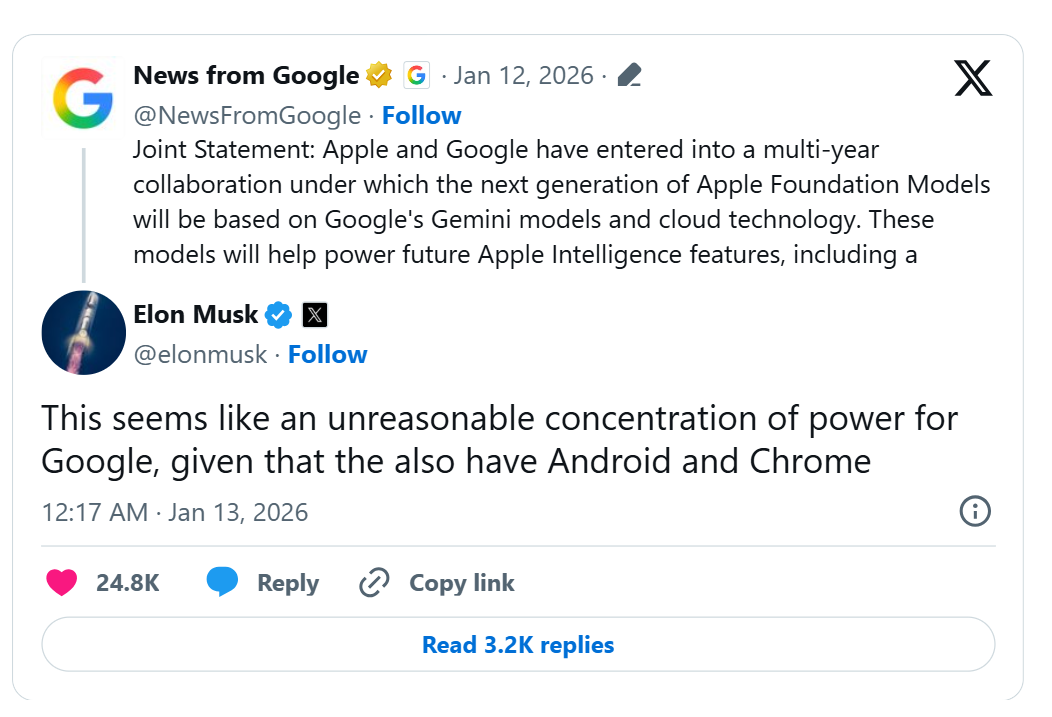
As Elon Musk pointed out (because of course he did), “This seems like an unreasonable concentration of power for Google, given that they also have Android and Chrome.”
Musk might have a point.
What Went Wrong at Apple?
The AI stumble might reveal deeper problems. Over the past few months, Apple has lost several key executives, including John Giannandrea, their former AI chief. The initial rollout of Apple Intelligence received lukewarm reception. Features looked kind of gimmicky. AI-generated summaries were sometimes hilariously inaccurate. Users were frustrated.
This isn’t the Apple we’re used to, the company that revolutionized phones, tablets, and watches. This looks to be a company scrambling to catch up, throwing money at problems, and hoping partnerships can paper over fundamental execution issues.
The Winners and Losers
Google looks to be the clear winner here. Their stock jumped, pushing their market cap above $4 trillion. They now power AI on both Android (obviously) and iOS devices. They’ve essentially won the mobile AI war without even trying that hard.
OpenAI gets pushed to a supporting role. ChatGPT remains available for complex queries, but it’s no longer Apple’s primary AI partner. Sam Altman reportedly issued a “code red” last year when Google’s Gemini 3 launched. This deal probably won’t make him feel any better.
Apple? The jury’s still out. They’ve bought themselves time to ship an updated Siri later this year. But they’re paying billions for the privilege, their margins are under pressure, and they’ve surrendered strategic control of a critical technology.
The Bottom Line
Apple’s partnership with Google appears to be a band-aid, not a cure. It solves the immediate problem (shipping an AI-powered Siri) but it doesn’t address the fundamental issue: Apple is behind in AI and doesn’t seem to have a clear path to catch up.
The company that once prided itself on vertical integration, on controlling every aspect of the user experience, is now dependent on its competitors for one of the most important technologies of the decade.
We’ll know more at WWDC 2026 in June. Until then, expect volatility in Apple’s stock, continued criticism of their AI strategy, and more questions about whether the iPhone maker can navigate this AI transformation without losing its way.
One thing’s almost certain: this isn’t the Apple way. And investors are starting to notice.
Editor’s note: In an earlier note, we incorrectly stated that Apple pays Google to be the default search engine on Safari. In reality, the arrangement works the other way around. Google pays Apple an estimated tens of billions of dollars annually to remain the default search provider on Apple’s Safari browser.
Disclaimer – This article draws from sources such as the Financial Times, Bloomberg,and other reputed media houses. Please note, this blog post is intended for general educational purposes only and does not serve as an offer, recommendation, or solicitation to buy or sell any securities. It may contain forward-looking statements, and actual outcomes can vary due to numerous factors. Past performance of any security does not guarantee future results.This blog is for informational purposes only. Neither the information contained herein, nor any opinion expressed, should be construed or deemed to be construed as solicitation or as offering advice for the purposes of the purchase or sale of any security, investment, or derivatives.The information and opinions contained in the report were considered by VF Securities, Inc.to be valid when published. Any person placing reliance on the blog does so entirely at his or her own risk, and does not accept any liability as a result.Securities markets may be subject to rapid and unexpected price movements, and past performance is not necessarily an indication of future performance. Investors must undertake independent analysis with their own legal, tax, and financial advisors and reach their own conclusions regarding investment in securities markets.Past performance is not a guarantee of future results.
