 Skip to content





Picture this: You’re burning through nearly a billion dollars every month. Your AI chatbot seems to be decent but not great. Google and OpenAI are eating your lunch. What do you do?
If you’re Elon Musk, you simply merge your struggling AI company with your wildly profitable rocket business and call it a day.
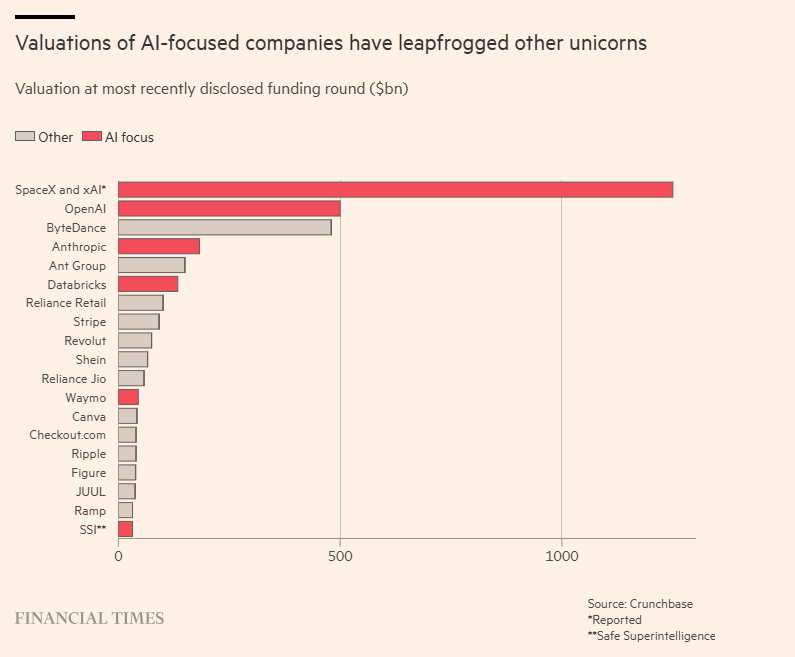
On Monday, Musk announced that SpaceX is acquiring xAI for $250 billion, creating a combined entity worth $1.25 trillion. That’s right. The world’s most valuable private company just got born, and it wants to put data centers in space.
Let’s break down this messy deal.
The Deal
Here’s the simple math: SpaceX, valued at $1 trillion, is buying xAI for $250 billion. Every seven shares of xAI will convert into one share of SpaceX. The combined company’s shares are priced at $527 each.
But wait, there’s a catch. SpaceX’s valuation suddenly jumped from $800 billion in December to $1 trillion now. Why? Musk says it’s because Starlink revenue is booming. Convenient timing, wouldn’t you say?
Meanwhile, xAI’s $250 billion price tag matches its recent funding round valuation. The two-year-old startup that’s hemorrhaging cash gets bought at a premium while SpaceX investors get diluted. Classic Musk.
The Grand Vision (Or Excuse?)
Musk’s official explanation seems beautiful in its audacity: AI needs massive computing power. Computing power needs massive energy. Earth can’t provide enough energy without destroying the environment. Solution? Launch data centers into space.
Think about it. In space, you get unlimited solar power without pesky clouds or nighttime getting in the way. SpaceX’s Starlink satellites can beam the data back to Earth. SpaceX already knows how to launch stuff. xAI needs computing power. It might be a perfect match!
Or is it?
The Reality Check
Here’s what xAI is actually dealing with: revenue in the low hundreds of millions, burning through $1 billion monthly, and warning that it might spend over $10 billion in 2025 just on chips and data centers.
Its chatbot Grok? Barely making money. The company keeps getting into scandals, from antisemitic posts to generating explicit images of minors. Not exactly a stellar track record.
Meanwhile, OpenAI and Google are dominating consumer AI, while Anthropic has cornered enterprise customers. One investor bluntly told the Financial Times: “On its own, xAI is not that good.”
SpaceX, on the other hand, appears to be printing money. It generated $16 billion in annual revenue and $8 billion in operating profit. It has a monopoly on commercial rocket launches and Starlink subscriptions are surging.
So who’s really winning here?
The Financial Engineering
Let’s call this what it is: SpaceX’s cash flow is now subsidizing xAI’s cash burn.
SpaceX will issue $250 billion in new shares to pay for xAI, diluting existing shareholders. But as one investor noted, “if you’re diluting yourself, it’s not too bad.” Translation: Musk controls both companies, so he’s essentially moving money from his left pocket to his right pocket.
xAI shareholders are thrilled. They’re getting SpaceX stock at what many believe is an inflated valuation. Some early Twitter employees who ended up with xAI equity might suddenly triple their money.
SpaceX shareholders? They’re getting a money-losing AI company attached to their profitable rocket business. But they can’t really complain. Musk controls both, and as multiple investors admitted, “there’s little anyone can do to stop him.”
The IPO Play
Here’s where it gets interesting. SpaceX is planning an IPO in June, potentially raising $50 billion, which would make it the largest public offering in history.
Why June? Musk claims it’s because of a rare planetary alignment of Jupiter, Venus, and Mercury. But investors think it’s really about beating OpenAI and Anthropic to the public markets.
Both rival AI startups are also planning to go public this year. They have better AI models and more revenue than xAI. But bankers worry the public markets can’t absorb all three at once. First mover wins.
By merging now, Musk can take xAI public through the SpaceX IPO without xAI having to stand on its own merits.
Clever? Absolutely. Sketchy? Many think so.
The Musk Pattern
This isn’t Musk’s first rodeo with controversial mergers.
In 2016, he used Tesla stock to buy SolarCity, which was struggling financially and happened to be run by his cousin. That deal faced eight years of lawsuits over governance concerns.
Last year, xAI merged with X (formerly Twitter), valuing the combined entity at $113 billion. That merger rescued Twitter investors who had written down their stakes after Musk’s chaotic takeover.
Last week, Tesla announced a $2 billion investment in xAI. Musk also cut electric vehicle models and pivoted Tesla toward AI chips and humanoid robots. Investors are already speculating about an eventual Tesla merger into this growing empire.
The pattern seems clear: Musk uses his profitable companies to prop up struggling ones, rewarding loyal investors and keeping the whole ecosystem afloat.
The Practical Problems
Let’s get back to those space data centers. Sounds cool, right? Except there are massive engineering challenges nobody’s solved yet.
Can AI chips survive cosmic radiation? Unclear. Is launching data centers into space actually cheaper than building them on Earth, even with SpaceX’s low costs? Doubtful, especially since Starship (the rocket that’s supposed to make launches super cheap) is behind schedule and hasn’t even reached orbit yet.
And there’s another risk: X is under investigation in Europe and Britain for data regulation breaches and that Christmas image generator scandal. If courts find violations, the EU could fine up to 6% of global revenue, Britain up to 10%. With the merger, would SpaceX’s revenue count too? Nobody knows.
The Tangled Web
The corporate structure appears now to be hilariously complex. Google owns 7% of SpaceX, meaning it now indirectly owns part of xAI, which competes with Google’s own AI efforts and with Anthropic (of which Google owns 14%).
Nvidia invested $2 billion in xAI, which will use that money to buy Nvidia’s AI chips. Tesla invested $2 billion in xAI. It’s a circular money flow that would make any accountant dizzy.
But as long as everyone believes the AI revolution is coming, these creative financial arrangements should keep working.
The Bottom Line
Is this merger about building data centers in space and colonizing Mars? Or is it about using SpaceX’s profitability and upcoming IPO to bail out a struggling AI startup?
The answer is probably both. Musk genuinely believes in his grand vision. But he’s also a master at financial engineering, using his cult-like investor following and control over multiple companies to move pieces around the board.
One investor summed it up perfectly: “None of the valuations are based on any rational multiple. They’re all trading off Elon.”
Whether you think Musk is a genius or just good at shuffling money around probably depends on whether you own xAI shares (congrats!) or SpaceX shares (condolences?).
Either way, the world’s most valuable private company seem to be betting that the future of AI involves shooting computers into space from the moon using electromagnetic mass drivers.
Because of course it does.
Image source – Gemini
