 Skip to content





The Big News
Nvidia just wrote a $2 billion check to Synopsys. And no, this isn’t just another investment in the AI hype cycle. This could fundamentally change how we build everything from computer chips to jet engines.
But here’s the thing most people are missing: This deal isn’t really about AI chatbots or the next viral app. It’s about something far more consequential, yet invisible to most of us.
Let me explain.
First, What’s Synopsys?
Imagine you want to design the latest smartphone chip. Or maybe a processor for an autonomous vehicle. Or even a jet engine. Before you spend millions of dollars building a physical prototype, you’d want to test it virtually, right?
That’s where Synopsys comes in.
Synopsys makes the software that engineers use to design and simulate complex products before they’re physically manufactured. Think of it as the ultimate sandbox for engineers. Companies like Google, Tesla, and even Nvidia itself use Synopsys tools to design their chips.
The company operates in what’s essentially a duopoly with Cadence Design Systems in the electronic design automation (EDA) space. If you’re designing cutting-edge semiconductors, you’re probably using tools from one of these two companies.
The Problem That Nobody Talks About
Here’s where it gets interesting.
Currently, when engineers use Synopsys software to simulate a new chip design or test how a component will perform under stress, these simulations can take weeks to complete. Yes, weeks.
Why? Because these simulations run on traditional CPUs (Central Processing Units), the general-purpose processors that have been the workhorse of computing for decades.
But there’s a better way. And that’s where Nvidia comes in.
Nvidia makes GPUs (Graphics Processing Units), which were originally designed for rendering graphics but have become the backbone of AI computing. These chips are exceptionally good at parallel processing, which means they can handle many calculations simultaneously.
The breakthrough insight: Those same capabilities that make GPUs perfect for AI could also revolutionize engineering simulations.
According to Nvidia CEO Jensen Huang, simulations that currently take weeks could be compressed to just a few hours using GPU acceleration. That’s not a marginal improvement. That’s a complete transformation of how engineering works.
Why This Matters
Let’s put this in perspective.
When you can compress weeks of simulation time into hours, you’re not just making engineers more productive. You’re fundamentally changing what’s possible.
Suddenly, engineers can run thousands of different scenarios and iterations in the time it previously took to test just one. This means:
- Faster innovation cycles across industries
- Lower development costs (fewer physical prototypes needed)
- More ambitious designs that were previously too computationally expensive to even attempt
- Accelerated time-to-market for new products
This applies far beyond semiconductors. Synopsys tools are used in aerospace, automotive, industrial equipment, and energy sectors. We’re talking about redesigning how we build almost everything in the modern world.
The Strategic Chess Move
But there’s another layer to this deal that makes it brilliant.
Nvidia hasn’t just invested money. They’ve purchased the shares at $414.79 each, representing about 2.6% of Synopsys’ outstanding stock. More importantly, they’ve secured a multi-year partnership to deeply integrate their technologies.
The collaboration focuses on several key areas:
GPU Acceleration: Synopsys will rewrite its software to run on Nvidia’s CUDA platform, allowing engineers to harness GPU power for everything from chip design to electromagnetic analysis.
AI Agents in Engineering: They’re integrating Synopsys’ AgentEngineer technology with Nvidia’s AI stack. Imagine AI assistants that can autonomously handle routine design tasks while engineers focus on creative problem-solving.
Digital Twins: Using Nvidia’s Omniverse platform and Synopsys’ Cosmos technologies, they’re building virtual replicas of physical systems. This means you could test how a semiconductor fab or automotive production line would perform before building it.
Cloud Access: They’re making these GPU-accelerated tools available in the cloud, democratizing access to supercomputer-level simulation capabilities.
The Skeptics Have a Point (Sort of)
Now, whenever Nvidia makes a big investment, critics raise concerns about circular deals. The worry is simple: Nvidia invests in companies, those companies then buy Nvidia chips, and everyone’s valuations go up artificially.
It’s happened with OpenAI. It happened with CoreWeave. It even happened with Intel, oddly enough.
But both CEOs addressed this head-on. Synopsys CEO Sassine Ghazi explicitly stated there’s no commitment to use the $2 billion to purchase Nvidia GPUs. The deal is non-exclusive, meaning Synopsys can work with AMD, Intel, or any other chipmaker on similar initiatives.
Huang emphasized this isn’t about creating a captive customer. It’s about upgrading the technological foundation of an entire industry that’s still stuck using outdated computing infrastructure.
The money gives Synopsys “optionality” to adapt its software for GPU acceleration without financial constraints. That’s actually quite different from a circular deal.
Why Wall Street Is Paying Attention
CNBC’s Jim Cramer made an astute observation about this deal. While AI chatbots get all the headlines, they’re ultimately a business-to-consumer play. And consumer markets are notoriously fickle.
But this? This is business-to-business. And Wall Street loves B2B because it’s more stable, predictable, and often more profitable.
When Nvidia announced the deal, its stock rose 1.65% while Synopsys jumped nearly 5%. That might not sound dramatic, but remember, Synopsys stock had been down 14% for the year. This single announcement reversed much of that decline.
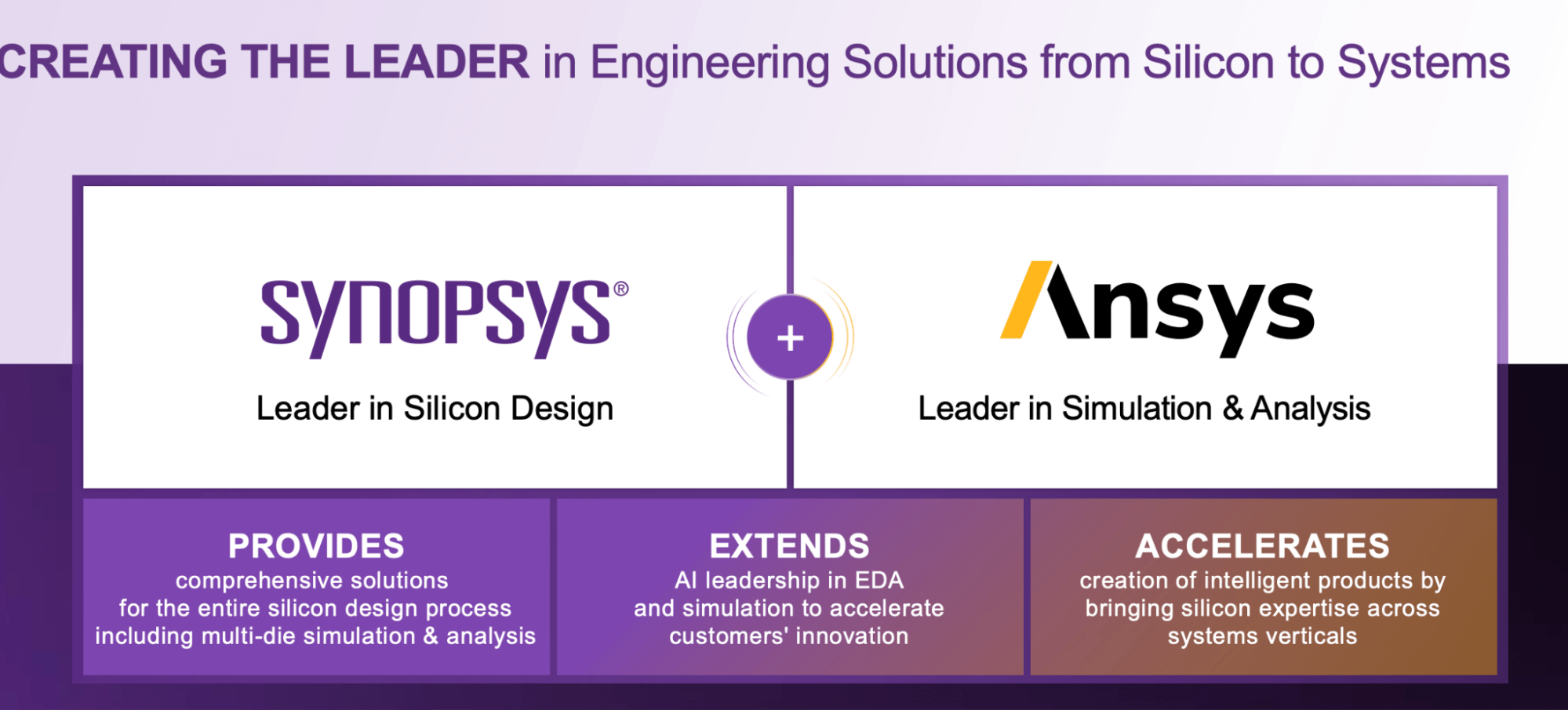
More importantly, it gave investors confidence in Synopsys’ future, especially after the company recently acquired Ansys (another simulation software giant) for a deal that left it with $14.3 billion in debt against just $2.5 billion in cash.
The Nvidia investment provides financial breathing room and validates Synopsys’ strategic direction.
The Bigger Picture: B2B as Nvidia’s Moat
Here’s what’s really clever about Nvidia’s strategy.
Everyone focuses on Nvidia’s dominance in AI chips. But that market is getting increasingly competitive. Google is building its own chips. Amazon has its own custom silicon. Even Microsoft is developing in-house processors.
By embedding itself deep into the engineering tools used across industries, Nvidia is creating a much more durable competitive advantage. It’s not just selling chips anymore. It’s becoming the foundational platform for how the next generation of products gets designed.
Think about it: If every major engineering team is using Nvidia-accelerated Synopsys tools, what chips do you think they’ll naturally gravitate toward for their final products?
It’s a seemingly brilliant long-term play that extends Nvidia’s reach far beyond the current AI hype cycle.
What This Means for Different Industries
Semiconductors: Chip designers can iterate faster, potentially accelerating Moore’s Law (or at least its practical benefits) by compressing design cycles.
Automotive: Electric and autonomous vehicle development could accelerate as companies simulate battery performance, aerodynamics, and sensor systems more rapidly.
Aerospace: Aircraft and spacecraft designers could test more radical designs without the prohibitive cost of physical prototyping.
Pharmaceuticals: While not explicitly mentioned, molecular simulations (which Synopsys supports) could accelerate drug discovery.
Manufacturing: Digital twins of entire factories could optimize production before a single machine is installed.
The Risks Nobody Wants to Talk About
Of course, this isn’t without risks.
Synopsys faces customer concentration risk. What if Nvidia or other major customers decide to develop their own EDA tools using generative AI? It’s not impossible.
The integration challenges are real too. Rewriting decades of software to run efficiently on GPUs isn’t trivial. There will likely be bugs, performance issues, and frustrated customers during the transition.
And there’s the debt burden. Even with Nvidia’s investment, Synopsys is sitting on substantial debt from the Ansys acquisition. If the integration doesn’t go smoothly or if the economy stumbles, that leverage could become problematic.
The Bottom Line
This deal represents something more profound than just another AI investment.
It’s about upgrading the fundamental infrastructure of innovation itself. When you make it 10x or 100x faster and cheaper to design new products, you’re not just improving efficiency. You’re enabling entirely new categories of products that were previously too expensive or time-consuming to even attempt.
The AI revolution has largely been about better software and smarter algorithms. But Nvidia and Synopsys are betting on something different: using AI and GPU acceleration to revolutionize how we design the physical world.
Disclaimer – This article draws from sources such as the Financial Times, Bloomberg, and other reputed media houses. Please note, this blog post is intended for general educational purposes only and does not serve as an offer, recommendation, or solicitation to buy or sell any securities. It may contain forward-looking statements, and actual outcomes can vary due to numerous factors. Past performance of any security does not guarantee future results. This blog is for informational purposes only. Neither the information contained herein, nor any opinion expressed, should be construed or deemed to be construed as solicitation or as offering advice for the purposes of the purchase or sale of any security, investment, or derivatives. The information and opinions contained in the report were considered by VF Securities, Inc.to be valid when published. Any person placing reliance on the blog does so entirely at his or her own risk, and does not accept any liability as a result. Securities markets may be subject to rapid and unexpected price movements, and past performance is not necessarily an indication of future performance. Investors must undertake independent analysis with their own legal, tax, and financial advisors and reach their own conclusions regarding investment in securities markets. Past performance is not a guarantee of future results
