 Skip to content





Amazon’s stock just took a 10% nosedive. Not because business is bad, actually, revenue beat expectations. The culprit? A spending plan so aggressive it’s making investors sweat.
Let’s break down what happened.
The Shock Announcement
Amazon just announced it’s going to spend $200 billion in 2026. That’s not a typo. $200 billion in a single year.
To put that in perspective, that’s more than double what Peru produces in an entire year. It’s roughly what Amazon’s total revenue was back in 2020. And it’s about $53 billion more than Wall Street was expecting.
Here’s how the quarterly numbers stacked up:
| Metric | Actual | Expected | Result |
| Revenue | $213.39B | $211.33B | Beat ✓ |
| Earnings per share | $1.95 | $1.97 | Miss ✗ |
| AWS revenue | $35.58B | $34.93B | Beat ✓ |
| Advertising revenue | $21.32B | $21.16B | Beat ✓ |
| 2026 capex forecast | $200B | $147B | Way above |
So Amazon beat on the top line, AWS grew at its fastest pace in over three years, and advertising is humming along nicely. But none of that mattered once CEO Andy Jassy revealed the $200 billion spending plan.
The stock tanked immediately in after-hours trading.
The Big Tech Arms Race
Here’s where it gets interesting. Amazon isn’t alone in this spending frenzy. Look at what Big Tech is planning for 2026:
| Company | 2026 AI Spending | Change from 2025 |
| Amazon | $200B | +53% (from $131B) |
| Google/Alphabet | $175B to $185B | More than doubled |
| Meta | $115B to $135B | Nearly doubled |
| Microsoft | $72B+ disclosed | Ongoing, no pullback |
| Combined total | ~$650B | Massive increase |
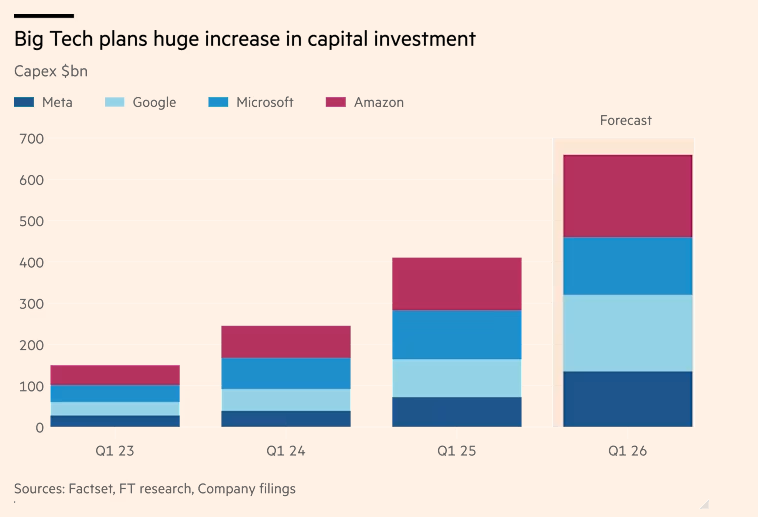
Think about that for a second. Four companies are collectively planning to spend $650 billion on AI infrastructure in one year. That’s an arms race, plain and simple.
But here’s the uncomfortable question investors are asking: what if they’re all building too much, too fast?
Where’s the Money Going?
Andy Jassy was pretty clear about Amazon’s priorities. The bulk of that $200 billion is heading to AWS, Amazon’s cloud computing division. Specifically:
AI infrastructure and data centers get the lion’s share. AWS is adding capacity as fast as it can because, according to Jassy, customers are ordering faster than Amazon can build.
Custom AI chips are another focus. Amazon is trying to compete with Google’s TPU chips and reduce reliance on Nvidia’s expensive GPUs.
Robotics for warehouse automation. Because faster deliveries mean happier customers and better margins.
Low Earth orbit satellites to compete with SpaceX’s Starlink. Because apparently $200 billion means you can chase multiple moonshots simultaneously.
The AWS numbers do look solid. Revenue grew 24% year-over-year. The contract backlog hit $244 billion, up 40% from last year. Jassy called it “very high demand” and said they’re “monetizing capacity as fast as we can install it.”
On paper, that sounds great. So why did the stock crash?
The Problem: Returns vs. Investment
Here’s the core issue troubling investors. AWS revenue grew 24% in the quarter. That’s impressive. But capital expenditure is jumping 53% in 2026.
Do the math. Revenue growth isn’t keeping pace with spending growth.
Now, Amazon (and the other tech giants) would argue this is necessary investment for future returns. Build the infrastructure now, reap rewards later. And there’s logic to that. AWS didn’t become profitable overnight either.
But investors are getting nervous about a few things:
First, the competition is brutal. Amazon, Google, Microsoft, and others are all racing to build similar infrastructure. They can’t all win equally. As one analyst put it, they’re “locked in an escalating build-out that may not work out for all of them.”
Second, proof of returns is still murky. Sure, there’s demand for AI services. But is there $650 billion worth of demand? Will these investments actually generate the profits everyone’s banking on?
Third, the bubble warnings are getting louder. The Bank of England warned in December about a potential “sharp correction” in tech valuations. Cisco’s CEO said there will be “carnage along the way” and some companies “won’t make it.” Even JPMorgan’s Jamie Dimon admitted some of this money will “probably be lost.”
The Awkward Irony
Here’s what makes this especially uncomfortable: Amazon just laid off 30,000 people.
In October, they cut 14,000 jobs. Last week, another 16,000. The reason? Cost reduction.
So let me get this straight. Amazon is cutting 30,000 jobs to save costs while simultaneously announcing plans to spend $200 billion. That’s a tough pill to swallow, especially for those who lost their jobs.
The company would argue these are different pots of money, different strategic priorities. Trimming inefficient headcount while investing in future growth. But optics matter, and this looks jarring.
Is This Actually a Bubble?
That’s the trillion-dollar question everyone’s dancing around.
On one hand, AI is clearly transformative. It’s already changing how we work, create, and solve problems. The technology is real, the applications are expanding, and the demand is legitimate.
On the other hand, this level of spending has “bubble” written all over it. When four companies collectively spend more than most countries’ GDP on a single technology trend, and when that spending vastly outpaces revenue growth, alarm bells should ring.
History offers some guidance. The dotcom bubble burst because companies were valued on potential rather than fundamentals. Lots of money chased too few profitable opportunities. When reality hit, valuations collapsed.
But the dotcom era also gave us Amazon, Google, and the modern internet economy. The bubble popped, but the technology was real. The winners who survived became generational companies.
So which is this? Dotcom bubble or internet revolution?
Probably both. AI will likely transform everything, just like the internet did. But not every company spending billions will come out ahead. Some will win spectacularly. Others will waste billions on infrastructure that sits idle or becomes obsolete.
The Bottom Line
Amazon’s $200 billion bet is a statement of conviction. Andy Jassy genuinely believes AI will “forever change the size of AWS and Amazon as a whole.” He might be right.
But investors are demanding proof, not promises. They want to see returns that justify these massive outlays. Right now, the gap between spending growth and revenue growth is widening, not narrowing.
The next year will be telling. If AWS can convert that $244 billion backlog into actual revenue, if AI workloads actually materialize at the scale everyone’s betting on, Amazon will look brilliant.
But if demand softens, if competitors flood the market with excess capacity, or if the economics of AI don’t work out as planned, this could go down as one of the most expensive miscalculations in corporate history.
For now, Wall Street is voting with its feet. And that vote is a resounding “show me the money” before we believe the hype.
Image Source – Gemini
