 Skip to content





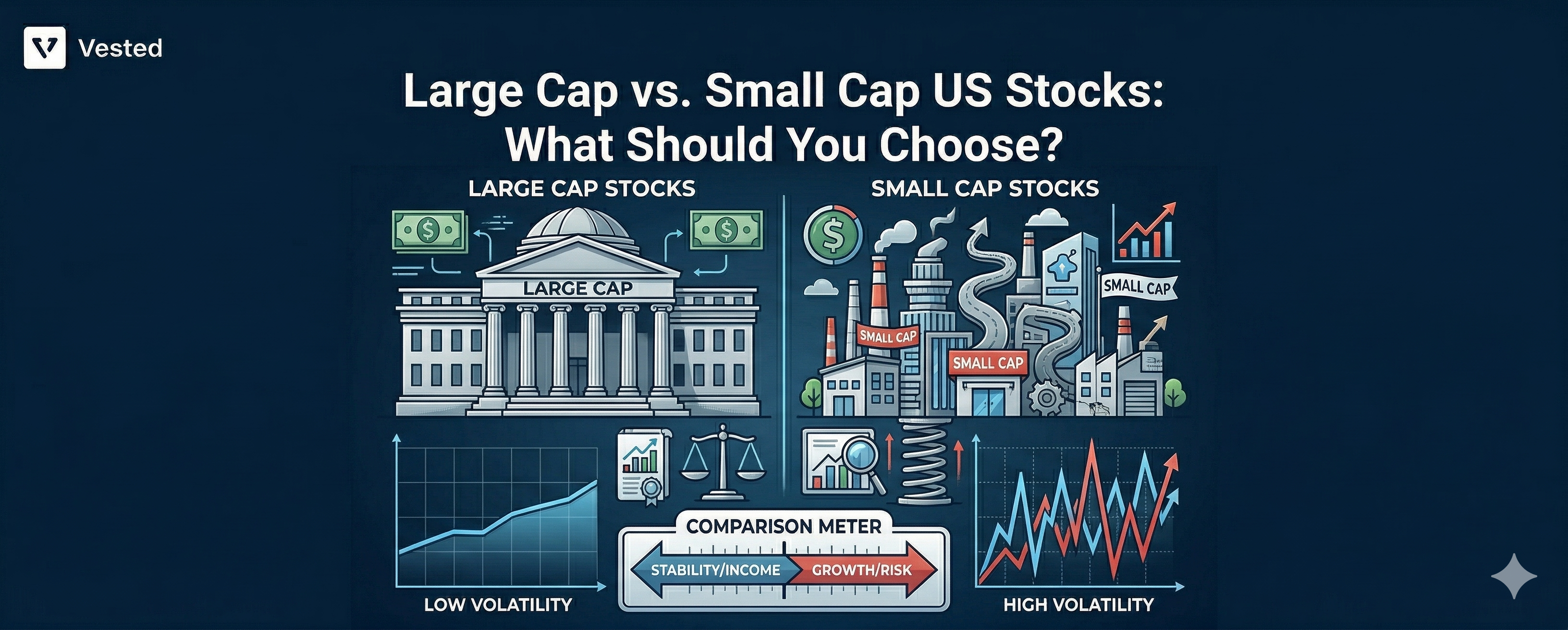
This is a common dilemma that most investors face when they start investing in stocks. They often feel confused about whether to select large-cap or small-cap stocks. Both belong to the same market, but they behave very differently. Large-cap stocks are usually more stable, while small-cap stocks have higher growth potential.
So, selecting large-cap stocks offers capital safety, while selecting small-cap stocks offers higher appreciation potential. But how much to invest in each category?
The choice depends on your investment goals, risk appetite, and time horizon. Keep reading to understand why and how.
What Are Large-Cap US Stocks?
Large-cap US stocks are shares of large and well-established companies. These companies typically have a market capitalisation of $10 billion or more. Market capitalisation simply means the total value of a company’s outstanding shares on a given day.
A few examples of large-cap US stocks include Amazon, Alphabet, and Apple. These companies have been around for decades. They tend to have steady earnings, strong balance sheets, and high trading volumes. Because of this, their prices are usually less volatile than the stocks of smaller companies.
In a long-term investment portfolio, large-cap stocks often form the foundation. They bring stability and offer consistent growth over time.
What Are Small-Cap US Stocks?
Small-cap US stocks are shares of companies with market capitalisations typically between $300 million and $2 billion. These are generally younger or smaller companies that are still building their market position. Note that not all small-cap companies are startups — many are established businesses operating in niche industries.
A few examples of small-cap US stocks include Amplitude (digital analytics, market cap ~$960 million) and Serve Robotics (autonomous delivery robotics, market cap ~$700 million). Because of their smaller size, the stocks of these companies often experience wider price swings. Earnings may not always be steady, which adds to their volatility.
Small-cap stocks attract growth-oriented investors owing to their high potential. If the business performs well, the returns can be much higher than those of large-cap stocks.
Large-Cap Stocks vs Small-Cap Stocks: Key Differences
Growth Potential
Large-cap companies grow steadily. They are already leaders in their industries, so expansion tends to be gradual. Small-cap companies, on the other hand, have the potential to grow rapidly. Being smaller, they have more room to scale, and a successful business model can drive outsized returns.
Risk & Volatility
Large-cap stocks are usually less volatile. Their prices still move, but extreme swings are rare. Small-cap stocks, by contrast, can be highly unpredictable. Their prices may rise or fall sharply as they are more susceptible to market and economic changes.
Business Stability
Large-cap companies have established business models. They have proven their worth over time, built vast customer bases, and generate reliable cash flows. Small-cap companies are still building their position in the market. Some may become industry leaders, while others may struggle.
Liquidity & Market Access
Large-cap stocks are traded in very high volumes. They offer high liquidity and are easy to buy and sell. Small-cap stocks, on the other hand, have lower trading activity. They are not as liquid, and buying or selling can sometimes take longer or result in a less favourable price.
Dividend & Income Potential
Many large-cap companies pay regular dividends. They generate enough profits to share with shareholders, making them ideal for investors seeking regular income. Small-cap companies, on the other hand, typically reinvest their earnings back into the business. Their focus is on growth, so dividends are less common.
Performance Comparison Across Market Cycles
Large-cap and small-cap stocks often behave differently in different market conditions. During bull markets, small-cap stocks tend to gain more value. Investors are willing to take more risks, and small-cap companies can provide faster growth, resulting in high returns.
During bear markets or recessions, the pattern reverses. Large-cap stocks hold up better because of their stable businesses and consistent revenues. Their value can still decline, but typically not as severely as small-cap stocks. Investors tend to seek stability during such periods and allocate more towards large-caps.
Over the long term, a combination of large-cap and small-cap stocks tends to work best. The exact proportion depends on an investor’s risk profile and financial goals.
Large Cap vs Small Cap US Stocks: Risk–Return Trade-Off
When choosing between large-cap and small-cap stocks, the risk-return trade-off is a crucial consideration. Although small-cap stocks have the potential to provide high returns, the downside risk is also larger. Their prices can move sharply, especially during uncertain markets.
Large-cap stocks offer more moderate returns but are much more stable. They do not exhibit the wild price swings typical of small-cap stocks.
Investors seeking stability over higher returns should opt for large-cap stocks. However, if your primary objective is earning high returns and you are comfortable taking on higher risk, small-cap stocks may be the better fit.
Which is Better for Long-Term Investing?
In the long term, a combination of large-cap and small-cap stocks tends to work best. Both offer different advantages. Large-cap stocks are often seen as dependable options that provide stability and help preserve capital. Returns are moderate but consistent over time.
Small-cap stocks, on the other hand, contribute to wealth creation. They have the potential to grow into large-cap companies over time, with their values increasing significantly in the process.
When investing, time horizon is an important factor. The longer you stay invested, the more time small-cap stocks have to recover from setbacks and deliver the returns you are targeting.
Portfolio Allocation: Large-Cap vs Small-Cap
Investors often use the “core-satellite” strategy to structure their portfolio allocation. Large-cap stocks form the “core,” providing consistency and reducing overall risk. Small-cap stocks form the “satellite,” improving the portfolio’s growth potential.
Conservative investors can allocate more towards large-cap stocks — around 70 to 80% — and invest the remaining 20 to 30% in small-caps for growth.
Aggressive or growth-focused investors may take a different route, allocating 50 to 60% to large-cap stocks and the remaining 40 to 50% to small-cap stocks.
How to Invest in Large-Cap & Small-Cap Stocks?
There are several ways to invest in large-cap and small-cap US stocks:
Direct Investment in Stocks
You can start picking and investing in stocks directly. This approach allows full control but requires market expertise and ongoing research. Platforms like Vested Finance can help you access US markets.
Mutual Fund Investment
If you are not experienced enough to pick stocks yourself, you can invest in market-cap-based mutual funds. These funds are managed by professional fund managers who make investment decisions on your behalf.
Investment in ETFs
You can also invest in Exchange-Traded Funds (ETFs) based on your market-cap allocation strategy. ETFs are traded on stock exchanges just like stocks. The S&P 500 ETF provides large-cap exposure, while the Russell 2000 ETF offers small-cap exposure.
Tax and Regulatory Considerations for Indian Investors
When investing in US stocks, it is crucial to understand the taxation and regulatory framework.
Capital Gains Tax
For Indian investors, the holding period determines how gains are classified. If you sell your US stocks within 24 months of investing, the gains are classified as Short-Term Capital Gains (STCG). These are added to your taxable income and taxed at the applicable income tax slab rate.
If you hold your US stocks for more than 24 months, the gains are classified as Long-Term Capital Gains (LTCG) and taxed at a flat rate of 12.5% without indexation. This rate was introduced in the 2024 Union Budget and confirmed unchanged for FY 2026–27.
Dividend Taxation
Dividends from US stocks are subject to withholding tax in the US. Under Article 10 of the India-US Double Tax Avoidance Agreement (DTAA), the US government withholds tax at 25% on dividends paid to Indian retail investors (reduced from the default 30% rate, provided Form W-8BEN is filed with your broker). A lower rate of 15% applies only to corporate investors that own 10% or more of the voting stock in the paying company, which does not apply to individual retail investors.
It is important to note that dividends are also taxable in India. Dividend income from US stocks is classified as “Income from Other Sources” and taxed at your applicable Indian income tax slab rate. However, you can claim a Foreign Tax Credit (FTC) in India for the US tax already withheld, ensuring you are not taxed twice on the same income.
Currency Risk
You must also consider currency exchange rate risk when investing. Even if your stocks perform well, a weaker US Dollar can reduce gains when converted into Indian Rupees (INR).
Common Myths About Large Cap and Small Cap Stocks
“Large Caps Don’t Grow”
This is a common misconception. Large-cap stocks may grow more slowly than small-cap stocks, but they still appreciate meaningfully over time. Many large-caps have delivered strong compounding returns over decades.
“Small Caps are Too Risky to Hold for the Long Term”
Small-cap stocks are highly volatile and riskier than large-cap stocks. But that does not mean you should avoid them entirely for the long term. They can provide excellent returns if the underlying business performs well. The key is limiting your exposure to a level that matches your risk tolerance.
“One Market-Cap Category is Always Better”
Investing in just one market-cap category is generally not a sound strategy. Large-caps provide stability but may not grow as much as small-caps. Small-caps have the potential to provide high returns but come with equally high risk. A balance of both is typically the most effective approach.
How to Decide Between Large Cap and Small Cap US Stocks?
Deciding between large-cap and small-cap stocks is not the same for everyone. You need to align your decision with your specific investment goals, risk appetite, and time horizon.
If you are seeking steady, predictable growth, invest more in large-cap stocks. If you are aiming for high long-term returns and can accept short-term volatility, invest more in small-cap stocks.
Large-cap stocks are relatively stable with fewer sharp declines. If you are a risk-averse investor, they suit you better. Small-cap stocks are highly volatile — invest in them only if you can tolerate significant price fluctuations.
If you are investing for the long term — say five to ten years or more — small caps can be worthwhile additions. For short-term investing, large caps are typically the safer option.
Key Takeaways
Large-cap stocks provide stability and consistent returns. They help preserve capital and serve as a portfolio foundation. Small-cap stocks offer high growth potential but come with greater risk and volatility.
The ideal approach is to create a diversified portfolio by combining both large-caps and small-caps in a balanced proportion. The allocation strategy must align with your risk tolerance, investment goals, and time horizon.
Banner Image Source – Google Gemini
Frequently Asked Questions
Are large-cap US stocks safer than small-cap stocks?
Yes, large-cap US stocks are generally safer than small-cap stocks because they belong to well-established companies with stable earnings, strong balance sheets, and high liquidity. Their stocks tend to be less volatile.
Do small-cap US stocks outperform large-cap stocks in the long term?
Small-cap stocks have the potential to outperform large-cap stocks over the long term. However, returns are never guaranteed and depend on the company’s performance, business model, and management quality.
How much small-cap exposure should a portfolio have?
The ideal small-cap exposure depends on an investor’s risk profile and financial goals. Aggressive investors can allocate up to 50% of their investments to small-caps. Conservative and short-term investors should generally not allocate more than 20 to 30%.
Are large-cap stocks better for beginners?
Yes, large-cap stocks are better suited for beginners because they are more stable and less volatile. They help rookie investors build confidence and market knowledge before venturing into the more unpredictable small-cap space.
Can large-cap and small-cap stocks be combined effectively?
Yes, combining large-cap and small-cap stocks can create a well-balanced portfolio. This diversification improves the overall risk-return ratio and supports long-term wealth creation.
