 Skip to content





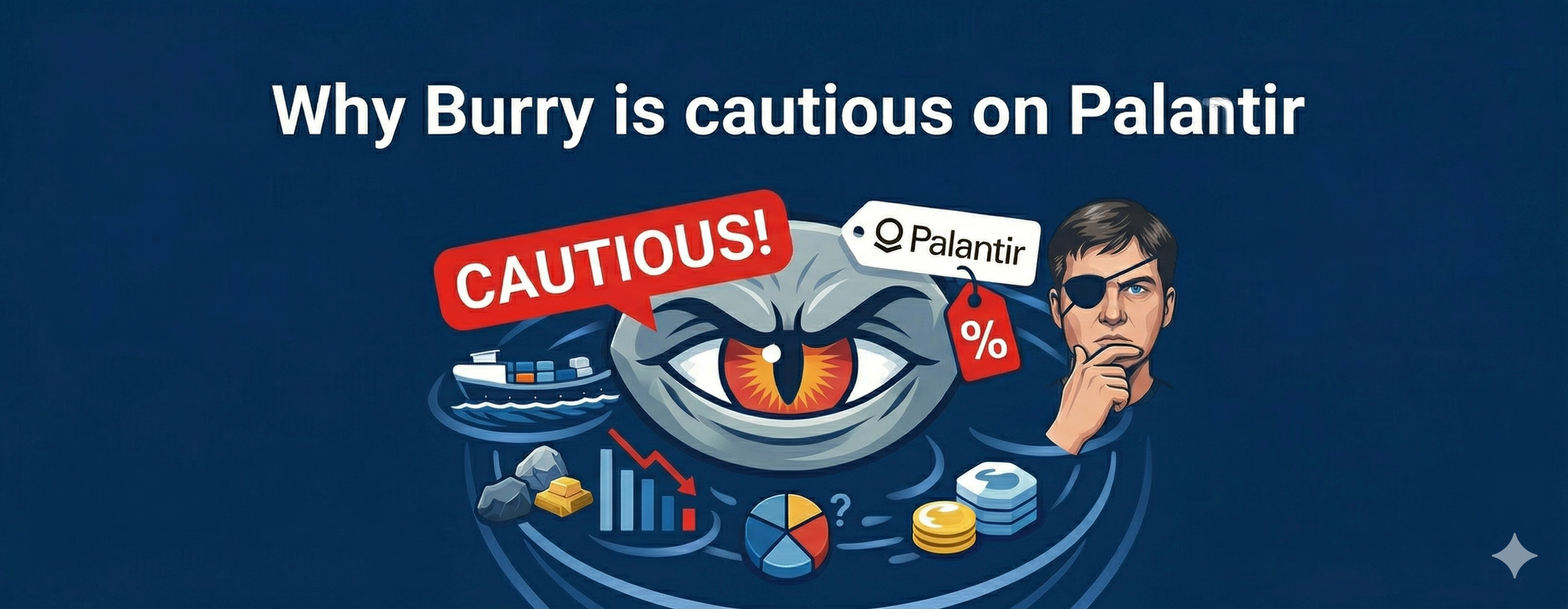
When the man who predicted the 2008 mortgage collapse calls a stock a bubble, Wall Street listens. When he then quietly scrubs that warning from the internet, Wall Street should listen even harder.
That is exactly what happened this week. Michael Burry, the “Big Short” investor who turned a housing market hunch into legend, posted a pointed broadside against Palantir Technologies on X and his Substack on Wednesday. He wrote that “Anthropic is eating Palantir’s lunch,” pointing to Anthropic’s revenue run-rate exploding from $9 billion to $30 billion in a matter of months, and declaring that Palantir “can have government, which is low margin and small.” The post sent Palantir shares tumbling to their steepest single-day drop in two months, even as the broader market rallied. Then, hours later, Burry deleted every word of it.
The deletion is the most important part of this story.
The Warning That Moved Markets
Burry’s comments cited data from Ramp’s March AI Index, which shows business AI adoption hitting a record 47.6%, with nearly one in four Ramp customers now paying for Anthropic, up from roughly one in 25 a year ago.

Anthropic’s adoption grew 4.9 percentage points month-over-month, its fastest pace yet, and it now wins roughly 70% of first-time, head-to-head enterprise purchasing decisions against OpenAI. That is a remarkable shift in a market that barely registered Anthropic as a commercial force eighteen months ago.
Burry tied this directly to Palantir’s valuation.
At a forward P/E of around 115 times, Palantir trades well above its sector median of 21 times and far above other large-cap AI names.
That gap has long been a sticking point for bears. In Burry’s framing, a company commanding premium AI multiples while a faster, cheaper competitor is hoovering up enterprise budgets is exactly the kind of setup he built his career identifying.
He went further than just numbers. Burry compared the Anthropic-Palantir rivalry to Google versus Yahoo in the early 2000s.
He noted that Yahoo had the chance to buy Google for $1 million in 1998 but rejected the offer, and again for $5 billion in 2002.
At its peak, Yahoo was valued at $125 billion before entering a long decline and eventually being sold to Verizon for just $4.5 billion. The implication was unmistakable: Palantir, in Burry’s view, is the Yahoo of this cycle.
The Short Position You Cannot Ignore
Before accepting or rejecting this thesis, the context is essential. Burry previously disclosed a sizeable short in Palantir via long-dated $50 strike put options expiring in 2027, giving him downside exposure to roughly 5 million shares.
He has argued Palantir is a low-margin consulting shop dressed up as a high-growth AI/SaaS story, pointing to accounts receivable expanding far faster than revenue and heavy stock-based compensation as red flags.
This is not a neutral analyst offering dispassionate commentary. Burry has a financial interest in Palantir’s stock going down. His posts moved the stock.
He then deleted them. That sequence demands scrutiny. Did he spot a flaw in his own argument? Did he face legal pressure?
Was the deletion itself a calculated move?
We do not know. What we do know is that a disclosed short seller made market-moving claims and then erased them after the price impact had already materialized.
Why the Comparison Is More Complicated Than Burry Let On
The Google-Yahoo analogy is seductive but imprecise in one critical way: Anthropic and Palantir are not actually competing for the same customers in the same way Google and Yahoo were.
Anthropic builds AI models. Palantir builds the operational infrastructure that allows large organizations to deploy those models against their own private, complex, and often classified data. These are different products serving different problems.
Palantir integrated Claude into its AI Platform after a November 2024 partnership with AWS and Anthropic, and analysts estimate Claude supports fifteen percent of AIP mission workflows across five federal agencies.
Removing the model requires rewriting prompts, retraining classification layers, and recertifying cyber controls, with engineers predicting months of work and millions in unexpected costs.
In other words, the company Burry says is “eating Palantir’s lunch” is also deeply embedded inside Palantir’s most sensitive defense deployments. Project Maven, the Pentagon’s flagship AI targeting system integrated with Palantir’s AIP, confirmed Anthropic as an official partner in February 2026. These two companies are partners, not rivals. Burry’s framing of a zero-sum battle between them collapses the moment you look at how defense AI actually works in practice.
The Numbers Burry Did Not Mention
There is another side to the Palantir story that Burry’s posts notably omitted. In Q4 2025, Palantir reported U.S. commercial revenue growth of 137% year-over-year, U.S. total revenue growth of 93%, and overall revenue growth of 70%, with the company closing a record $4.262 billion in total contract value, up 138% year-over-year.
These are not the numbers of a company losing an enterprise war. CEO Alex Karp called the results “indisputably the best results that I’m aware of in tech in the last decade.”
Palantir’s Rule of 40 score, the sum of its revenue growth rate and profit margin, hit 127% in Q4 2025, placing it in a league of its own among enterprise software companies.
A business losing its core market to a competitor does not typically post those metrics while simultaneously guiding for 115% U.S. commercial revenue growth in the year ahead.
The Real Question Burry Is Raising
Strip away the deletion drama and the flawed Yahoo analogy, and there is a legitimate underlying question in Burry’s thesis that investors should take seriously: is Palantir’s valuation pricing in a dominance it may not achieve?
The Ramp data showing Anthropic’s enterprise momentum is real.
The shift toward plug-and-play AI models that businesses can adopt quickly without deep integration work is real. Since Burry’s dire warnings about AI began in early November, Palantir shares are down 26%. His timing, whatever the merits of the specific argument, has been directionally correct.
The stock is down 16% year to date.
At a valuation that prices in near-perfect execution for years into the future, any crack in the growth story, any quarter where commercial momentum slows, any defense contract that goes to a competitor, gets amplified. That vulnerability is real and it does not require the Anthropic narrative to be true.
What Happens Next
Burry has gone quiet, his posts gone.
But the questions he raised are still circulating through trading desks and analyst reports. Palantir’s next earnings report will be scrutinized more intensely than usual.
Any softening in U.S. commercial growth, any sign that the $3.1 billion commercial guidance for 2026 is in jeopardy, will be read through the lens of the deleted posts.
For investors sitting on Palantir positions, the honest answer is that the Anthropic threat is largely overstated as a near-term competitive risk, particularly given the two companies’ defense partnership.
But the valuation risk Burry is circling is not. A forward P/E of 115 times leaves no margin for anything less than exceptional execution. That is a different and more durable concern than whether Claude is stealing Foundry contracts.
Burry deleted the posts. The risk he was pointing at, however imprecisely, did not delete itself.
Banner Image Source – Google Gemini
