 Skip to content






The final frontier has suddenly become Wall Street’s most lucrative playground. Over the last month, US space technology stocks have decoupled from the broader tech market, posting gains that haven’t been seen since the sector’s initial boom.
While the “New Space” economy has long promised a $1 trillion future, the last 30 days mark a critical shift from speculative dreaming to concrete capital allocation. The drivers? A perfect storm of massive defense spending, the looming shadow of a SpaceX IPO, and the integration of AI into orbital infrastructure.
This re-rating is not just theoretical. It’s showing up clearly in the performance of publicly listed space companies – several of which are core holdings in our Space Tech Portfolio.
Here is why the sector is skyrocketing – and the stocks leading the charge.
The Breakout Stars of January 2026
The rally has been broad, but three US companies have separated themselves from the pack.
Notably, two of the three companies highlighted below are constituents of our Space Tech Portfolio , reflecting our focus on scalable space infrastructure rather than speculative concepts.
- Planet Labs (NYSE: PL): The Eye in the Sky Planet Labs has arguably been the standout performer of the new year. As of mid-January 2026, the stock is sitting at an all-time high, having surged 658% over the past year.
- The Catalyst: The company has shifted from selling raw images to selling “sovereign capabilities.” A massive multi-year agreement with the Swedish Armed Forces and continued integration with US intelligence agencies have validated its business model. Investors are betting that in a tense geopolitical climate, Planet’s daily scan of the Earth is a non-negotiable asset.
- Intuitive Machines (NASDAQ: LUNR): The Lunar Landlord While many stocks promise the moon, Intuitive Machines is actually going there. The stock climbed approximately 47% in the last month alone.
- The Catalyst: A major driver was the January acquisition of Lanteris Space Systems, which significantly beefs up its manufacturing capabilities. Despite a high valuation, investors are piling in, betting on the company’s central role in NASA’s Artemis program and the emerging “Moon economy.”
- Rocket Lab (NASDAQ: RKLB): The “SpaceX Alternative” Rocket Lab has continued its explosive run from 2025 into 2026. After gaining nearly 174% last year, the stock is up over 20% year-to-date.
- The Catalyst: Analysts have dubbed Rocket Lab the “premier alternative to SpaceX.” Recent contracts with The U.S. Space Development Agency has kept the momentum alive, proving that the market craves a second reliable launch provider.
The Three Engines Driving the Rally
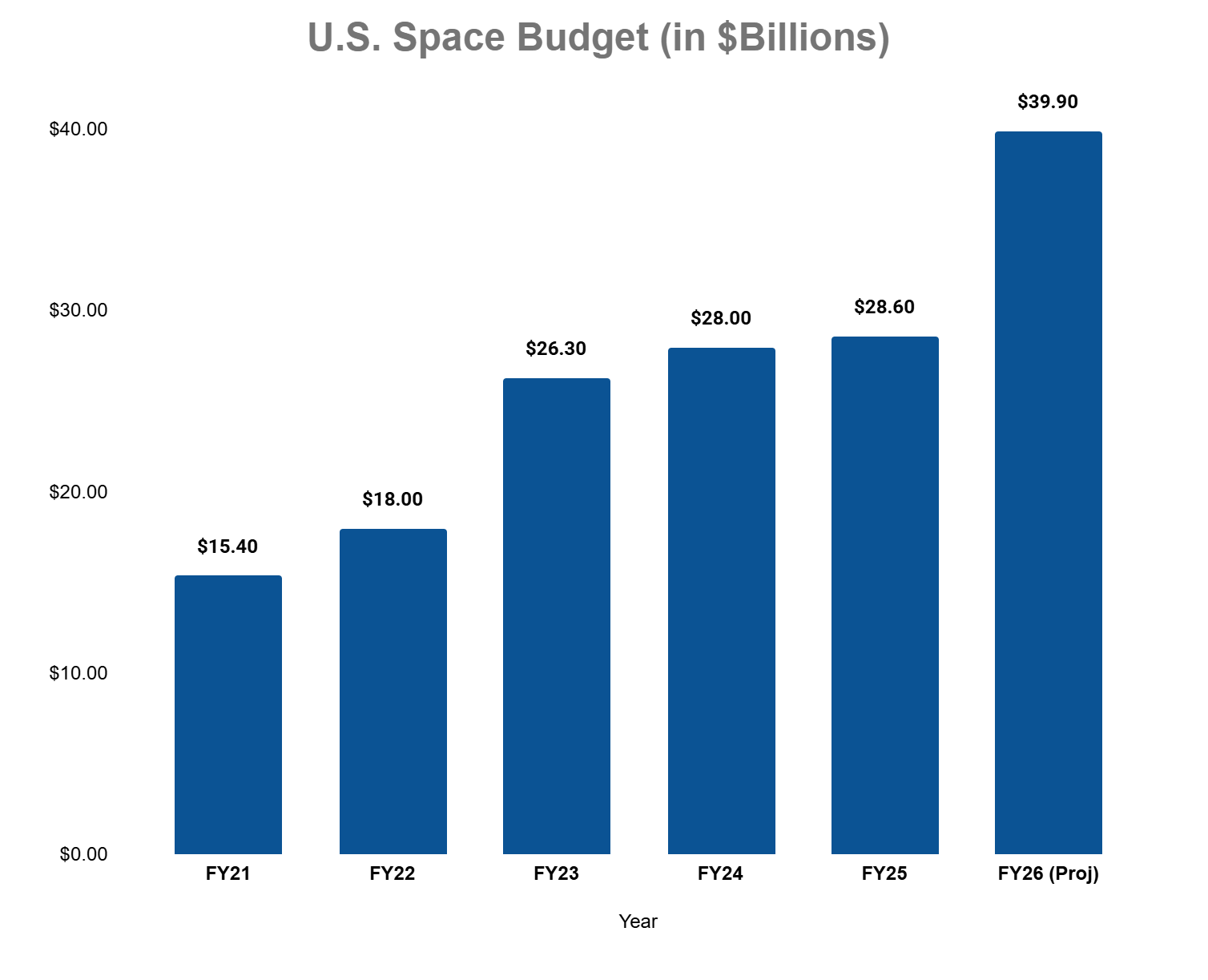 U.S. Space & Defense Budget Growth (2021–2026)
Why are these stocks rallying now? The timing is driven by three macro-factors that crystallized in early 2026.
1. The “Golden Dome” & Defense Budget
Geopolitics has forced the US government to open its wallet. The President’s FY 2026 National Defense Budget requests a staggering $1.01 trillion, with a specific focus on the “Golden Dome” missile defense initiative. This budget allocates $40 billion specifically to the US Space Force – a 30% increase from the previous year. This is a rising tide lifting all defense-adjacent space boats. Companies like Planet Labs and Rocket Lab are viewed as direct beneficiaries of this spending spree.
2. The SpaceX IPO “Halo Effect”
Reports have intensified that SpaceX is preparing for a mid-2026 IPO that could value the company at $1.5 trillion. This is creating a “SpaceX Adjacency” trade. Investors who can’t yet buy SpaceX are pouring money into the next best things – companies like Rocket Lab and Redwire. It is the “Netscape moment” for space; the arrival of a titan is validating the entire industry.
3. AI Meets Orbit
A newer narrative is “Orbital Compute.” The logic is that space offers the ultimate environment for AI data centers – limitless solar power and natural cooling. While still in its infancy, this narrative is allowing space companies to draft off the AI boom. Nvidia has even publicly profiled startups pursuing space-based data centers, signaling that “space tech” is increasingly becoming synonymous with “AI infrastructure.”
To capture this shift from venture risk to industrial value, we built the Space Tech Portfolio – focused on listed companies benefiting from defense spending, launch demand, satellite data, and the commercialization of orbit.
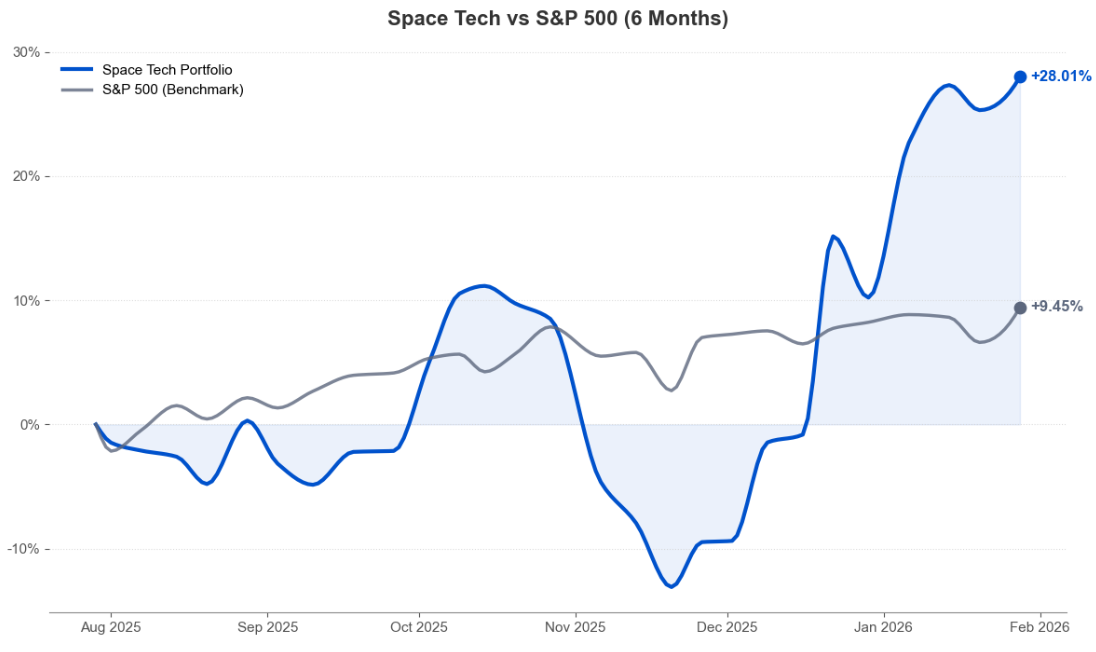
Space Tech Portfolio vs S&P 500 (Last 6 months Months)
Final Verdict
The “December-January” lift-off of 2026 is different from the hype of 2021. This rally is backed by a $1 trillion defense budget, tangible revenue growth from leaders like Planet Labs, and the structural tailwind of a potential SpaceX IPO.
For US investors, the message is clear: Space is no longer a speculative fringe. It is becoming a core component of the industrial and defense economy.
For investors looking to gain diversified exposure to the space economy’s next phase, our Space Tech Portfolio offers a curated approach to participating in this transformation.
Blog Featured Image Source – Gemini
