 Skip to content





Every quarter, the world holds its breath waiting for Tesla’s delivery numbers. Not because Tesla is the biggest carmaker in the world (it isn’t, BYD took that crown last year). But because Tesla isn’t really a car company anymore. Or at least, that’s what Elon Musk keeps telling us.
So when the Q1 2026 numbers dropped last week, the reaction was predictably messy.
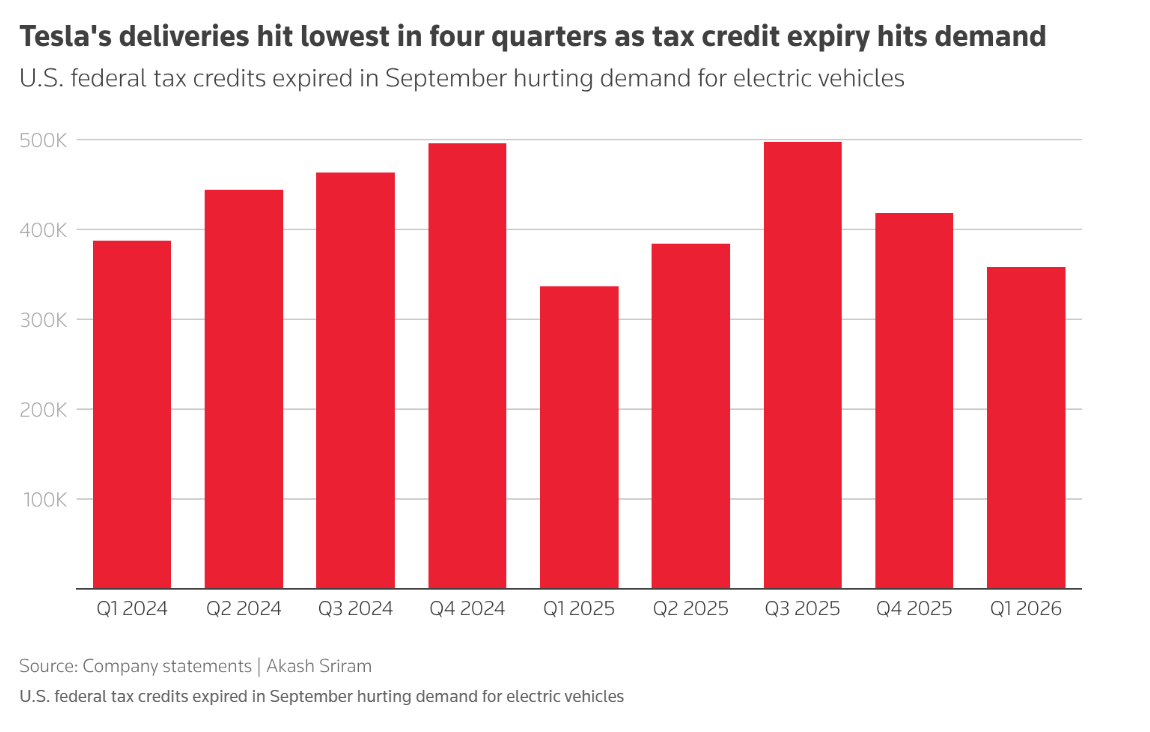
358,023 vehicles delivered. Up 6.3% from a year ago. Down 14% from last quarter. And about 7,600 units short of what Wall Street expected.
Shares fell over 4% on the news. Bears celebrated. Bulls said “just wait.” Classic Tesla.
Let’s Start With What Actually Happened
Tesla delivered 358,023 cars in the first three months of 2026, while producing 408,386. That means Tesla built roughly 50,000 more vehicles than it actually sold, the widest production-delivery gap in at least four years.
Think about what that means for a second. Factories ran at full tilt. Buyers didn’t show up in the same numbers. The result is a growing pile of unsold inventory sitting on lots around the world.
Why? A few things collided at once.
The $7,500 federal EV tax credit that made buying a Tesla feel almost affordable for middle-class Americans expired in September 2025. Gone. Just like that. The demand cushion it provided vanished with it. Tesla’s Full Self-Driving system still hasn’t received regulatory approval in Europe either, cutting off a meaningful chunk of potential buyers there. A Dutch regulatory decision expected this month could change that, but for now, Europe remains a headwind.
And then there’s the broader economy. Overall US EV purchases in Q1 were down 28% year-over-year across the entire industry. Auto loan delinquency rates hit 5.2% in Q4 2025, the highest since 2010. Consumers are under real financial stress. People aren’t rushing to finance a $45,000 car right now.
This isn’t entirely a Tesla problem. It’s an EV market problem. But Tesla, as the category leader in the US, feels it the hardest.
The China Silver Lining
Buried inside the grim headline number is one genuinely encouraging data point. Tesla’s China-made vehicle sales rose 23.5% year-over-year, marking two consecutive quarters of growth in that market. In South Korea, registrations jumped 330% in March alone.
China matters enormously here. Giga Shanghai is one of Tesla’s most efficient factories, and it operates in the backyard of BYD, the Chinese giant that dethroned Tesla as the world’s top EV seller last year. Growing there, against that kind of competition, isn’t a small thing.
Europe also showed early signs of stabilisation, with Tesla gaining ground in key markets like France during Q1. Not a recovery yet, but at least the bleeding appears to be slowing.
The Inventory Problem Nobody Wants to Talk About
Here’s the number that should make Tesla investors genuinely uncomfortable. Production exceeded deliveries by 50,363 vehicles in Q1. That’s not a rounding error. That’s a structural mismatch between what Tesla can build and what the market currently wants to absorb.
Fading US tax incentives played a role. So did rising competition from legacy automakers and lower-cost Chinese rivals. And so did the simple reality that Tesla has now recorded two straight years of delivery declines, with some forecasters warning a third is coming.
Tesla’s energy storage business, which had been a rare bright spot, also disappointed. Deployments fell 15.4% from a year earlier, adding another layer of concern to an already complicated quarter.
But Here’s Where the Story Gets Interesting
Tesla’s current stock price of roughly $1.4 trillion in market value has almost nothing to do with how many Model 3s it ships each quarter. The market is pricing in a very different version of Tesla’s future, and Musk has been methodically building that future even as the car numbers wobble.
Cybercab mass production begins this month at Giga Texas. The Cybercab is a purpose-built, two-seat robotaxi priced under $30,000, engineered specifically for high-utilisation ride-hailing rather than personal ownership. Tesla’s robotaxi service already runs without safety drivers in Austin, and expansion to Dallas, Houston, Miami, Phoenix, Las Vegas, and several other cities is planned for the first half of 2026. Musk has publicly stated he’s targeting at least 2 million Cybercabs per year across multiple factories, with a ceiling of 4 million annually.
Then there’s TERAFAB, a joint $25 billion chip factory announced with SpaceX, based in Austin. Two facilities: one dedicated to AI compute for Tesla’s vehicles and Optimus robots, the other targeting space-based data centres. It is vertical integration taken to an almost extraordinary scale, and it signals that Tesla and SpaceX are becoming operationally intertwined in ways that go well beyond sharing a CEO.
And SpaceX itself filed confidentially for a US IPO targeting a valuation of $1.75 trillion, with a potential listing as early as mid-June. Tesla doesn’t own SpaceX. But when SpaceX generates institutional excitement, sentiment around Tesla tends to benefit. The two companies increasingly share investor mindshare, supplier relationships, and strategic direction.
The Company Musk Is Dismantling
To understand where Tesla is going, it helps to understand what Musk is deliberately leaving behind.
He killed the Model S and Model X this quarter, the luxury flagships that defined Tesla’s brand for over a decade, and converted those Fremont factory lines to build Optimus humanoid robots. He has said publicly that roughly 80% of Tesla’s long-term value will come from Optimus, not cars. The company’s broader strategy, which Tesla calls “Amazing Abundance,” envisions AI, robotics, and energy storage systems addressing resource scarcity at civilisational scale.
That’s an enormous claim. It may sound like science fiction. But Tesla has a habit of making things that sounded like science fiction eventually real, even if the timeline always slips.
So What Is Tesla, Exactly?
That’s the question investors have been arguing about for a decade, and it still doesn’t have a clean answer.
The car business is genuinely struggling. Two consecutive years of delivery declines, a growing inventory problem, expired tax incentives, and fierce Chinese competition are not small headwinds. Vehicle sales still account for roughly three-quarters of Tesla’s revenue. That matters.
But Musk is clearly building something else at the same time. A robotaxi network. An AI chip infrastructure. A humanoid robot division. An energy business. And an increasingly deep partnership with a space company preparing for what could be one of the largest IPOs in history.
The Q1 earnings call on April 22 will be the next moment to hear what Musk actually plans to do with all of it.
Until then, the Tesla story remains exactly what it has always been. Two completely different companies sharing one stock ticker. Investors simply have to decide which one they believe in.
The car company had a rough quarter.
The other company? That story is just getting started.
Banner Image Source – Google Gemini
