 Skip to content





A quick update from our side.
Many investors tell us their US stocks, ESOPs, or RSUs end up spread across platforms, which makes tracking and managing them harder over time.
To help with this, we are running a cashback offer on US asset transfers, starting at 1% and going up to 1.5% for eligible transfers during the offer period.
You can read the full details and apply for your transfer.
Now to this week’s update. Markets were busy across tech, AI, and global economies.
Do read on.

The World in a Week: How Major Markets Moved
U.S. | Markets ended mixed. Nasdaq fell 1.84% as large-cap tech had its worst week since November, while value outperformed growth by 400 bps. ADP jobs rose just 22,000, job openings fell to 6.54 million (lowest since 2020), and layoffs jumped 118% YoY. Manufacturing rebounded to 52.6, and services stayed steady at 53.8.
Europe | European stocks rose, with the STOXX 600 up 1.0%. Inflation cooled faster than expected, with headline CPI at 1.7% and core at 2.2%. The ECB held rates at 2.0%, while the BoE kept rates unchanged but signaled possible cuts from March.
Japan | Japanese equities gained, with the Nikkei up 1.75% and TOPIX up 3.72%. The yen weakened to 157 per dollar, 10-year JGB yields stayed near 2.23%, and household spending fell 2.6% YoY.
China | Markets declined. CSI 300 fell 1.33%, Shanghai Composite dropped 1.27%, and Hang Seng slid 3.02%. Private PMIs improved modestly (services 52.3, manufacturing 50.3), while official data pointed to weaker domestic demand.
India | Indian equities rose, with the NIFTY 50 up 1.08% and mid- and small-caps outperforming. Consumer Durables (+7.1%) and Realty (+6.2%) led gains, while IT (–7.3%) lagged. FIIs sold ?4,894 crore; DIIs bought ?3,742 crore. India VIX fell 10.7%.
Commodities | Metals weakened; oil stayed range-bound.
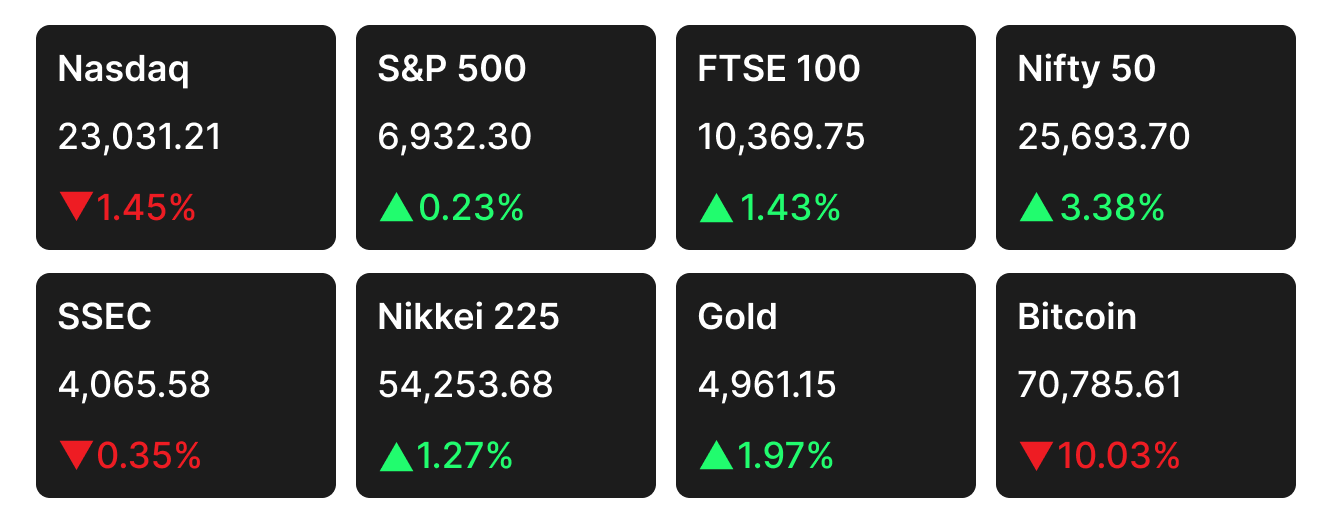
Stock market closing data for the week of Feb 2 to Feb 6, 2026
Index information: STOXX 600 (tracks 600 large, mid- & small-cap EU firms), DAX (top 40 German blue chips), CAC 40 (leading French stocks), Nikkei 225 (225 top Japanese stocks), CSI 300 & SSEC (mainland China A-shares), and Hang Seng (large-cap Hong Kong-listed firms). For these indices, we track 1-week returns to capture how global sentiment is shifting.
News Summaries
AI Is Taking the Semiconductor Industry to $1 Trillion
The global semiconductor industry is set to reach $1 trillion in revenue in 2026 for the first time. Industry sales stood at $791.7 billion in 2025 and are forecast to grow another 26% this year, according to the Semiconductor Industry Association.
This milestone is arriving much earlier than expected. Earlier projections suggested it could take several more years, but AI-related demand has sharply accelerated spending across chips, servers, and data center infrastructure.
The surge is being driven by large-scale investment in AI computing, as companies expand capacity to support training and deployment of advanced models. What started as a software-led trend is now translating into real capital spending across global supply chains.
Amazon Stock Slides After Earnings Show Slower Cloud Growth
Amazon reported earnings that showed slower-than-expected growth in its cloud business, AWS. The company also said spending on AI-related infrastructure and technology rose by nearly 60% from a year earlier.
The stock fell after the results, and the move weighed on broader US technology shares.
AWS remains Amazon’s largest profit contributor and a key indicator for the global cloud market.
The latest numbers suggest cloud growth is moderating, while investment requirements for AI infrastructure are rising.
For investors, the focus is increasingly on how cloud providers balance rising AI demand with capital spending and profitability as the industry becomes more capital-intensive.
Also Read: Amazon’s Q4 Earnings
Big Tech Is Entering A More Capital-Intensive AI Phase
Four of the largest U.S. technology companies, namely Alphabet, Amazon, Meta and Microsoft, are forecast to spend roughly $650 billion on AI computing and infrastructure in 2026, an increase of about 60% from the prior year.
That spending is going into new data centres, networking equipment and the high-performance chips needed to train and run modern AI models.
Each company’s planned outlay would, on its own, rank among the highest annual capital expenditures recorded by any corporation over the past decade, and collectively they far exceed the capital spending of most major U.S. industries combined.
Meta has projected its own capex could rise as high as $135 billion, Microsoft is increasing its investment by about 66%, Alphabet is planning up to $185 billion, and Amazon’s capex plan tops $200 billion for the year.
For investors, the scale of these commitments highlights how the AI build-out from servers and networking gear to power and cooling infrastructure is becoming a defining driver of tech sector capital allocation and may shape where returns emerge in the coming years.
Key Headlines of the Week
Musk unifies SpaceX and xAI in $1.25 trillion tech consolidation | Elon Musk’s aerospace company SpaceX has acquired his AI startup xAI in an all-stock deal valued at about $1.25 trillion, combining rockets, satellites and AI under one corporate roof ahead of a planned IPO later this year.
Nvidia nears $20 billion OpenAI investment | Nvidia is reportedly close to finalizing a roughly $20 billion investment in OpenAI as part of the AI startup’s latest funding round, which could value OpenAI near $830 billion and strengthen the chipmaker’s role in the AI ecosystem.
U.S. job openings hit lowest since 2020 | Labour market data showed a notable drop in job vacancies, suggesting softening demand for workers even as headline unemployment remains moderate, a key signal for economic and Fed policy watchers
