 Skip to content





If you’ve been following the news lately, you know the broad strokes.
On February 28, 2026, the US and Israel launched strikes on Iran, killing Supreme Leader Ali Khamenei. Iran hit back by doing something the world had long feared but never actually seen: it closed the Strait of Hormuz. That narrow strip of water between Iran and Oman, barely 33 kilometres wide at its narrowest point, is the single most important energy chokepoint on the planet. About 20 million barrels of oil pass through it every single day. One-fifth of all global LNG too.
When it shut, the world seemed to panic. Brent crude surged from $72 to above $120 a barrel. Gas prices doubled in Europe. Asian countries began energy rationing. Shell’s CEO went on stage at an industry conference warning that Europe could face a fuel shortage by April.
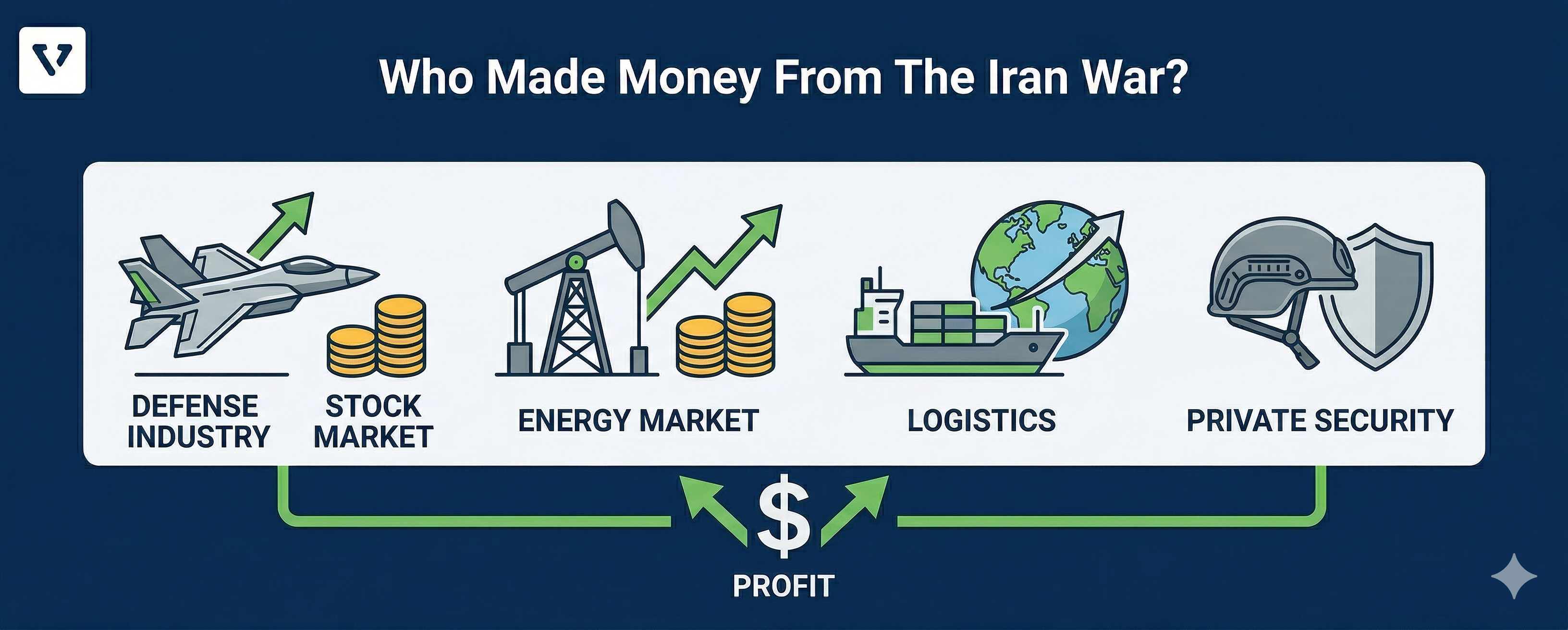
But here’s the thing about massive economic disruption. For every country or company that gets hurt, someone else may be quietly profiting. Sometimes obscenely so.
Today, let’s follow the money.
First, a quick explainer on who was hurt
Before we get to the winners, it helps to understand the damage. Because the winners only make sense in context.
Qatar, which hosts the world’s largest LNG facility at Ras Laffan, took a direct hit when Iranian strikes damaged the complex. Production stopped. Qatar Airways suspended flights. The UAE’s property market, which had been booming, began wobbling as hedge funds started thinking about exits. Dubai’s stock index fell 16% in March alone, making it the worst-performing bourse in the world that month.
India had 220,000 of its nationals evacuated from the Gulf. Energy rationing spread across South Asia, then Southeast Asia, then started creeping toward Europe.
The head of the International Energy Agency called it the greatest global energy security challenge in history.
So yes, the damage was real and widespread.
Now. Who made money?
Russia: The Biggest Winner That Fired No Shots
Let’s start with the most important one.
Right before the war broke out, Russia looked to be in serious trouble. Its oil revenues had collapsed by nearly 50%. The Kremlin was quietly drawing up plans to cut all non-security government spending by 10%. Analysts in Moscow were privately warning that a financial crisis could arrive within months. Inflation was running hot. Interest rates were stuck high. The Russian economy, already distorted by years of war spending in Ukraine, was beginning to buckle.
Then the Strait of Hormuz closed. And Vladimir Putin’s budget crisis essentially disappeared overnight.
Here is the simple reason why. When 20 million barrels of Gulf oil got “walled in” every single day, the rest of the world desperately needed oil from somewhere else. Russian oil, which had been trading at a steep discount to global prices because of Western sanctions, suddenly became enormously valuable. The price of Russian Urals crude surged from below $60 per barrel to around $90, nearly matching the global Brent benchmark.
And then Trump made it even better for Moscow. After a phone call with Putin, the US temporarily waived Russian oil sanctions on some countries, to help ease the global supply shock. Countries like India, which was facing a domestic fuel crisis, got emergency waivers to buy Russian crude. Russian tankers that had been shunned were suddenly welcome again.
In the first 15 days of March alone, Russia was pocketing around 372 million euros every single day from oil exports. That is 14% higher than its February average. According to the KSE Institute, depending on how long the conflict lasts, Russia could earn between $45 billion and $151 billion in additional budget revenues this year compared to a scenario where the war never happened.
But here is what most people missed. Russia’s windfall was not just oil. Aluminum prices rose 12% because aluminum shipments also moved through Hormuz. Urea, the most widely traded fertilizer in the world, surged nearly 75% because Gulf fertilizer exports were choked off. Russia is a massive exporter of both. The war appears to have handed Moscow a commodity bonanza across the board.
One Carnegie analyst summed it up perfectly: “What he was spending on the war meant he was basically pawning the country. Now, he doesn’t have to do that anymore.”
Shell and the Oil Traders: Making Money from Both Sides
This one requires a small explainer.
You might think that Shell, which had assets damaged in Qatar’s Ras Laffan facility, would be a net loser from this conflict. And operationally, it did take a hit. Gas production fell around 5%. The company warned of lower output.
But Shell is not just an oil producer. It runs one of the most sophisticated commodity trading operations in the world. And commodity trading desks love one thing above everything else: volatility.
When oil prices swing wildly, traders who are positioned correctly, meaning those who’ve bought options, futures, or physical cargoes at the right time, make enormous returns. Shell’s trading desks were seemingly positioned correctly.
The company reported “significantly higher” profits from its commodity trading operations in the first quarter of 2026. Its renewable energy trading division alone was expected to post earnings of between $200 million and $700 million for the quarter, compared to just $100 million the quarter before. All of this while Shell’s CEO was publicly warning governments about the energy crisis.
This is not unusual. This is how integrated energy majors work. The production arm and the trading arm operate almost independently. One was hurting. The other was printing.
And it wasn’t just Shell. Non-Gulf energy producers everywhere, US LNG exporters, Norwegian oil fields, Australian gas producers, suddenly found themselves in a seller’s market. Every molecule of energy that didn’t have to travel through Hormuz became more valuable overnight. American LNG terminals were running at full capacity, shipping cargoes as fast as physically possible.
The Defence Industry: Old Giants, New Startups, Same Story
Now here is where it gets really interesting. And also a little uncomfortable.
Wars consume weapons at a terrifying rate. In just the first 16 days of the conflict, the US and coalition forces burned through more than 11,200 munitions, at an estimated cost of $26 billion. Among these were over 1,200 Patriot missile-defence systems made by RTX, hundreds of Tomahawk cruise missiles, and more than 300 Thaad interceptors built by Lockheed Martin.
Here is why that number matters. A single Patriot missile costs more than $3 million. And it takes months to build one. You cannot just order more and have them show up next week. Replacing what was used in the first two weeks alone will require years of sustained production. Which means years of sustained revenue for the companies that make them.
RTX, Lockheed Martin and Northrop Grumman were expected to be the biggest beneficiaries. The US State Department approved $16.5 billion worth of foreign military sales to Gulf states since the war began. The Pentagon announced Boeing would triple production of key missile components under a new seven-year agreement. The Trump administration was preparing a $1.5 trillion defence spending request to Congress, with an additional $200 billion earmarked specifically for the Iran war.
Defence Secretary Pete Hegseth summarised the philosophy in four words: “It takes money to kill bad guys.”
But the more surprising story is what happened further down the chain.
South Korea’s LIG Nex1, a missile defence company most people outside the defence industry had never heard of, saw its shares jump 40% at the war’s start. Its product, the Cheongung-II air defence system, is significantly cheaper than RTX’s Patriot and had already been sold to Saudi Arabia, Iraq and the UAE. With Patriot missiles taking months to build and costing millions each, buyers were suddenly very interested in affordable alternatives.
Israel’s Elbit Systems briefly became the highest-valued company on the Tel Aviv Stock Exchange. Israel approved a large increase in its defence budget and signed a new contract with Elbit for artillery ammunition.
And then there were the startups.
Arizona-based SpektreWorks built low-cost attack drones by literally reverse-engineering captured Iranian Shahed drones. The US started using them within the first 24 hours of the conflict. Los Angeles-based Neros, which had previously supplied attack drones to Ukraine, saw Pentagon demand spike rapidly. Its CEO noted they’d never seen “the need for having systems on the shelf ready to go for urgent demands” at this scale before.
Even Estonia got in on it. A company called Frankenburg Technologies is developing AI-guided interceptor missiles that it claims will be ten times cheaper than conventional weapons.
The war created a demand signal across the entire spectrum of the defence industry, from the $3 million Patriot to the $800 drone. Just about everyone with something that flies, explodes, or intercepts was suddenly getting calls from governments.
The Prediction Market Traders: The Most Suspicious Winners
This one needs the most careful handling.
Polymarket is a prediction market platform where users bet real money on real-world events. Think of it like a stock market, but instead of companies, you’re betting on outcomes: will there be a ceasefire? Will a specific leader survive? Will oil hit $130?
These platforms work because they aggregate information. If someone with genuine knowledge bets heavily on an outcome, the price moves, and it signals to everyone else that something might happen. In theory, it’s a useful truth-telling mechanism.
In practice, during the Iran war, it looked a lot like insider trading.
Multiple accounts on Polymarket, several created in February 2026 just before the conflict, bet exclusively on Iran-war-related events. One trader placed wagers hours before key unannounced military actions, with a 93% win rate on bets involving five-figure sums. A trader called “Magamyman” made $553,000 on a single bet that Khamenei would lose power. Six coordinated accounts reportedly netted $2 million combined. Total Iran-related betting volumes ran into hundreds of millions of dollars.
Nobody has been charged. The trades are crypto-funded and largely anonymous. But the timing patterns were striking enough that multiple analysts publicly raised the possibility that some of these traders were receiving leaks from inside the US military or the White House.
It may never be proven. But it happened.
And Then There Was Iran Itself
Here is perhaps the darkest irony of all.
Iran closed the Strait of Hormuz. But it did not close it to everyone.
It selectively allowed passage for “friendly” vessels, at a reported fee of $1 per barrel of cargo, payable in yuan or stablecoins. At an estimated $2 million per ship, Iran was generating direct hard revenue from the very chokehold it had imposed on the world. The country that triggered the crisis was also charging admission to get through it.
The Bottom Line
A conservative estimate of explicitly documented war profiteering across gold repositioning, oil futures, prediction markets, commodity trades and defence contracts exceeds $30 billion. The real number, accounting for untraceable positions and anonymous wallets, is almost certainly much higher.
The ceasefire signed in early April has brought oil back below $100 a barrel. Shell’s trading profits should normalise. Russia’s windfall should narrow if the peace holds. Polymarket will likely find a new event to bet on.
But some things will not go back to normal. Russia’s relationships with India and China have been reconfigured. The taboo around closing the Strait of Hormuz seems to have been broken. And a new generation of defence startups now has proven products, government contracts, and a story to tell investors.
The war may be winding down. The money it made is not going anywhere.
Disclaimer – This article draws from sources such as the Financial Times, Bloomberg,and other reputed media houses. Please note, this blog post is intended for general educational purposes only and does not serve as an offer, recommendation, or solicitation to buy or sell any securities. It may contain forward-looking statements, and actual outcomes can vary due to numerous factors. Past performance of any security does not guarantee future results.This blog is for informational purposes only. Neither the information contained herein, nor any opinion expressed, should be construed or deemed to be construed as solicitation or as offering advice for the purposes of the purchase or sale of any security, investment, or derivatives.The information and opinions contained in the report were considered by VF Securities, Inc.to be valid when published. Any person placing reliance on the blog does so entirely at his or her own risk, and does not accept any liability as a result.Securities markets may be subject to rapid and unexpected price movements, and past performance is not necessarily an indication of future performance. Investors must undertake independent analysis with their own legal, tax, and financial advisors and reach their own conclusions regarding investment in securities markets.Past performance is not a guarantee of future results
Banner Image Source – Google Gemini
