 Skip to content







The Story
Alphabet just did something that, on the surface, sounds absolutely insane.. The company behind Google sold bonds that won’t mature until the year 2126. That’s right, a full century from now. When your great-great-grandchildren might be reading history books about how quaint smartphones were.
And here’s the kicker: investors went crazy for it. Alphabet wanted to raise £1 billion with this century bond and received £9.5 billion in bids. That’s nearly 10 times oversubscribed. The overall debt raise across dollars, sterling, and Swiss francs hit almost $32 billion in less than 24 hours.
This is unprecedented in modern tech. The last time a technology company issued a 100-year bond was in 1997 when Motorola did it, right in the middle of the dot-com bubble. Most of us know how that story ended.
But here’s what makes this moment different and fascinating: Alphabet has only existed for about 28 years. Google started in a garage in Menlo Park, California, with desktop computers and a $100,000 investment from an angel investor. Now they’re asking bondholders to trust them for longer than many nations have existed in their current form.
The AI Gold Rush Needs Cash, Lots of It
To understand why Alphabet is doing this, you need to understand the sheer scale of money being thrown at artificial intelligence right now.
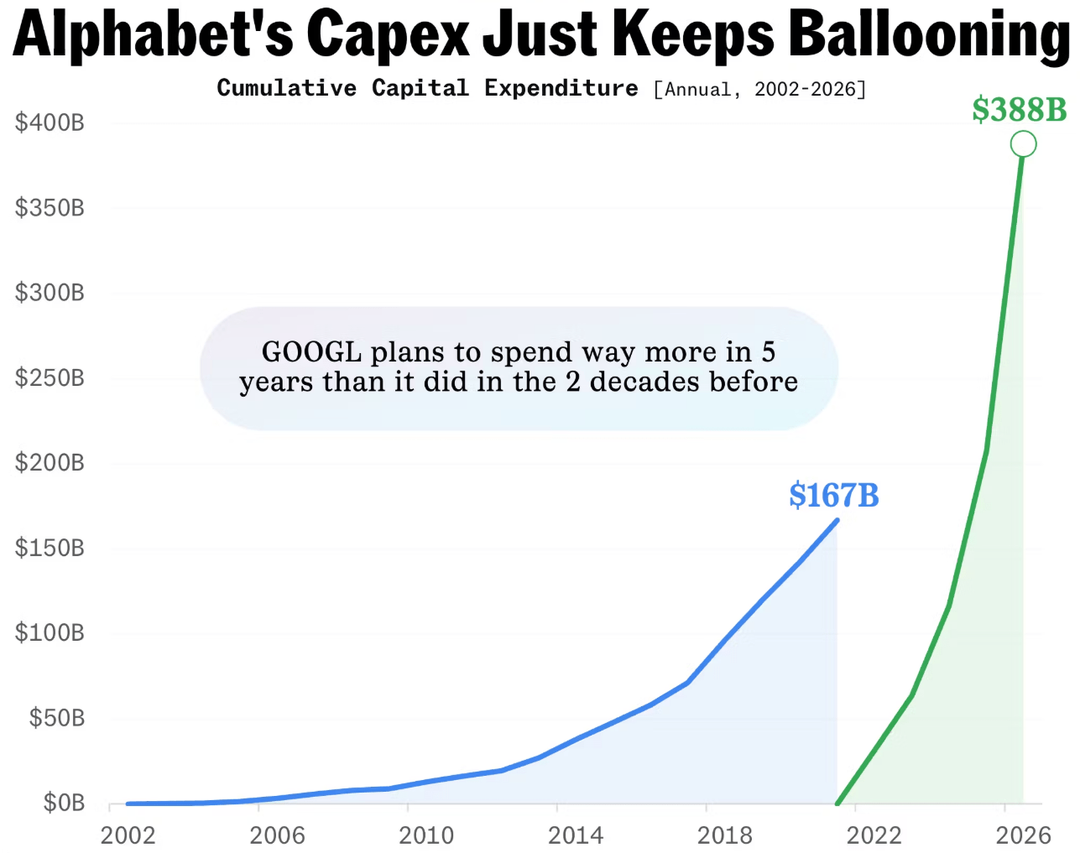
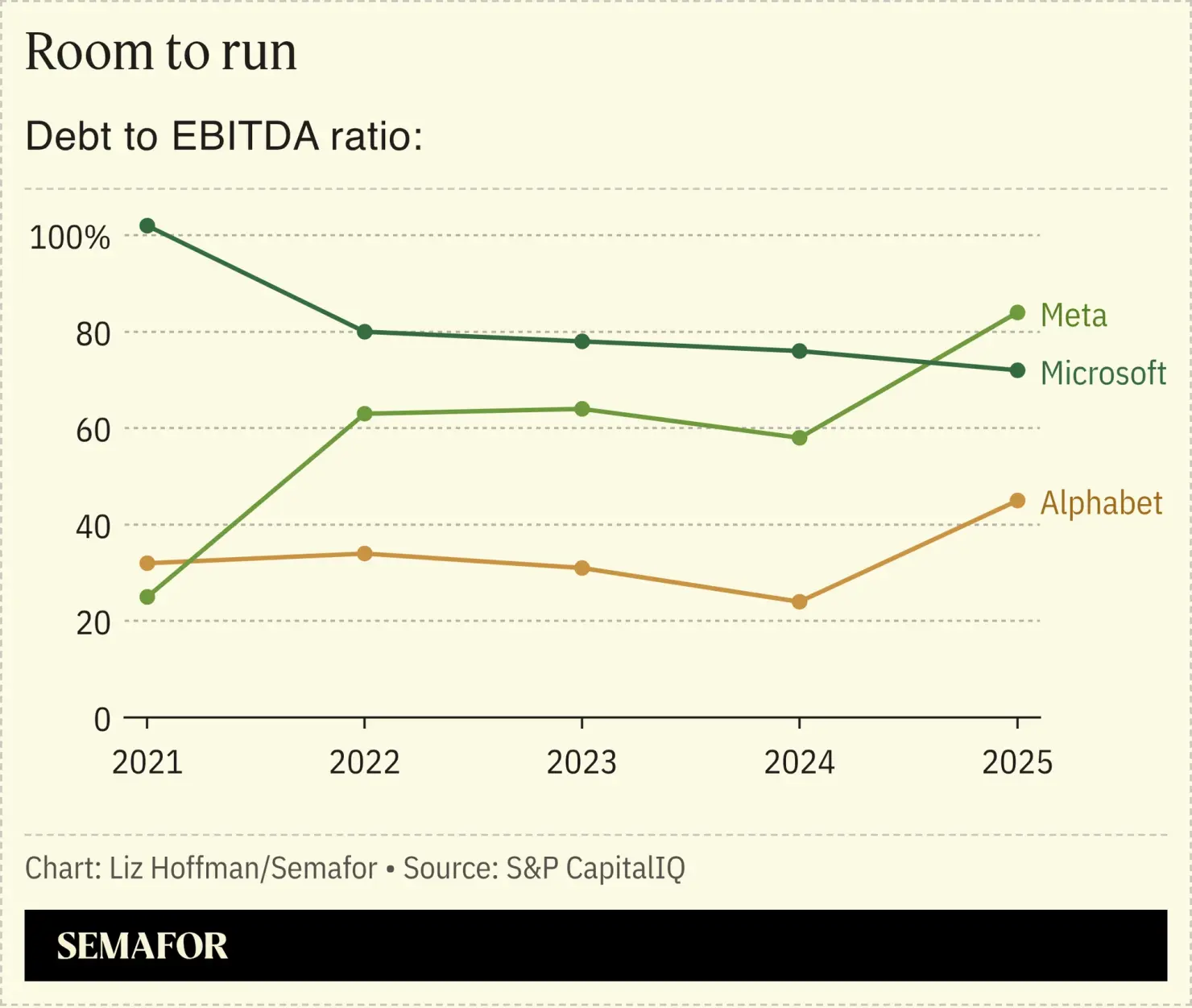
Alphabet announced it plans to spend up to $185 billion in capital expenditures in 2026 alone. Read that number again. That’s more than double the $75 billion they spent in 2025. Their long-term debt quadrupled in 2025 to $46.5 billion. They held a $25 billion bond sale just in November.
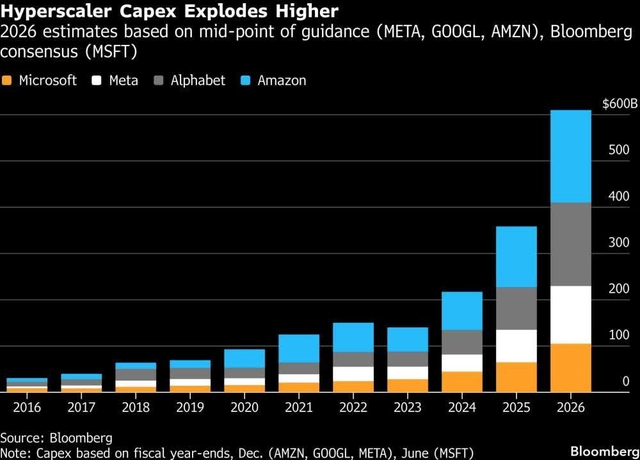
And Alphabet isn’t even the biggest spender. According to various estimates, the big four tech giants (Alphabet, Microsoft, Meta, and Amazon) are collectively expected to spend at least $630 billion to $650 billion this year on AI infrastructure. That number is projected to increase by more than 60% from the already historic levels reached in 2025.
What are they spending on? Data centers. Nvidia AI chips that cost a fortune. Cooling systems to prevent those chips from melting. Power infrastructure because these data centers consume electricity like small cities. Networking equipment to connect it all. And of course, land to build on.
When Alphabet CEO Sundar Pichai was asked on the earnings call what keeps executives up at night, he didn’t say competition or regulation. He said “compute capacity” and then added “power, land, supply chain constraints, how do you ramp up to meet this extraordinary demand for this moment?”
That answer tells you everything. The constraint isn’t ideas or software or even money in the traditional sense. It’s physical infrastructure.
Why a 100-Year Bond Makes Strange Sense
On the surface, a tech company issuing 100-year bonds sounds ridiculous. Technology moves fast. Who knows what computing will look like in five years, let alone 100?
But from a financial engineering perspective, this is actually brilliant. Here’s why:
First, the buyers. Century bonds are typically bought by insurance companies and pension funds. These institutions have liabilities that stretch decades into the future. If you’re a UK pension fund that needs to pay retirees for the next 50 years, a 100-year bond paying 6.125% interest is exactly what you need. You match your long-term liabilities with long-term assets.
Second, the cost. Alphabet locked in 6.125% interest for an entire century. In the current environment, that’s incredibly cheap money. The final terms were set at 120 basis points over gilts, down from initial price thoughts of 145 to 150 basis points. The bond is rated AA+, which is actually higher than the UK government’s own rating.
As one portfolio manager at TwentyFour Asset Management noted: “For the rating, at that spread, I can see why people would want to play it in a strong credit environment.”
Third, and this is the wild part, these bonds came with basically no strings attached. Unlike typical tech bonds that include protective covenants, interest coverage ratios, and guarantees from subsidiaries, Alphabet’s century bonds have what analysts at Covenant Review called “no meaningful restrictive covenants.”
The analysts wrote in a note: “While this may be a low-risk issuer, this is bad market precedent since other tech giants do have covenants.” The bonds aren’t guaranteed by subsidiaries and lack protection against future subordination to other Alphabet debt.
Alphabet essentially told investors: trust us for 100 years, take our word that we’ll exist and thrive, and we’re not giving you any legal protections beyond the promise to pay. And investors still lined up 10 times over.
The Dot-Com Echo That Sounds Different
For anyone who lived through the late 1990s, this should trigger alarm bells. Century bonds from tech companies? Massive capital expenditures with uncertain returns? Investor euphoria? This feels familiar.
When Motorola issued its century bonds in 1997, it was a sign of the frothy excess of the dot-com era. Those bonds are still outstanding today with coupon rates of 5.22%, but Motorola is a shadow of its former self. JCPenney issued century bonds around the same time and filed for bankruptcy in 2020, just 23 years later.
So is this another bubble about to pop?
Here’s where the story gets interesting. The key difference between now and the dot-com era is simple but crucial: today’s tech giants actually make money. A lot of it.
Google Cloud’s operating income jumped 154% year over year in the fourth quarter. Ad revenue increased 13.5% to $82.28 billion. Alphabet’s stock rocketed 107% in 2025 after a sharp sell-off in April, and the company is reporting double-digit earnings growth.
Over the past two years of massive capital expenditure deployment, both Microsoft and Google actually increased their free cash flows. They’re not burning cash hoping to make money eventually. They’re making money while spending unprecedented amounts.
According to Morgan Stanley estimates, of the projected $2.9 trillion in hyperscaler capital expenditure over the coming years, almost half will be financed by cash flows. Corporate debt like these century bonds will make up less than 10% of the total.
This is fundamentally different from the fiber optic buildout of the 1990s, when telecom companies borrowed billions to lay cable that often generated zero revenue. The silicon buildout is still primarily being financed by actual cash that these companies are generating from their
The Creative Accounting Risk
There’s another wrinkle in this story that deserves attention. Not all of the AI infrastructure spending is showing up on corporate balance sheets in straightforward ways.
Meta and Oracle have begun restructuring their borrowing practices in unusual ways. Morgan Stanley believes that over $1 trillion of the total AI funding will come from private credit and “other capital” like private equity and venture capital firms.
Meta created a holding company jointly owned with Blue Owl Capital called RPLDCI to finance a data center venture. The running theory is that this was done to keep the debt off Meta’s books, though some analysts are skeptical since Wall Street can usually see through such tricks.
This creative structuring represents a risk. When companies start using off-balance-sheet vehicles and complex financial arrangements, it can be a sign that the straightforward financing options are either too expensive or too constraining.
What Alphabet is Actually Saying
To their credit, Alphabet is being surprisingly candid about the risks in their annual financial report filed with the SEC.
For the first time, they included warnings about AI potentially cannibalizing their core search and advertising business. As more consumers adopt generative AI tools like Gemini (which now has over 750 million monthly active users), there’s a real possibility that traditional search usage could decline.
The filing states: “We and our competitors are constantly adjusting to meet this shift and provide new and evolving advertising formats. There is no assurance that we will adapt effectively and competitively to meet this shift.”
They also acknowledged the risk of ending up with “excess capacity” from their costly infrastructure commitments. What happens if they build all these data centers and lease all this equipment, but the AI demand doesn’t materialize as expected?
And there are operational complexities: “To meet the compute capacity demands of AI training and inference, as well as traditional cloud computing services, we are entering into significant leasing arrangements with third party operators, which may increase costs and operational complexity.”
Large commercial agreements could increase “liabilities and obligations in the event of nonperformance by us, our counterparties, or vendors.”
Translation: we’re making massive bets on infrastructure that could blow up if anything goes wrong with us, our partners, or our vendors.
Disclaimer – This article draws from sources such as the Financial Times, Bloomberg, and other reputed media houses. Please note, this blog post is intended for general educational purposes only and does not serve as an offer, recommendation, or solicitation to buy or sell any securities. It may contain forward-looking statements, and actual outcomes can vary due to numerous factors. Past performance of any security does not guarantee future results. This blog is for informational purposes only. Neither the information contained herein, nor any opinion expressed, should be construed or deemed to be construed as solicitation or as offering advice for the purposes of the purchase or sale of any security, investment, or derivatives. The information and opinions contained in the report were considered by VF Securities, Inc.to be valid when published. Any person placing reliance on the blog does so entirely at his or her own risk, and does not accept any liability as a result.Securities markets may be subject to rapid and unexpected price movements, and past performance is not necessarily an indication of future performance. Investors must undertake independent analysis with their own legal, tax, and financial advisors and reach their own conclusions regarding investment in securities markets.Past performance is not a guarantee of future results
