










Two types of GIFT City funds are worth understanding in detail.
The first is an actively managed fund. The second is a set of passive funds tracking major US indices.
The DSP Global Equity Fund is one of the first retail mutual funds launched from GIFT City and remains a useful reference point for understanding the actively managed structure.
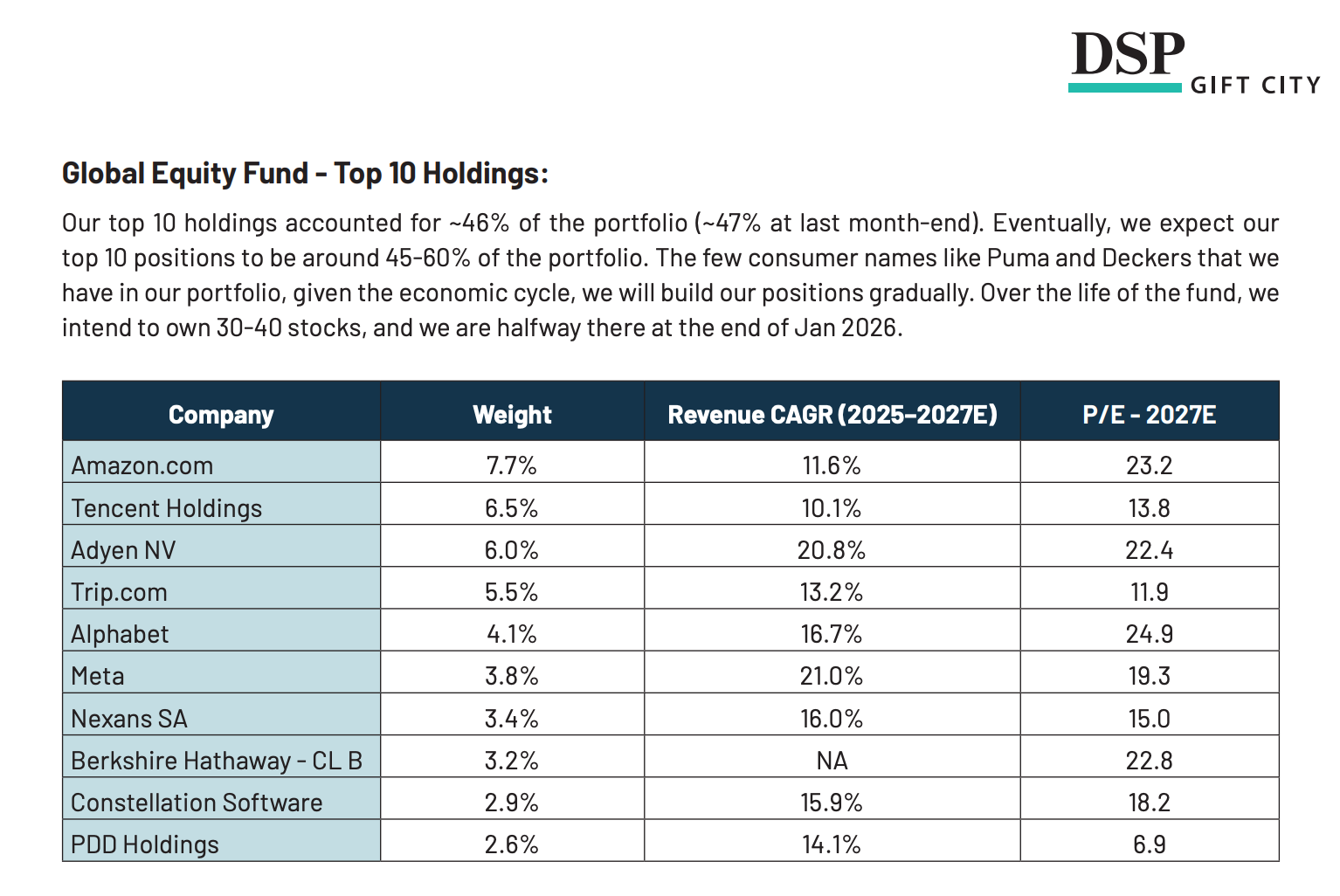
The fund directly holds global stocks across sectors and geographies. Its portfolio has included companies like Apple, Meta, Lululemon, Nintendo, Brookfield, and Puma. The fund manager makes active decisions on which stocks to buy, hold, and sell.
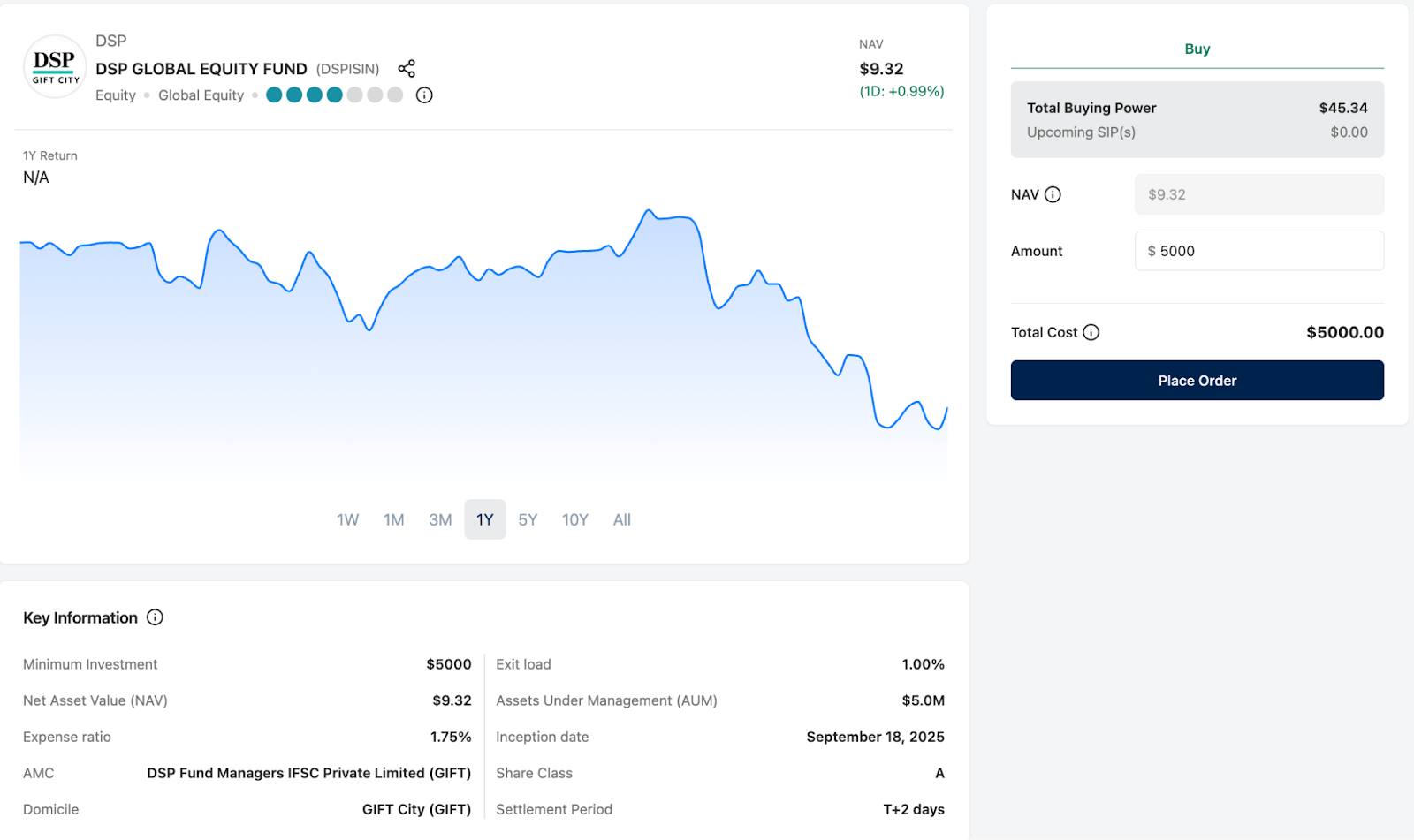
The expense structure is transparent. The management fee is up to 1.5% per annum. Operating expenses add around 0.25%. The total expense ratio works out to up to 1.75% per annum.
There is an exit load of 1% if you redeem within two years. After two years, no exit load. All taxes are already factored into the daily NAV. The NAV you see is post-tax and post-expense. There are no surprise deductions at the time of redemption. 🙂
Compare the 1.75% total expense ratio to Indian feeder funds that often charge between 2 and 3% in total when you add up the feeder layer and master fund expenses. GIFT City funds are actually cheaper, because there is only one layer.
You can invest in the DSP Global Equity Fund through Vested, too.
Under the Global Funds section, the fund appears with its latest NAV and fund documents. You fund your account under LRS, the money converts to dollars, you specify the amount, and units are allotted at the applicable NAV. When you redeem, the money returns to your account in dollars.
The second type is passive.
PPFAS Asset Management, the fund house behind the well-known Parag Parikh Flexi Cap Fund, has launched two index funds from GIFT City.
The Parag Parikh IFSC S&P 500 Fund of Fund tracks the S&P 500, which covers roughly 500 of the largest publicly listed companies in the United States.
The Parag Parikh IFSC Nasdaq 100 Fund of Fund tracks the Nasdaq 100, which covers 100 of the largest non-financial companies on the Nasdaq exchange, with heavy representation from technology companies.
Both funds invest in ETFs and UCITS funds that track these indices.
The minimum investment for both Parag Parikh GIFT City funds is $5,000, with subsequent investments of $500 per transaction. The expense ratio is 0.30% for direct plans and 0.60% for regular plans.
This is significantly lower than both the DSP fund and India-domiciled international feeder funds, which reflects the passive nature of these funds. No active stock picking means lower costs.
Here is a side-by-side look at these three funds.
| DSP Global Equity Fund | Parag Parikh IFSC S&P 500 FoF | Parag Parikh IFSC Nasdaq 100 FoF | |
| Type | Actively managed | Passive index | Passive index |
| What it tracks | Global stocks, fund manager’s picks | S&P 500 | Nasdaq 100 |
| Minimum investment | $5,000 | $5,000 | $5,000 |
| Top-up amount | Varies | $500 | $500 |
| Total expense ratio | Up to 1.75% | 0.30% direct, 0.60% regular | 0.30% direct, 0.60% regular |
| Exit load | 1% within 2 years | Nil after 2 years | Nil after 2 years |
| Fund structure | Direct stock ownership | ETF and UCITS | ETF and UCITS |

Comments
Login or register to join the conversation.