










A few years ago, many retail investors in India began facing a practical problem.
They wanted exposure to specific ideas in the market. Electric vehicles. Digital payments. Specialty chemicals. Banking leaders. But translating that idea into an actual portfolio was not always easy.
If someone wanted to invest in a theme, they had to select multiple stocks individually. That meant identifying the companies, deciding how much weight to give each one, and maintaining the portfolio over time.
For most investors, this required far more research and monitoring than they had the time or confidence for.
This is the gap that smallcase tried to address in Indian markets.
Instead of asking investors to construct portfolios themselves, smallcase created ready-made baskets of stocks built around specific themes, strategies, or sectors. Each basket contained a set of companies along with a defined allocation.
An investor could simply invest in the basket and get exposure to the idea without needing to assemble the portfolio manually.
For many retail investors, this changed how they approached multi-stock investing. Instead of selecting companies one by one, they could participate in a structured portfolio built around a clear investment rationale.
A similar need exists in global markets
When investors start exploring global markets, the same challenge appears again, often at a much larger scale.
The number of companies available globally is far greater than what most investors are used to domestically. Thousands of stocks and hundreds of ETFs become accessible once an international brokerage account is opened.
Many investors may already have a view about certain global trends. Artificial intelligence infrastructure. Semiconductor supply chains. Next-generation mobility. Healthcare innovation.
But turning that conviction into a well-constructed portfolio still requires answering the same questions.
Which companies actually represent the theme? How many should be included? How much weight should each company receive? And how should the portfolio evolve if something changes in the industry?
This is where structured portfolios become useful in global investing as well.
The idea behind Managed Portfolios
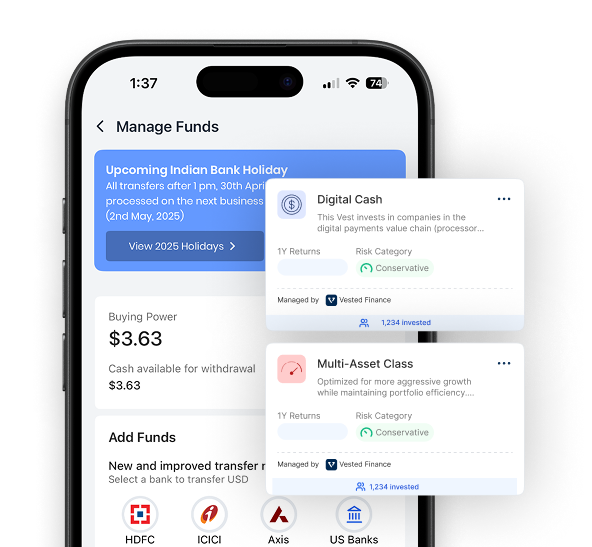
Managed Portfolios are essentially a pre-constructed basket of global stocks and ETFs built around a defined investment strategy or theme.
Instead of an investor selecting each security individually, a research team designs the portfolio. The team identifies the relevant companies or ETFs and determines the allocation across them.
When an investor allocates money to the portfolio, the underlying securities are purchased directly into the investor’s brokerage account in the same proportions as the portfolio structure.
This is different from a pooled investment product like a mutual fund.
You are not purchasing units of a fund. Instead, you own the actual underlying stocks and ETFs in your own account, just as you would if you had bought them individually.
The portfolio simply provides the structure and ongoing oversight for how those holdings are selected and maintained.
Bringing structure to global investing choices
In global markets, the opportunity set is extremely wide. While access has become easier over time, building a coherent portfolio within that opportunity set still requires structure.
Managed portfolios provide one way to approach this. They allow investors to access a range of strategies or themes while keeping the underlying securities in their own brokerage account.
In the next sections, we will look at how these portfolios are structured and how portfolio updates or changes are handled over time.
Comments
Login or register to join the conversation.