










LRS was introduced by the Reserve Bank of India in 2004.
At the time, the limit was modest. Indian residents were allowed to remit up to USD 25,000 per year. For that phase of the economy, this was considered sufficient.
But India was and is changing quickly.
More Indians were travelling abroad. Students were going overseas for education. Families were supporting relatives living in other countries. And gradually, individual investors also began looking at global markets.
As these needs grew, the RBI expanded the limits step by step.
| Month and Year | Yearly LRS limit (in US $) |
| Feb 2004 | $25,000 |
| Dec 2006 | $50,000 |
| May 2007 | $100,000 |
| Sep 2007 | $200,000 |
| Aug 2013 | $75,000 |
| Jun 2014 | $125,000 |
| May 2015 | $250,000 |
Source: Reserve Bank of India – LRS Guidelines and historical revisions
You can see that progression in the table above. The limit moved from USD 25,000 in 2004 to USD 50,000, then to USD 100,000, and eventually to USD 250,000 per financial year, where it stands today.
It means an individual Indian resident today can legally move up to USD 250,000 abroad every financial year for permitted purposes under the LRS framework.
And if we look at how this framework is actually being used, an interesting pattern appears.
For many years, most outward remittances under LRS were dominated by travel, education, and supporting family members abroad. Investment was only a small part of the total.
But over the past few years, that has started to change.
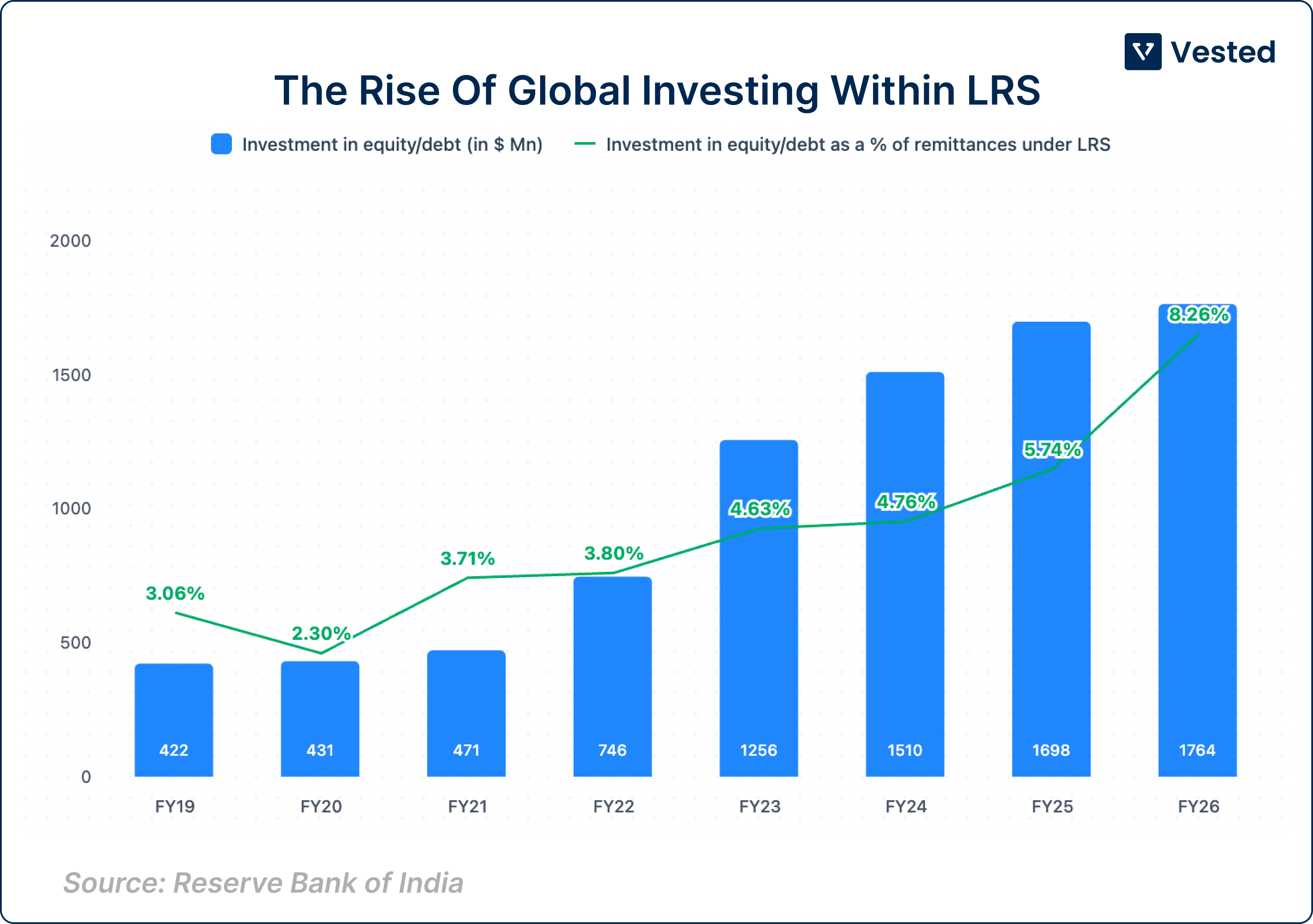
The chart below shows how overseas equity and debt investments by Indian residents have grown within the LRS framework.
In FY19, Indians invested roughly USD 422 million abroad in equity and debt through LRS. By FY26, that number had grown to about USD 1.76 billion.
The change is also in percentage share.
In FY19, investment accounted for about 3% of total remittances under LRS. By FY26, that share had risen to over 8%.
In other words, global investing is gradually becoming a more common use of this framework.
People still use LRS for travel, education, and other needs. But increasingly, it is also becoming the route through which Indian investors participate in global markets.
And that is exactly the part we will focus on next.
Comments
Login or register to join the conversation.