 Skip to content








One issue that investors sometimes encounter with India-listed international ETFs is that they may trade above their Net Asset Value (NAV).
The NAV represents the actual value of the underlying stocks held by the ETF.
For example, if an ETF holds a basket of global stocks worth ₹100 per unit, the ETF should ideally trade close to ₹100 on the stock exchange. However, in recent years, many international ETFs in India have traded at ₹105 or even ₹108.
In effect, investors are paying 5 to 8% more than the value of the underlying assets. In some cases, this premium is as high as 20%, too.
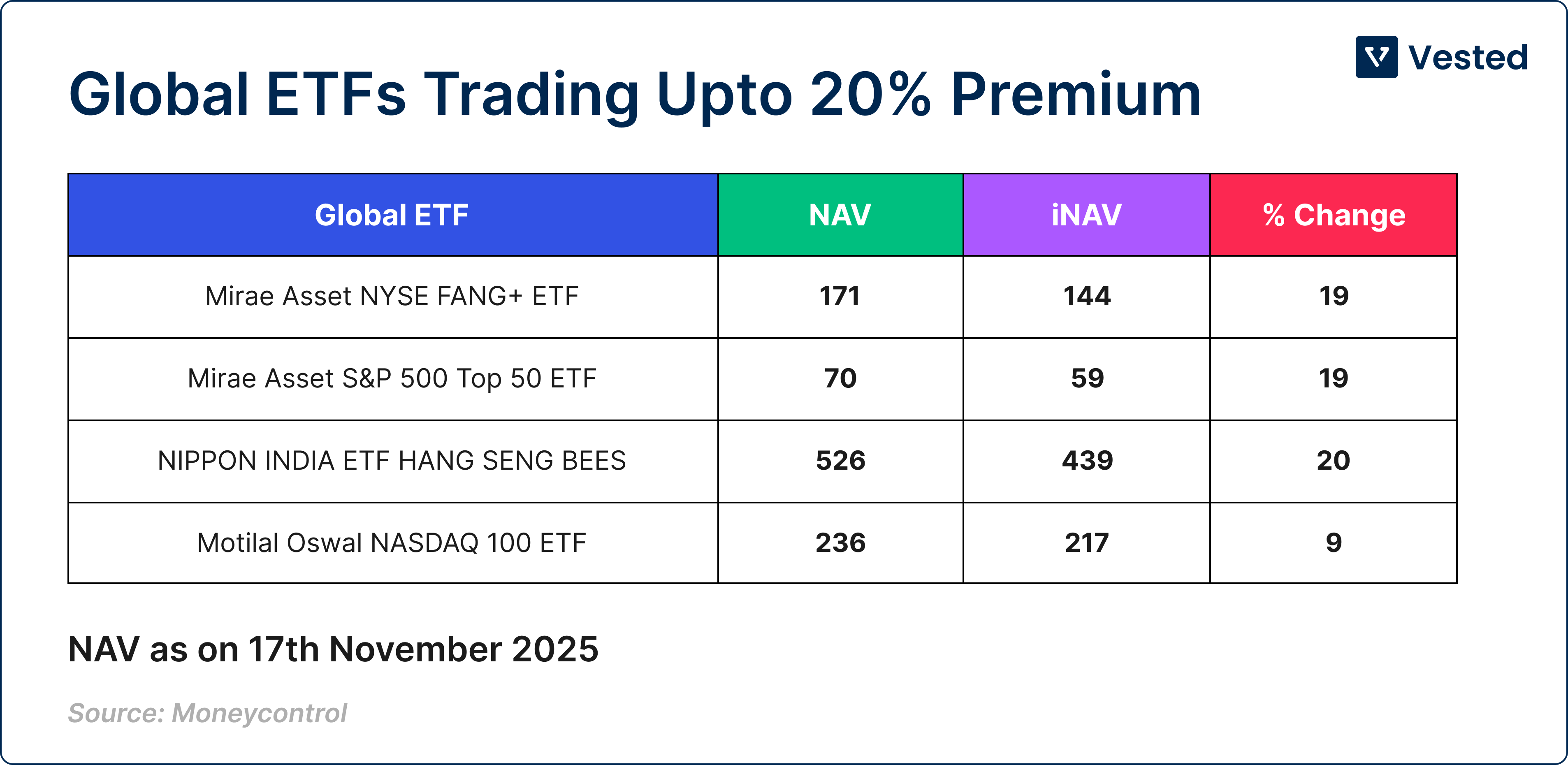
This situation is linked to the overseas investment cap we discussed earlier.
Under normal circumstances, ETFs have a built-in mechanism that keeps their market price close to the NAV. If the ETF price rises above the value of its underlying holdings, institutional investors can step in. They buy the underlying stocks, create new ETF units, and sell those units in the market. This increases supply and pushes the price back toward the NAV.
But this mechanism only works if new ETF units can be created.
Creating new units requires the fund house to invest additional money overseas. Because the SEBI overseas investment limit for the mutual fund industry is already fully utilised, fund houses are currently unable to expand their international holdings. As a result, they cannot create new ETF units.
In practical terms, the supply of ETF units becomes fixed.
At the same time, demand from investors has continued. Many investors want international exposure, and with several international mutual funds temporarily closed for fresh investments, some investors turn to ETFs instead.
When demand rises, but supply cannot increase, prices get pushed higher.
A simple example helps illustrate this.
Imagine there are 100 ETF units available, representing underlying stocks worth ₹10,000 in total. That means the true value is ₹100 per unit. If many more investors want to buy those units and no new units can be created, the market price might rise to ₹105 or ₹110.
If an investor buys at ₹110, they are effectively paying 10% more than the value of the underlying assets. The underlying stocks would need to rise by more than 10% just for the investment to break even.
Another point to remember is that this premium can disappear quickly.
If the overseas investment cap is increased and fund houses are once again able to create new ETF units, additional supply can enter the market. In that case, the ETF price may quickly move back toward the NAV. The underlying stocks may not have fallen, but the ETF price can adjust simply because the premium disappears.
This does not mean international ETFs should be avoided.
However, it is sensible to check the difference between the market price and NAV before investing. If the premium is small, say around 1 to 2% then it may not matter much.
But if it rises to 5% or more, that premium effectively becomes an extra cost you are taking on from the start. Essentially, it will eat into your returns.

Comments
Login or register to join the conversation.