










Let’s return to gold for a moment, because it helps make the currency discussion easy. We all relate to gold much better than anything else. 🙂
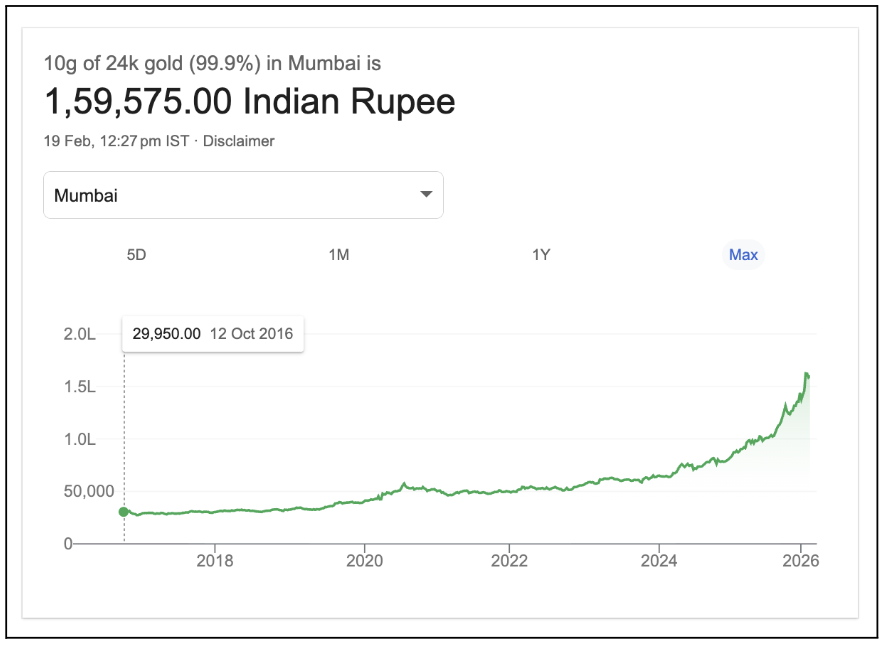
In 2016, the price of 10 grams of gold in India was roughly ₹30,000. Today, it is closer to ₹1.6 lakh.
Over ten years, that is more than a fivefold increase. In CAGR terms, that works out to around 20–21% annually, which by any standard looks impressive.
But if you look at gold in global terms, the picture is a bit different.
In 2016, gold was trading around $1,250 per ounce. Today, it is roughly in the $5,000 range. That is strong growth, but it is a fourfold increase. In annual return terms, gold delivered roughly 15%.
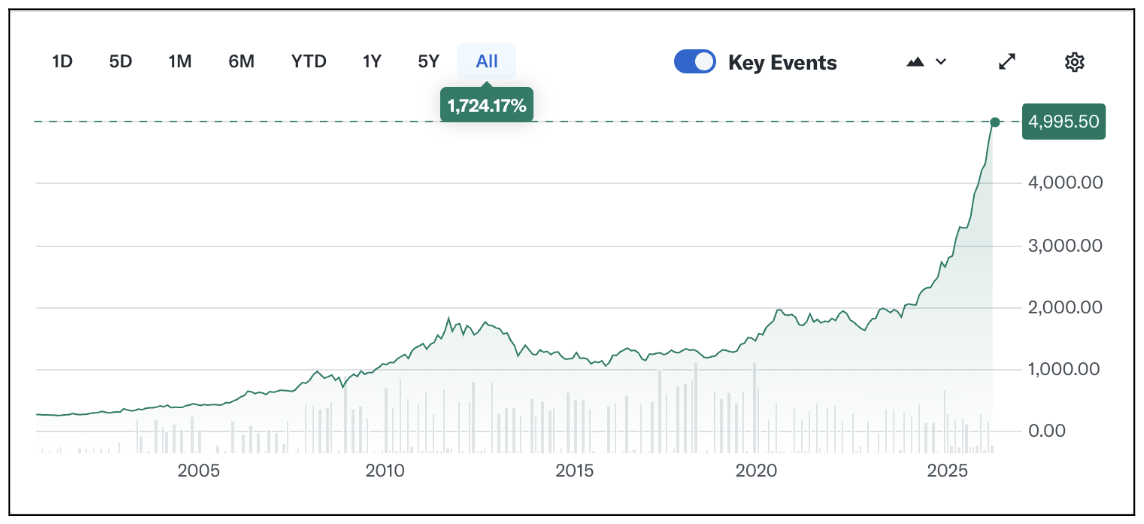
So Indian investors saw higher returns than investors who measured gold purely in dollars.
The reason for that difference is the exchange rate.
In 2016, one US dollar was worth around ₹66. Today (in Feb 2026), it is closer to ₹92. Over this period, the rupee has weakened against the dollar. When a currency weakens, assets priced in that stronger currency automatically become more expensive in local terms.
Gold is priced globally in dollars. The Indian price is simply the dollar price converted into rupees. So when the dollar price of gold rises and the rupee weakens at the same time, the rupee return becomes higher than the dollar return.
Part of what appears to be strong gold performance in India is therefore not just gold itself, but also the movement of the rupee.
This is important because the same logic applies to any global asset.
When you invest outside India, your return depends not only on how the asset performs but also on how the rupee moves against that currency. Currency is not a small rounding adjustment at the end. It directly affects the final number you see in your portfolio.
Gold simply makes this easier to see.
And once you understand this, the next step is to look at how the rupee has actually behaved over longer periods.

ss