










Now that we have seen how currency affected gold, it helps to look at the rupee itself over a longer stretch of time.
In 2010, one US dollar was roughly ₹45. By 2013, it had crossed ₹60. By 2020, it was above ₹75. Today (as of 2026), it moves somewhere between ₹90 and ₹92 depending on the month.
Chart: Value of 1 USD to INR from 2005 through 2026
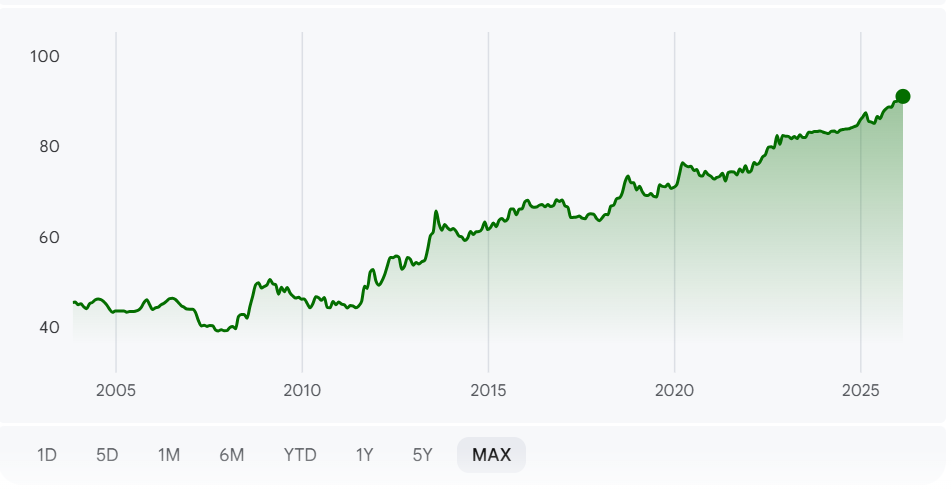
If you simply compare 2010 to now, the rupee has almost halved in value against the dollar over about fifteen years. Even if you focus only on the last decade, the move from the mid-60s to near ₹90 is roughly 35 to 40% depreciation.
The same scenario is against other currencies as well.
In 2015, the euro was around ₹73. Today it is above ₹100. The British pound was in the high ₹80s around 2016; now it is above ₹115.
Why does this happen?
Part of it comes down to inflation. If prices in India rise faster than in the US or Europe, over time the currency adjusts. Trade balances and capital flows. These are macro factors, essentially.
For an investor, the point is not to worry about where USD/INR will be next quarter.
The point is to recognise that over long periods, the rupee has gradually weakened against major global currencies.
That gradual movement does not feel like it when you look at one year at a time. But when you look at a decade, it changes how much your money is worth outside India.

Comments
Login or register to join the conversation.