










After seeing how one Indian fund benefited from global exposure, the next question is simple: Does this happen regularly?
The answer is yes.
If you look at country returns over a long period, you will see that leadership keeps changing. The country that performs best in one year is rarely the same country that performs best the next year.
For example, between 2010 and 2014, the US market delivered strong returns. The S&P 500 grew at roughly 13% per year in dollar terms. During the same period, Indian markets grew more slowly, around 4% per year in rupee terms. Both markets were positive, yet the difference in pace was noticeable.
Also, if you look at country-level data from 2015 to 2025, the ranking based on returns keeps changing. Japan is at the top in some years. The US leads in others. India has strong years as well, including 2021.
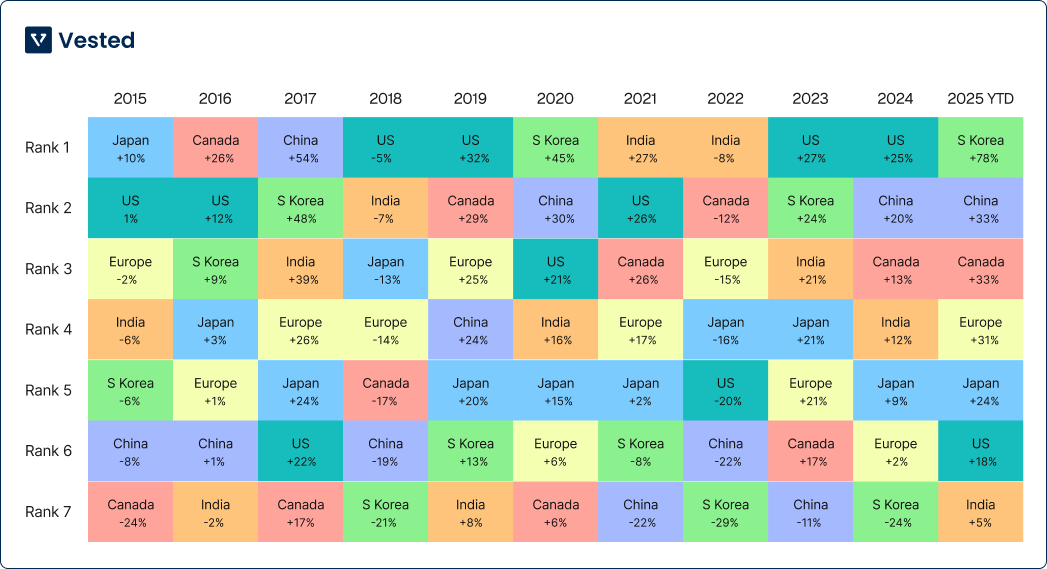
These differences definitely translate to returns.
If your portfolio is invested in only one country, your results will closely follow whatever phase that country happens to be in.
When you hold exposure to more than one country, your returns are not tied to just one story. Different parts of the portfolio respond to different economic conditions.
Over time, that reduces the chance that one country’s slow period dominates your entire portfolio’s returns.

Comments
Login or register to join the conversation.