










Once investors understand the cost structure involved in international transfers, the next question becomes more about: how does the money actually move abroad when you want to invest?
In practice, investors typically use one of three methods when sending money abroad.
Method 1: Direct transfer through your bank’s portal
The most common route is initiating the remittance directly through your bank’s net banking portal.
In this method, the investor fills out the outward remittance form inside the bank’s app or website. The form usually asks for a few standard details:
- Beneficiary name
- Beneficiary bank name and SWIFT code
- Account number or brokerage identifier
- The LRS purpose code for overseas investments
Vested actually simplifies this step by providing transfer instructions within the platform.
These instructions contain all the required beneficiary details. Investors simply download or view the instructions and copy the information into their bank’s remittance form.
Once the transfer request is submitted, the bank converts rupees into dollars and sends the funds through the international wire network.
In most cases, the funds reach the overseas brokerage account within one to three working days.
This route works with almost every bank and gives the investor full control over the transfer, but the process requires manually entering the remittance details each time.
Method 2: Platform–bank partnership transfers
Some investment platforms simplify this process by building direct integrations with specific banks.
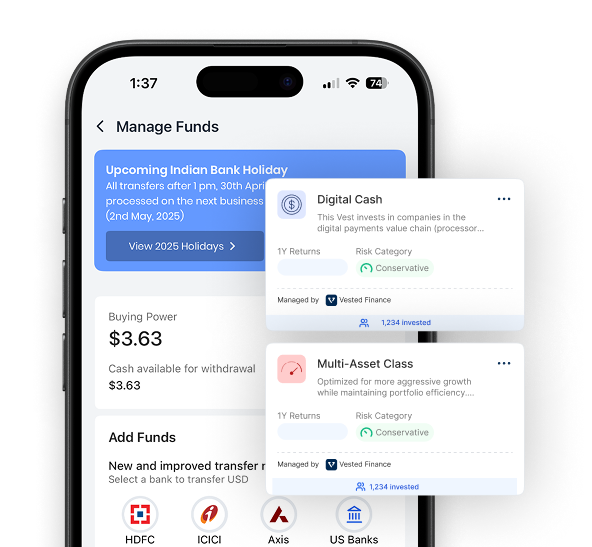
A good example of this is the Vested partner-bank transfer flow.
Vested has partnerships with HDFC Bank, Axis Bank, IDFC First Bank and ICICI Bank specifically for international investment transfers. When investors use this route, the transfer can be initiated through the Vested interface itself, which connects directly with the partner bank.
Compared to initiating a standard outward remittance independently, a few things change.
Zero fixed wire fee: normally, banks charge a flat outward remittance fee of around ₹750 to ₹1,500 per transfer plus GST. Under the partner-bank flow, this fixed fee is waived entirely. Since the fee itself does not apply, GST on that fee is also not charged.
More competitive FX rates: Banks publish a TT selling rate, which is the default retail exchange rate. Through its partnerships, Vested negotiates more competitive FX pricing, which can be better than the standard retail rate offered through normal remittance flows.
Real-time transfer tracking: The transfer journey can be tracked inside the Vested app, from the moment the bank processes the remittance to when the funds arrive in the brokerage account.
For investors using other banks such as Kotak Bank, SBI, or IndusInd Bank, the transfer instructions can still be downloaded from the Vested platform and submitted through the bank portal manually. The partner-bank benefits, however, apply specifically to HDFC, Axis, and ICICI.
Because several operational steps are automated, this route is often one of the simplest ways to initiate international transfers.
Method 3: Direct relationship with your bank
Some investors prefer to work directly with their bank’s foreign exchange desk or relationship manager.
This approach is more common among investors making larger transfers abroad.
Instead of accepting the default exchange rate shown in the bank’s portal, the investor may contact the relationship manager before initiating the transfer and request a custom FX quote.
Banks sometimes offer slightly better exchange rates through this route, particularly for larger remittances.
For example, an improvement of 10–30 paise per dollar can occasionally be negotiated on larger transactions.
While this method may help improve FX pricing slightly, it usually involves more coordination with the bank and is less automated than the other two routes.
Comparing the three deposit methods
Each transfer route has a slightly different balance of control, convenience, and cost.
| Method | How it works | Advantages | Limitations |
| Direct bank portal transfer | Investor downloads transfer instructions and initiates outward remittance through bank app or net banking | Works with most banks; investor retains full control of the transfer | Manual process; standard bank fees and FX rates apply |
| Platform–bank partnership transfer | Transfer initiated through investment platform integrated with partner banks | Simplified process; zero fixed wire fee; improved FX pricing; real-time transfer tracking | Typically available only for specific partner banks |
| Direct bank relationship (RM or FX desk) | Investor coordinates directly with bank relationship manager to execute the remittance | Potential to negotiate slightly better FX rates on larger transfers | Requires coordination with bank; less automated |
Comments
Login or register to join the conversation.