










You will often hear the US market described as deep and liquid.
It is worth taking a moment to understand what that actually means, because it is not just a technical detail. It affects you every time you place an order.
Liquidity, simply put, means how easily you can buy or sell something without the price moving against you because of your own transaction.
Think about what happens when you try to sell a house in a small town with only a few potential buyers. You might have to wait months or accept a lower price if you are in a hurry.
Now think about trying to buy or sell shares of Apple during US market hours.
There are buyers and sellers active at every moment, from individual investors in Mumbai to pension funds in London to hedge funds in New York.
The gap between what you can buy at and what you can sell at is often a fraction of a cent per share.
In 2025, average daily volume in US equities hit 17.6 billion shares, up 44.6% from 2024. Average daily notional value traded reached $1.1 trillion, also up 43% year on year.
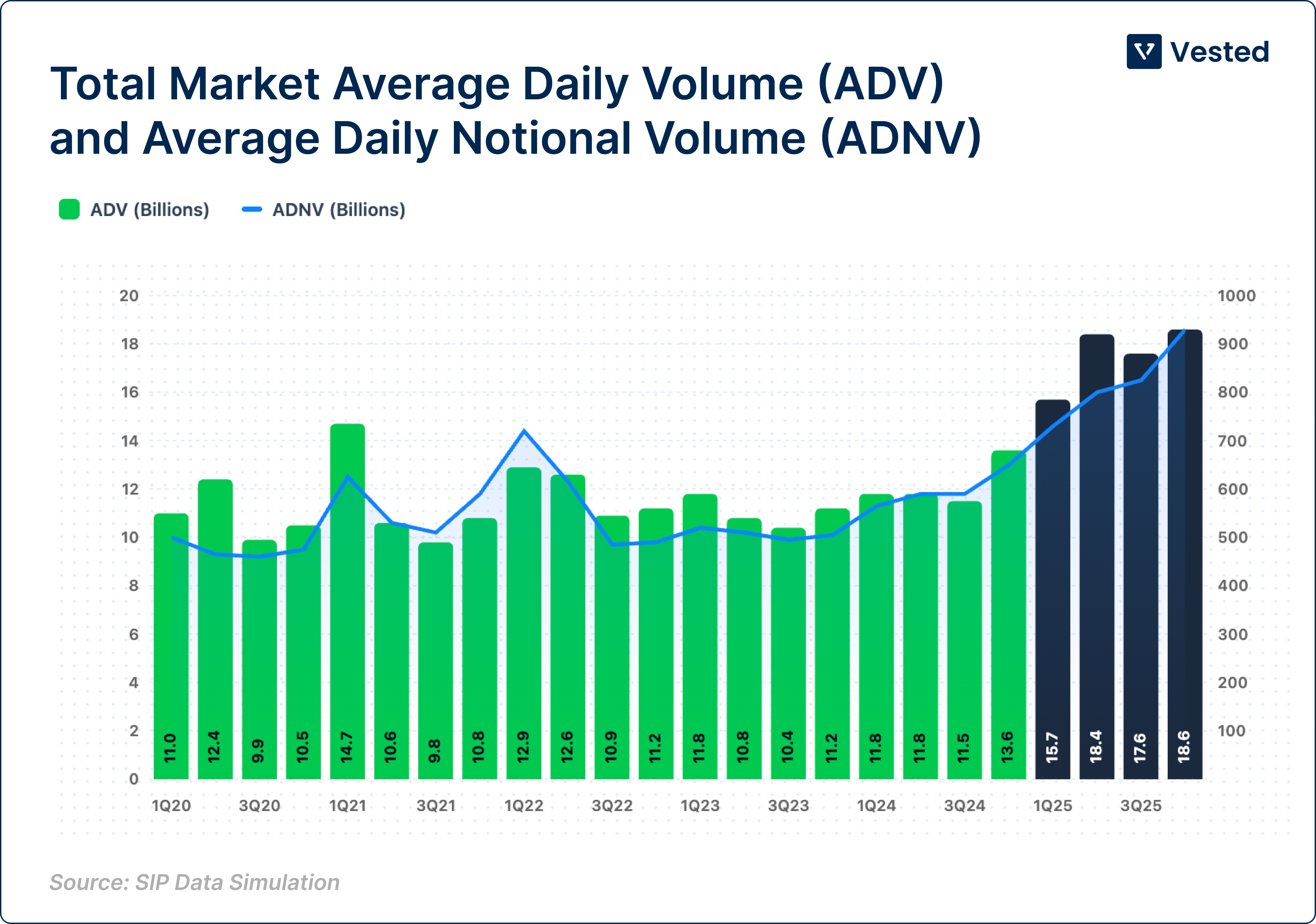
On April 9, 2025, the single day when President Trump announced a 90-day pause on the sweeping tariffs that had just gone into effect a week earlier, trading hit an all-time peak of $1.86 trillion in notional value and 30.98 billion shares.
That was the best single-gain day for the S&P 500 since October 2008. The market absorbed an extraordinary amount of activity without breaking. That is what deep liquidity looks like under stress.
Even outside of crisis moments, the growth in participation is striking.
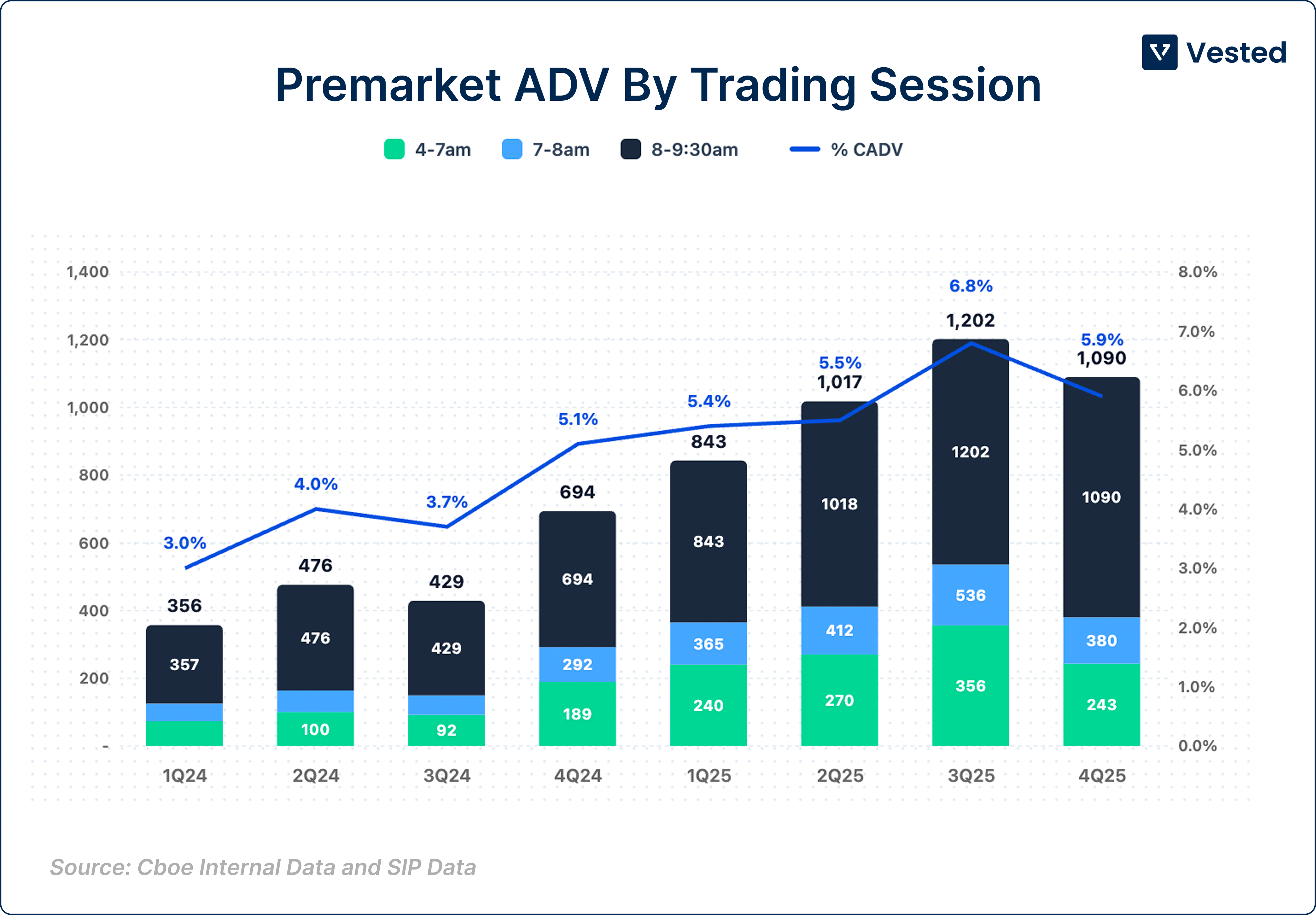
Pre-market trading, the session between 4 AM and 9:30 AM Eastern, more than doubled in 2025, growing 111% year on year to account for nearly 6% of total daily volume.
Retail investor trading on major exchanges rose 47% year on year. The US market is not just large. It is getting more actively used, by more kinds of participants, at more hours of the day, than ever before.
For comparison, the entire NSE handles roughly $10 to $15 billion on a typical day. The scale difference is not incremental. It is a different order of magnitude entirely.
But here is where the liquidity story gets more nuanced, and this nuance matters.
A 2024 study examining all companies above €250 million in market cap found that the average daily value traded in the US was 4.4 times higher than in Europe, $288 billion versus $65 billion.
At first glance, that sounds like an overwhelming advantage. But when you look at what is driving that gap, the picture changes.
Just 79 mega-capitalisation stocks in the US account for over 50% of all US equity turnover. Europe, by comparison, has only 20 mega-caps listed.
Strip those out, and the gap between the two markets narrows considerably. For an average large-cap stock, the daily traded value in the US is only 1.3 times higher than its European equivalent. For an average mid-cap stock, it is about 2 times higher.
Meaningful, but not the order-of-magnitude difference the headline suggests. Turnover velocity, which measures value traded as a proportion of market capitalisation, tells a similar story. European markets are more robustly liquid relative to their size than the raw volume numbers suggest.
What this means practically is straightforward. The US liquidity advantage is real, but it is concentrated.
It lives almost entirely in the largest names. And those largest names are exactly where most Indian investors will be putting their money when they access the US market through ETFs and index funds.
So for your purposes, the advantage is genuine and meaningful. But it is worth understanding that buying a broad US index fund is not the same as getting access to uniformly superior liquidity across thousands of companies. You are getting access to the most liquid companies in the most liquid market in the world, and that is a specific, concentrated thing.

Comments
Login or register to join the conversation.