










For most of stock market history, investing meant buying whole units of a company’s stock. If a share was priced at USD 1,000, you needed that full amount upfront to own even a small position. Anything less meant waiting until you had saved enough.
That is no longer the case.
Today, most platforms that offer US stock investing also offer fractional shares. Instead of entering a quantity, you invest a fixed dollar amount. The broker calculates what portion of a share that amount buys you at the current price, and that portion is credited to your account.
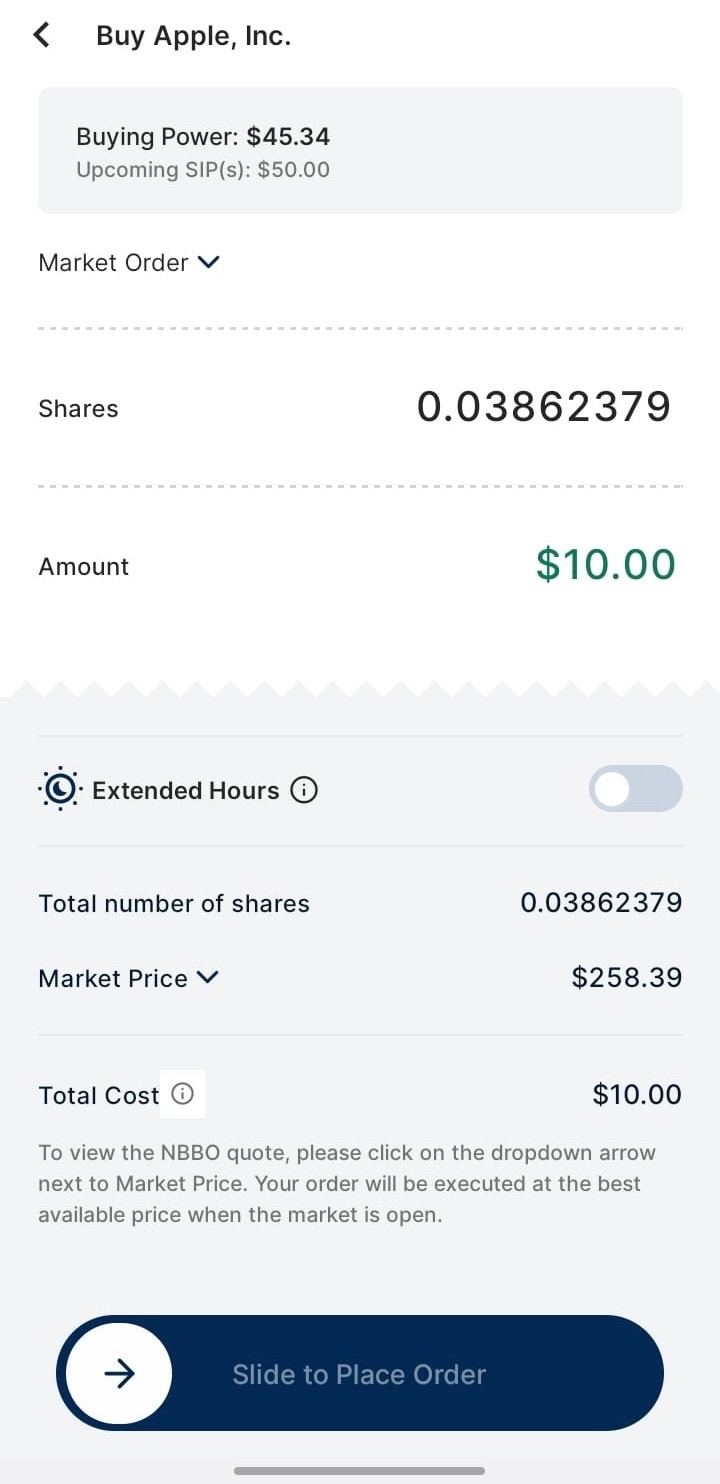
Say Apple is trading at USD 258.39 per share and you want to invest USD 10. Under the old model, this would be a dead end.
You cannot buy one full share of Apple for USD 10. With fractional investing, you simply enter USD 10 and hit buy. Your broker divides USD 10 by USD 258.39 and credits 0.0387 of a share to your account.
That 0.0387 moves with Apple’s price in exact proportion to your ownership. If Apple rises 10% to USD 284.23, your fractional position is now worth USD 11.
You made USD 1 on a USD 10 investment. The same 10% gain a full shareholder would see, just scaled to the size of your position. The maths is identical to owning a whole share. Only the size is different.
Fractional shares are not always created by an investor choosing to buy a partial position. They can also arise in other ways.
Many brokers offer dividend reinvestment plans, where cash dividends are automatically used to buy more of the same stock.
When the dividend amount is not enough to buy a full share, the reinvestment produces a fractional position. Stock splits with uneven ratios, such as a 3-for-2 split, can also create fractions.
If you held 5 shares before such a split, you would end up with 7.5 shares afterwards. Mergers and acquisitions can produce them too, because the share exchange ratios used in these transactions rarely result in perfectly whole numbers for every investor.
Beyond these situations, most modern brokers today also allow investors to purchase fractional shares directly.
This is how the majority of fractional investing works in practice. The fractions are not created on any exchange. They are tracked entirely within the broker’s own system.
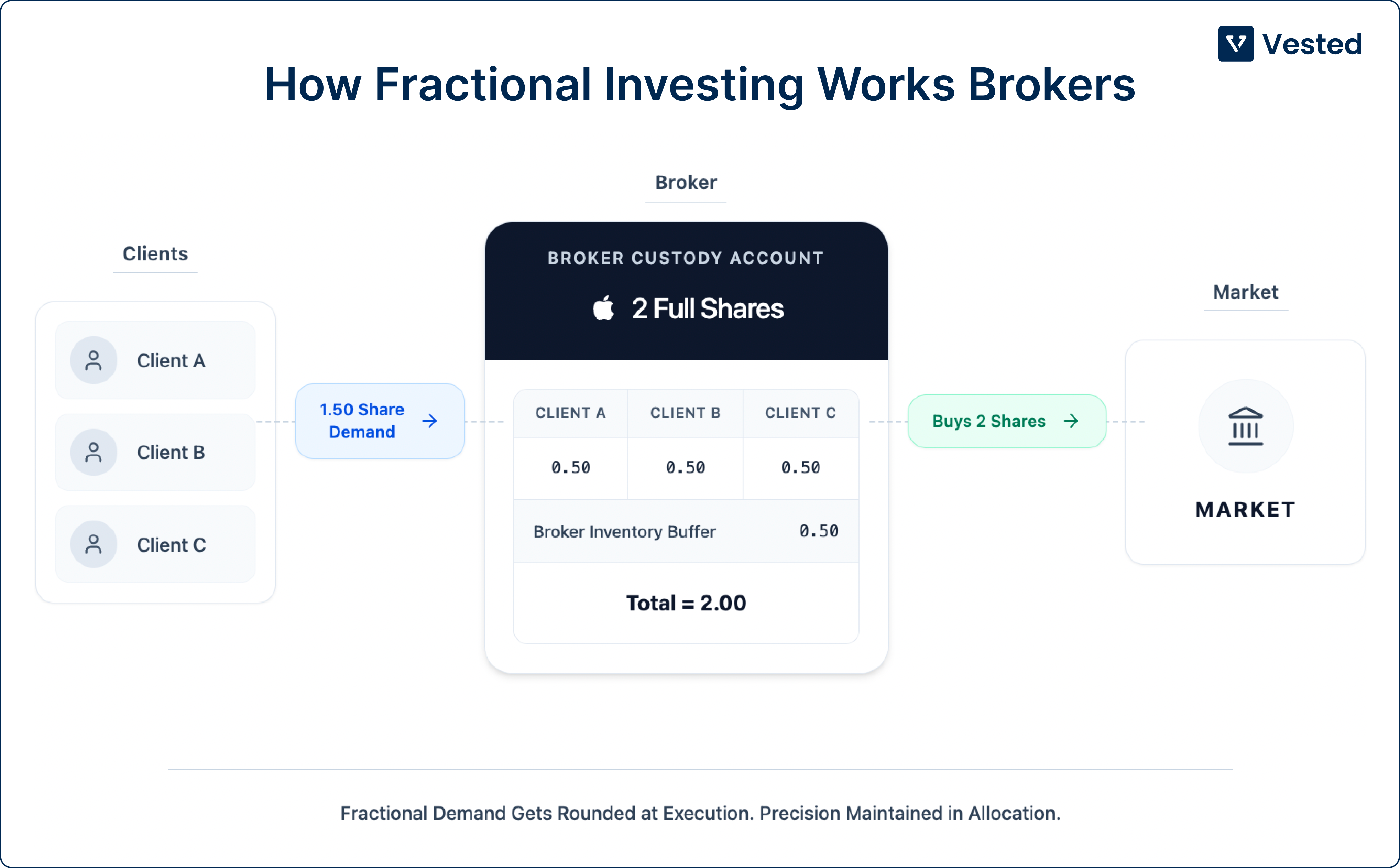
This is worth understanding because fractional orders do not travel through the market the same way a regular whole share order does.
When you submit a fractional order, your broker splits it into two parts. If your order results in one or more whole shares, that portion is routed to the open market and filled in the normal way. The fractional remainder is filled differently.
The broker acts as the counterparty to that portion directly, from its own inventory, rather than routing it to an exchange.
What your broker does behind the scenes is maintain a pool of whole shares on behalf of all fractional investors on the platform. Your fractional position is recorded in your account, but the underlying whole shares are held by the broker as the registered owner.
You have a proportional claim on those shares, but the fraction itself does not exist as a separately tradable unit on any exchange. It lives inside the broker’s books.
This has a practical consequence that is easy to overlook.
Because fractional shares are not listed on any exchange and are tracked internally by your broker, they cannot be transferred to another platform the way whole shares can.
If you ever switch brokers, your fractional positions will be sold first and the cash proceeds transferred. That sale is a taxable event, the same as any other sale.
Fractional investing also extends to ETFs, not just individual stocks.
Some of the most widely followed ETFs carry per-unit prices of several hundred dollars, making them difficult to access for investors starting with smaller amounts.
Fractional ETF investing works the same way. You invest a fixed amount and receive a proportional slice of the ETF unit, with the same exposure to its underlying holdings, including any dividends it distributes, scaled to your ownership percentage.
If the stock or ETF you hold pays a dividend, you receive a proportional share of it based on the size of your position.
If Apple pays USD 1 per share and you hold 0.0387 of a share, you receive USD 0.0387. The payout arrives as cash in your brokerage account. Some platforms allow you to automatically reinvest these dividends into additional fractional shares, compounding your position quietly over time.
Voting rights are handled differently across platforms.
When companies hold shareholder votes, rights typically attach to whole share ownership. Some brokers pass voting rights through to fractional holders and aggregate their votes.
Others do not extend voting rights to fractional positions at all. It is worth checking your platform’s policy if this matters to you.
The most practical effect of all of this is that the share price is no longer a constraint on how you build a portfolio.
With fractional investing, you invest by amount rather than by quantity. This makes it easier to spread a limited amount of capital across many different companies and sectors from the beginning, rather than concentrating it into one or two whole shares you could afford at the time.
It also makes strategies like dollar-cost averaging easier to implement consistently. You do not need to accumulate enough for a full share before investing.
Every transfer can be put to work immediately in whatever proportions you choose, without leaving cash sitting idle simply because it does not add up to one whole unit.
A few things are worth keeping in mind before you start.
When investing feels frictionless and amounts are small, it becomes easy to trade frequently without a clear plan.
Small impulsive trades add up, and decisions made in response to short-term price movements rather than a long-term strategy can quietly erode returns over time.
It is also worth noting that spreading money across many stocks does not automatically mean a portfolio is diversified. If all the companies you hold are in the same sector or the same geography, the portfolio is still exposed to concentrated risk regardless of how many holdings it contains.
Finally, fractional shares are not available for every stock on every platform. Most brokers focus on the availability of large, heavily traded stocks listed on major US exchanges. Less liquid stocks may not be eligible. It is worth checking within your app before assuming a stock can be purchased fractionally.
Comments
Login or register to join the conversation.