










By this point, one thing becomes clear.
Investing in global markets is fairly straightforward. Reporting the taxes can feel much less so.
Dividends come with US withholding tax. Capital gains have to be converted into rupees using specific exchange rates. Foreign tax credit requires Form 67. And your Indian tax return asks for additional disclosures like foreign assets and foreign source income.
And doing it manually across dozens of transactions during the year can possibly become tedious.
This is exactly the friction Vested tries to remove through its Tax Documents module.
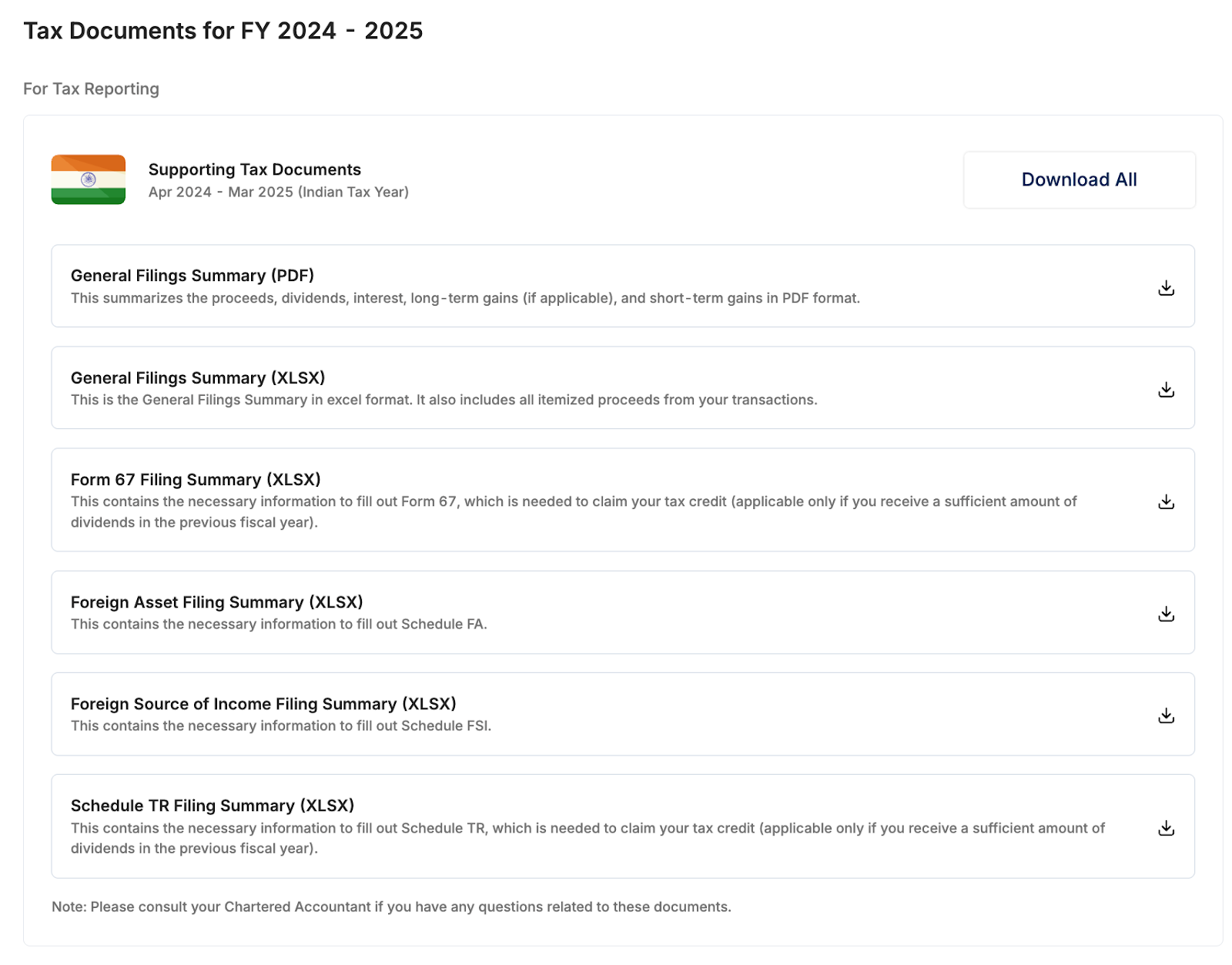
At the end of every financial year, the platform generates a set of reports that organise your entire year’s activity into formats aligned with Indian tax filing requirements.
Instead of reconstructing everything transaction by transaction, you can simply download the reports and use them while filing your return or share them directly with your chartered accountant.
Here is what each report does.
General Filings Summary
This is the starting point for most investors.
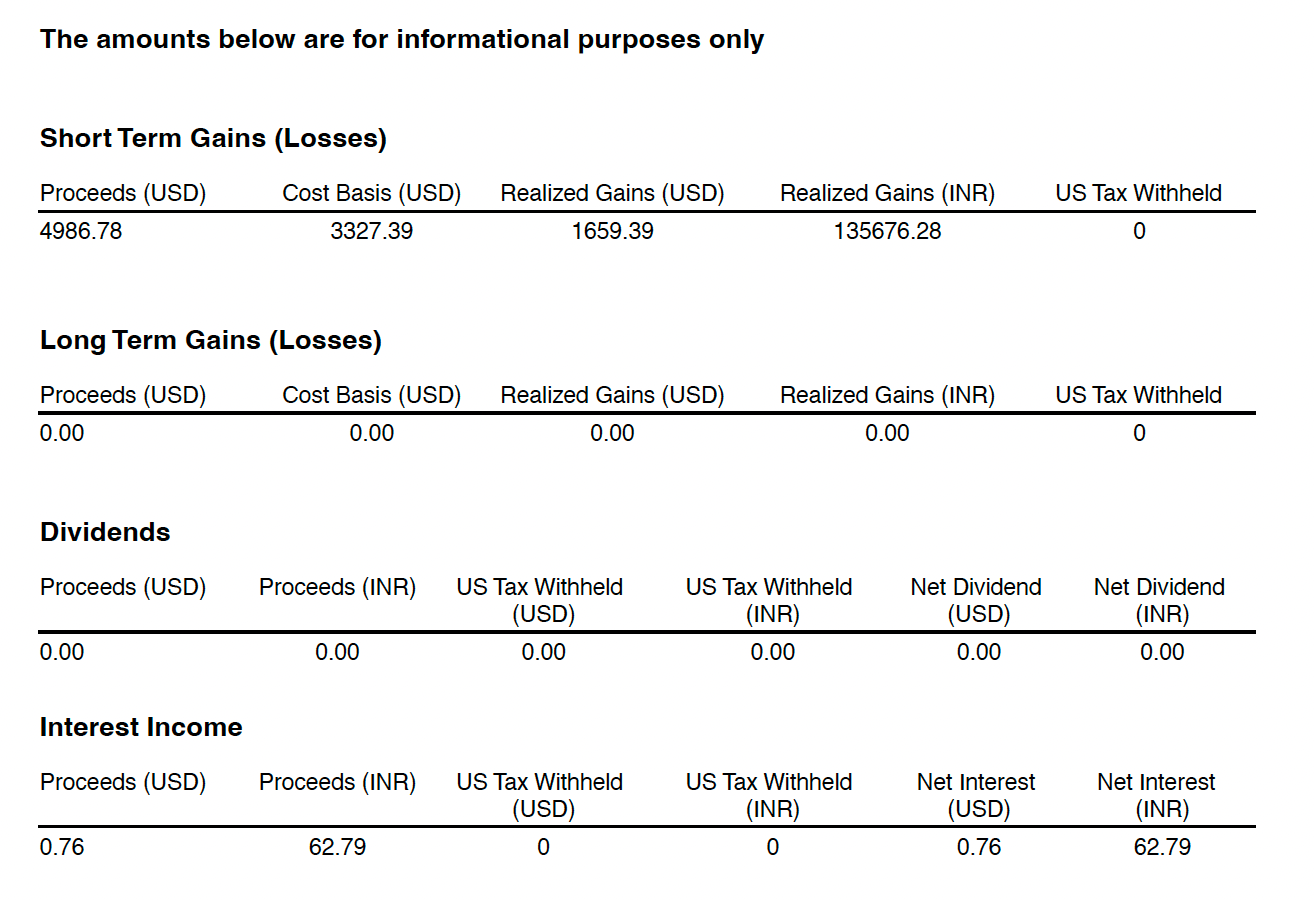
The report brings together the key numbers from your entire account in one place. It summarises:
- Total proceeds from stock sales
- Dividend income received during the year
- Interest earned, if any
- Short-term capital gains
- Long-term capital gains
Think of it as a high-level snapshot of your global investing activity for the year. It gives you the numbers that eventually flow into your income tax return without needing to go through every individual trade.
The report is available in both PDF and Excel format, depending on whether you want a quick overview or a detailed breakdown.
Form 67 Filing Summary
Earlier, we saw that dividends from US companies come with automatic withholding tax.
If a company declares $100 in dividends, the US keeps $25 and you receive $75 in your account. But India still taxes the full $100 as income. The way you avoid paying tax twice on the same income is by claiming a Foreign Tax Credit.
That credit is claimed through a filing called Form 67.
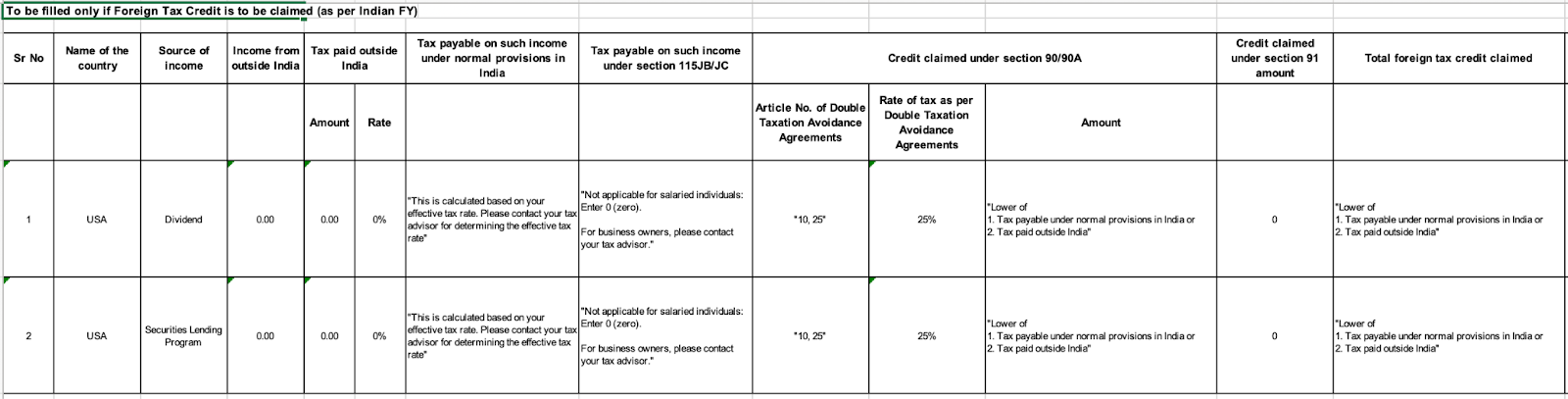
Form 67 is not a tax return by itself. It is a supporting disclosure submitted on the income tax portal before filing your ITR. It tells the Indian tax authorities how much tax was already paid in another country so that the same income is not taxed again in full.
But the form asks for fairly specific information.
For each source of foreign income, you need to report details such as:
- The country where the tax was paid
- The type of income (for most investors, this will be dividends)
- The total income earned from that country
- The tax already paid outside India
- The tax rate applied under the Double Taxation Avoidance Agreement (DTAA)
- The amount of foreign tax credit being claimed
The table above shows how this information is structured. Each row represents one category of foreign income and the taxes associated with it.
Now imagine assembling this yourself.
You would need to go through every dividend received during the year, identify how much tax was withheld in the US, calculate the total foreign income, and then determine the amount of credit that can be claimed in India.
This is where the Form 67 Filing Summary generated by Vested becomes useful.
Instead of extracting these details manually from brokerage statements, the report compiles the information required for the form in one place. It shows the relevant foreign income, the taxes already deducted abroad, and the information needed to calculate the credit under India’s tax rules.
In practice, this means that when you sit down to file your return, the numbers required for Form 67 are already organised and ready to use.
Foreign Asset Filing Summary (Schedule FA)
If you hold investments through an overseas brokerage account, Indian tax rules require you to disclose certain details about those holdings.
The goal is that the tax department wants visibility into assets that Indian residents hold abroad.
For someone investing in US stocks, this typically means reporting:
- The foreign brokerage account
- The country where the asset is located
- The companies whose shares you hold
- The value of those holdings during the year
The information requested is fairly detailed.
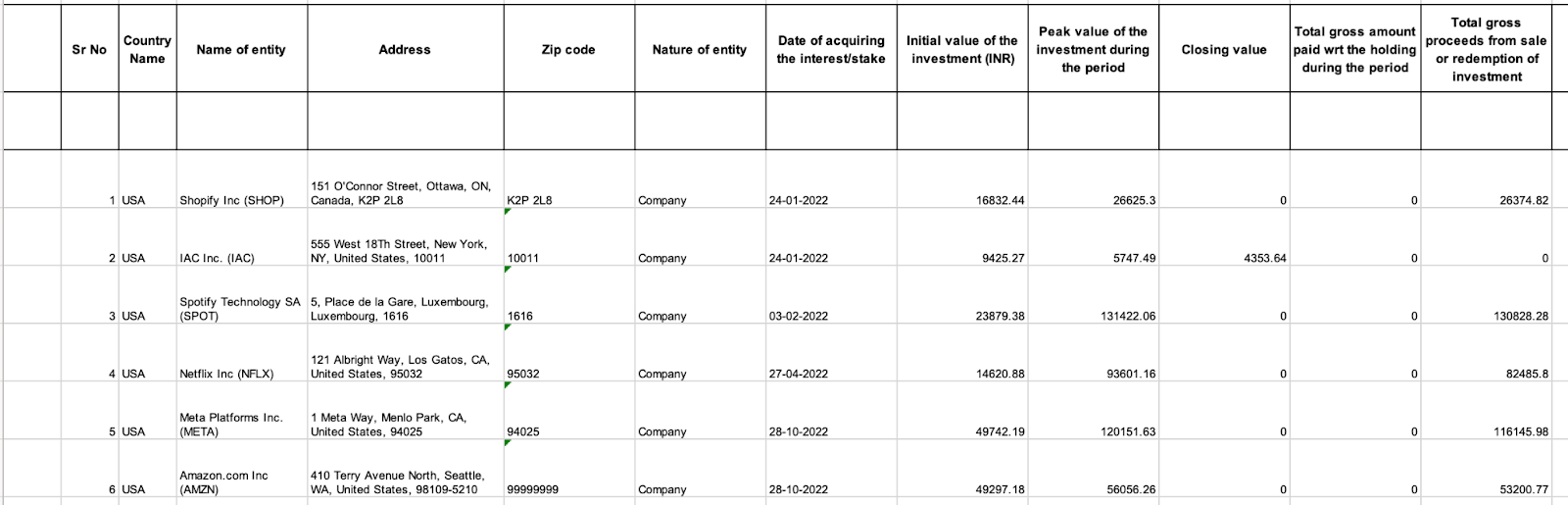
For each holding, the return asks for things like:
- Country name
- Name of the company
- Address of the company
- Date when the investment was acquired
- Initial investment value
- Peak value during the year
- Closing value at the end of the financial year
- Sale proceeds if the investment was sold during the year
A small snapshot of how this data looks is shown in the example below. Each row corresponds to one investment and captures the required information for reporting in Schedule FA.
Instead of calculating these numbers yourself, the report by Vested automatically compiles the information needed for Schedule FA. It lists each holding along with the relevant values and details so that the disclosure section of your tax return can be filled without reconstructing the data from scratch.
For most investors, this turns what could have been a fairly technical exercise into a straightforward reporting step.
Foreign Source of Income Summary (Schedule FSI)
When you file your income tax return in India, the return does not only ask about income earned within the country.
If you earn income from overseas investments, that income must also be disclosed. This is done through a section called Schedule FSI, which stands for Foreign Source Income.
Schedule FSI records two things:
- Income earned outside India, and
- Taxes already paid on that income in another country
For investors holding US stocks, this section typically captures:
- Dividends received from US companies
- Capital gains from selling foreign shares
The table above shows how this information is structured.
For each country where income was earned, the tax return asks for details such as the following:
- The country where the income originated
- Type of income (salary, house property, capital gains, or other sources)
- Total income earned outside India
- Tax already paid outside India
- Tax payable on that income in India
- Tax relief available under the Double Taxation Avoidance Agreement (DTAA)
This section works alongside Schedule TR and Form 67 (can be downloaded from the Tax Reporting Module by Vested), which together allow you to claim credit for taxes already paid abroad.
Schedule TR
Once foreign income has been reported on your tax return, the next step is claiming relief for the taxes that were already paid outside India.
This is done through Schedule TR, which stands for Tax Relief.
While Schedule FSI records the income earned outside India, Schedule TR records the credit you are claiming for taxes already paid on that income in another country.
The table above shows how this section is structured.
For each country where tax has been paid, the return requires information such as:
- The country where the tax was paid
- The tax identification number (TIN) or passport number
- The total tax paid outside India
- The tax relief available under the Double Taxation Avoidance Agreement (DTAA)
- The final credit being claimed in India
In most cases for investors holding US stocks, this section reflects the dividend withholding tax already deducted in the United States.
India and the United States have a Double Taxation Avoidance Agreement (DTAA). Because of this agreement, the tax already paid in the US can be adjusted against your Indian tax liability instead of being taxed twice.
Schedule TR essentially formalises that adjustment.
The Schedule TR Filing Summary generated by Vested provides the information required for this section in the same structure used in the income tax return. It compiles the relevant foreign tax details so that the tax relief can be reported correctly when filing your ITR.
Together with Form 67 and Schedule FSI, this section completes the process of ensuring that income from your global investments is reported properly while avoiding double taxation.

Comments
Login or register to join the conversation.