 Skip to content





SpaceX is about to file for the largest IPO in history.
You cannot buy SpaceX.
But two funds that own a slice of it just lost their minds on the stock exchange. One of them is trading at 28 times the value of everything it actually owns. And retail investors are still buying.
Here is what is actually going on.
On Wednesday, The Information reported that SpaceX is preparing to file its IPO prospectus with US regulators, targeting a raise of over $75 billion. Advisers involved in the process expect it to dwarf every IPO ever done. Saudi Aramco raised $29.4 billion in 2019. This would be more than double that. The company is being discussed at a valuation of $1.75 trillion.
You still cannot buy it. It is private. And that single fact set off one of the stranger chain reactions in recent market memory.
First, how these structures actually work.
In America, a closed-end fund is a publicly listed investment vehicle that raises a fixed pool of capital, buys assets, and then lists its shares on a stock exchange. Unlike a mutual fund, it does not issue new shares when someone wants in or cancel them when someone wants out. The number of shares is fixed.
So the price of the share on the exchange and the actual value of the underlying assets can diverge as far as buyers and sellers are willing to push it. The market price is determined by supply and demand. The NAV, or net asset value, is determined by what the fund actually owns.
In normal circumstances, closed-end funds trade at a small discount to NAV because of management fees and the illiquidity of the holdings. What is happening with VCX and DXYZ right now is the precise opposite of normal circumstances.
Meet the two funds at the centre of this.
DXYZ is the Destiny Tech100 fund. It has been around since 2022. Here is exactly what is inside it:
| Company | Allocation |
| SpaceX | 16.2% |
| Shield AI | 4.1% |
| Databricks | 4.0% |
| Beast Industries | 3.5% |
| xAI | 3.5% |
| Revolut | 2.9% |
| Skild.ai | 2.3% |
| OpenAI | 2.1% |
| Kraken | 1.5% |
| Monzo | 1.4% |
| Redwood Materials | 1.2% |
| Vast Space | 1.2% |
| Others + Cash | 47.3% |
SpaceX at 16.2% is the headline. But look at what else is in there. xAI, OpenAI, Databricks, Kraken, Revolut, Discord, Klarna, Boom Supersonic. An entire portfolio of companies that retail investors have read about for years and never been able to touch. Nearly half the fund sits in cash equivalents, which means the actual private company exposure is even more concentrated than the top line suggests.
When the SpaceX IPO report dropped, DXYZ jumped 15% in a single session and is now up nearly 20% over five days, closing at $30.58.
VCX is the Fundrise Innovation Fund. It went public on March 19. It was founded in 2022 with the mission of democratising access to top private tech companies. Before listing it had over 100,000 investors and $650 million in assets. Here is the full portfolio as of February 15, 2026:
| Company | Allocation |
| Anthropic | 20.7% |
| Databricks | 17.7% |
| OpenAI | 9.9% |
| Anduril | 6.9% |
| Ramp | 5.1% |
| SpaceX | 5.0% |
| Epic Games | 3.5% |
| Flock Safety | 3.0% |
| dbt / Fivetran | 2.8% |
| Vanta | 1.9% |
| Canva | 1.8% |
This is a concentrated bet on the AI supercycle. Anthropic at 20.7%, Databricks at 17.7%, OpenAI at 9.9%. Those three names alone make up nearly half the fund. Add Anduril, SpaceX, and Ramp and you have covered most of the portfolio. The rest is a long tail of enterprise software companies that most people outside Silicon Valley have never heard of but which have raised billions in private markets.
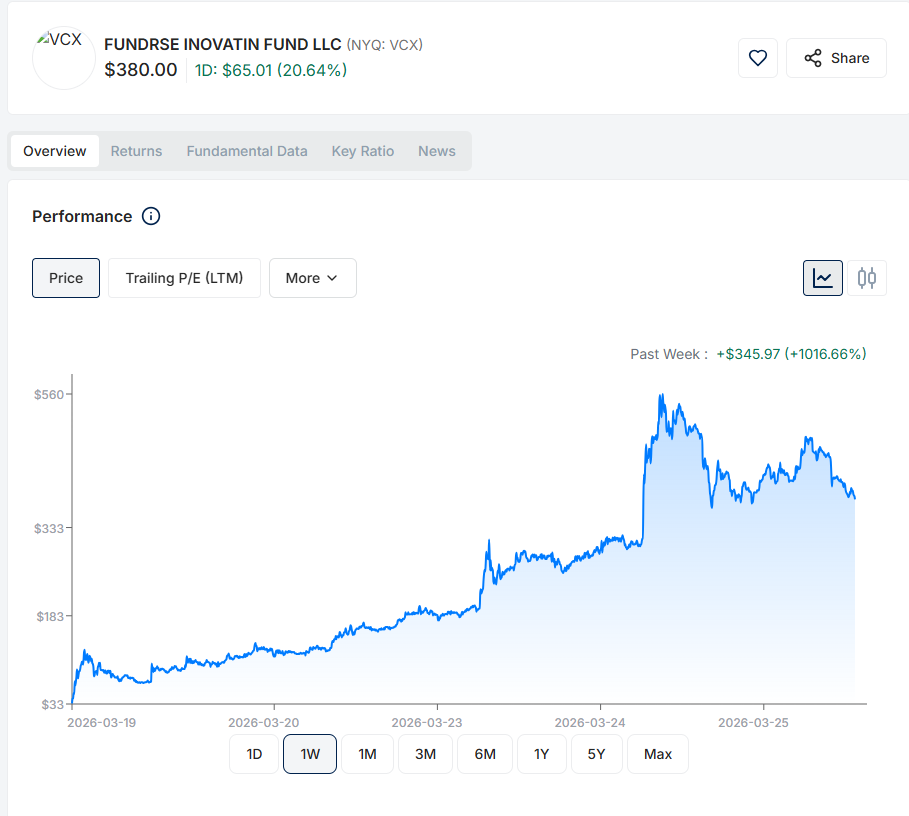
By Wednesday morning VCX was trading at $533. That is a 70% jump in a single day and a more than 1,500% increase since listing one week ago. The actual assets inside the fund are worth $18.26 per share.
Investors are paying $533 for $18 of assets. That is not a typo. That is a 28 times premium over the actual value of everything the fund owns.
And here is where it gets personal for Indian investors.
If you invest through Vested, you may have already seen SpaceX on the platform. Vested offered SpaceX access through private market instruments at a valuation of around $380 billion.
SpaceX is now being discussed at $1.75 trillion for its IPO.
That is more than four times the valuation at which private market access was available. The people who got in at $380 billion are sitting on paper gains that the public market is about to price out. And the people who missed those private market windows are now buying closed-end fund shares at 28 times NAV just to feel like they are in the room.
This is the dynamic that nobody is talking about clearly. Private market access, when you can get it at the right valuation and the right time, is genuinely one of the most valuable things in investing. The frustration of missing it is what is producing irrational prices in public markets today.
Why retail investors are piling in regardless.
Companies are staying private for longer than ever. SpaceX has been private for 23 years. Anthropic was founded in 2021 and is already valued at tens of billions without a single day of public trading. OpenAI is approaching a $1 trillion implied valuation entirely in private markets.
Retail investors have watched from the outside as the best returns were captured entirely before a listing ever happened. By the time these companies arrive on a public exchange, the hundred-to-one gains are already gone. The public gets the mature version, priced for perfection, with all the early risk already rewarded to someone else.
VCX and DXYZ offered something different. A listed vehicle. Something buyable through any brokerage account on a Tuesday afternoon without being an accredited investor or knowing someone at a venture firm.
And then SpaceX IPO news broke and every investor who had been waiting for a way in rushed the only doors currently open.
Trading in VCX was paused multiple times due to volatility. The float is artificially thin because shares purchased prior to February 20 are subject to a six-month lockup. When you combine a tiny tradeable float with enormous buyer demand, prices stop reflecting value and start reflecting desperation.
The broader space sector moved too. Rocket Lab and AST SpaceMobile jumped around 10%. Firefly Aerospace climbed 16%. York Space rose 5%. The entire ecosystem caught the SpaceX updraft in a single afternoon.
The SpaceX story underneath all of this is real.
Founded in 2002, SpaceX conducts more launches annually than any other firm globally. Its reusable Falcon 9 rockets changed the economics of getting things into orbit. Its Starlink satellite network, with over 9,500 satellites in orbit, is the company’s primary cash generator and dominant player in space-based broadband.
SpaceX recently acquired Elon Musk’s xAI in a deal valuing the combined company at $1.25 trillion. The vision being sold to IPO investors is not just a rocket company. It is a platform spanning rockets, satellite internet, artificial intelligence, and eventually data centres in space, a concept gaining real traction as terrestrial energy costs for AI computing become a growing constraint.
The report noted that allocation for individual investors in the SpaceX IPO could exceed 20%, though the final structure has yet to be determined. That detail signals that SpaceX and its bankers are aware of exactly the retail appetite that is currently lifting VCX and DXYZ, and may be thinking about how to channel it directly into the IPO rather than letting it pile into proxy vehicles.
The irony sitting at the centre of all of this.
VCX and DXYZ command enormous premiums because they offer something scarce. Access to private companies. That scarcity is the entire product.
The moment SpaceX goes public, the scarcity evaporates for SpaceX specifically. Anyone can buy it directly on any brokerage. The premium DXYZ commands for holding a 16.2% SpaceX position disappears because the direct version is now freely available. The same logic applies to Anthropic, OpenAI, and Databricks as and when they list.
VCX’s portfolio makes this particularly sharp. Anthropic, OpenAI, and Databricks together are nearly 48% of the fund. Those three companies going public removes the scarcity argument for almost half of everything VCX owns.
DXYZ has already lived this cycle once. In April 2024 shares soared over 1,000% on listing. Gave back the gains shortly after. Rebounded 600% in late 2024. Declined more than 50% from that peak. Today it trades at $30.58, still around 50% above its NAV, which looks almost modest compared to VCX’s 28x premium right now.
VCX is one week old. It has already done 1,500%.
What is actually worth watching.
The SpaceX prospectus, when it comes, will be the first time the world sees the company’s real financials in public. Revenue breakdown, margins, the cash burn from xAI, all of it laid bare. That filing will either confirm a $1.75 trillion valuation or raise serious questions about it. Everything before that is narrative dressed up as analysis.
Whether VCX’s lockup expiry triggers a selling wave. Millions of shares currently cannot trade. When they can, supply expands dramatically and the dynamic holding up $533 faces its first real test.
Whether the IPO pipeline delivers on schedule. Anthropic, Databricks, and OpenAI are expected to go public this year. If listings are delayed or public markets price these companies below private round valuations, the 28x multiple becomes very difficult to defend.
The hunger driving all of this is real and understandable. Private market access at $380 billion when the public market is now talking $1.75 trillion is a vivid illustration of exactly what being locked out costs. That gap is real money. That frustration is legitimate.
But closed-end fund premiums in the United States have a long and consistent history. They rise fast and compress faster. The story is real. The companies are real. The IPO pipeline is real.
The price being paid to access it right now is something else entirely.
