



Introduction: The Companies You Couldn’t Buy
Think about SpaceX, valued at over $350 billion, profitable and dominant in commercial space. Never listed on any exchange. You cannot buy it on any brokerage in the world.
Think about Stripe, which processes hundreds of billions of dollars in transactions globally. Or Databricks, the data and AI platform used by thousands of enterprises. Or Anthropic, one of the most important AI companies in the world right now. None of these are listed. None are accessible through a typical brokerage account, including the US stock platforms Indian investors use today.
This is private markets: the universe of high-growth, high-quality global companies that have chosen to remain private, often for a decade or more, while they scale into some of the most valuable businesses on the planet.
Vested gives eligible Indian investors access to this universe, not Indian startups, not domestic pre-IPO companies, but global companies, primarily US-based, that are not listed on any exchange anywhere in the world.
Understanding Private Markets
Why Are the Best Companies Staying Private So Long?
For most of the 20th century, going public was a necessary milestone. Companies needed exchange listings to raise capital and give early investors an exit. The typical US company went public at 5 to 6 years of age.
That playbook has been torn up. Research on 147 private companies that went public between 2011 and 2021 found the mean age at IPO had increased to 12 years by 2021 — companies are taking more than twice as long to list as they did two decades ago.
The influx of capital into private markets has given companies far greater flexibility to stay private longer, in some cases indefinitely. This trend, coupled with uncertainty in public markets, has led more companies to delay IPO plans and reallocate resources toward continued innovation, growth, and business optimisation.
The consequence for investors is structural and significant. The enormous value creation phase that used to happen after listing is now happening before it. Airbnb, Uber, and DoorDash all went public after their most explosive growth years were already behind them. The investors who made life-changing returns were private market investors who got in years earlier — not retail investors who bought shares on listing day.
How Big Is This Market?
Private markets are no longer a niche corner of finance. Assets under management totalled approximately $15 trillion in 2024, up from $11.87 trillion in 2023, and are projected to exceed $18 trillion by 2027.
Investment levels are rising across nearly all major segments — from private equity and venture capital to infrastructure and natural resources. Private equity alone saw a resurgence in 2024, with deal count rising 12% and deal value climbing 22% to $1.75 trillion.
The largest institutions in the world — pension funds, sovereign wealth funds, university endowments — treat private markets as a core allocation. The asset class has a 20-plus year track record of resilience and inflation protection, and now offers investors access to the next wave of growth.
The Case for Indian Investors
The Opportunity Gap Is Real
Indian investors who have ventured beyond domestic markets typically buy listed US stocks through LRS-based platforms. That gives you Apple, Nvidia, Microsoft — good companies, all of them — but still public market exposure, still priced by millions of participants every second, still moving with macro sentiment and Fed statements.
Direct IPO allocation is nearly impossible for Indian retail investors. US IPOs allocate shares to American institutional and retail investors first. When companies like Reddit, CoreWeave, or Figma listed, Indian investors were spectators — they could only buy after trading began, often after large first-day pops had already occurred.
Private markets flip this dynamic entirely. Instead of watching from the sidelines as Stripe or Databricks prepares for an eventual IPO, you invest during the private phase. If and when the listing or acquisition happens, you benefit from the value created during those private years — not from the moment a ticker appears on an exchange.
Three Reasons to Invest in Private Markets
- Access growth before it is priced in When Stripe eventually lists, its valuation will immediately reflect everything the market knows — revenue, growth rate, margins, competitive moat. That information gets priced in within hours. Private market investors who invested years earlier did so when that information was incomplete and valuations reflected genuine uncertainty. Higher risk, but meaningfully higher potential upside. The 50x or 100x returns in iconic companies were almost entirely earned before the IPO bell rang.
- Genuine diversification Most portfolios — whether Indian equities or US stocks — move together during macro events. Fed rate decisions, geopolitical shocks, and risk-off selloffs hit public markets simultaneously. Private market investments are valued based on business fundamentals at periodic intervals, not on daily sentiment. A company’s private valuation does not fall because Jerome Powell gave a hawkish speech or because Nifty corrected 5% last week. This is real diversification, not just owning more tickers in more countries.
- Exposure to the sectors defining the next decade Nearly half of surveyed institutional investors say technology and healthcare offer the greatest private market opportunities in 2025. The most consequential companies in AI infrastructure, enterprise software, defence technology, and fintech are predominantly private. If you only invest in public markets, you are structurally excluded from the companies most likely to matter most in ten years.
The Risks You Must Understand
Private markets offer genuine opportunity — but they come with risks that are fundamentally different from public market investing. These must be understood clearly before committing capital.
Liquidity is the defining constraint. There is no exchange. You cannot sell tomorrow or next month. Your capital is committed until a liquidity event occurs — whether an IPO, acquisition, or secondary transaction. The typical company in a private equity portfolio is held for more than six and a half years on average. If there is any chance you will need this money within three to four years, private markets are not appropriate for you.
Valuations can move against you. A company with a high private valuation can raise its next funding round at a lower price, miss growth expectations, or fail entirely. Capital loss is a genuine possibility. Unlike a public stock, you will not see the price falling each day — but the economic reality can still be negative.
Company-level outcomes vary enormously. The asset class has historically produced strong aggregate returns, but individual deals are a different story. The quality of the company, the entry valuation, the sector timing, and when a liquidity event happens all determine your actual outcome. Investing in private markets does not automatically produce strong returns.
How Vested Makes It Accessible
The SPV Structure Explained
When you invest in a private company through Vested, your investment is structured through a Special Purpose Vehicle, or SPV.
An SPV is a legal entity created specifically to pool investments from multiple investors into a single structure. Instead of every individual investor appearing directly on the private company’s cap table, all investors participate through the SPV, which then makes a single investment into the company.
Here is the practical logic: Stripe does not want hundreds of individual Indian investors appearing on its shareholder register — that creates significant administrative complexity. So one SPV is created. Every investor puts money into the SPV. The SPV makes a single investment into Stripe, which sees only one entity on its cap table, while investors hold proportional ownership in that SPV.
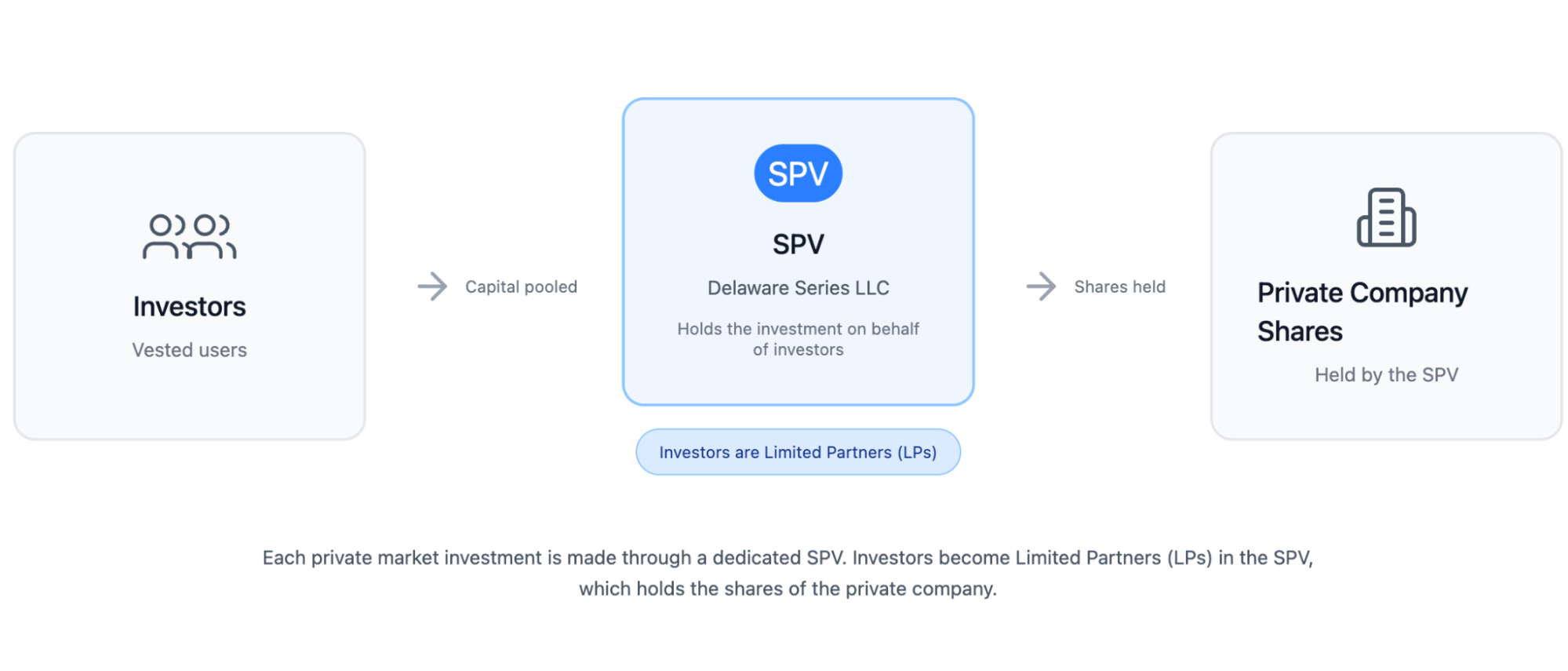
Each SPV on Vested is structured as a Delaware Series LLC — a well-established US legal structure familiar to companies, lawyers, and regulators globally. You become a Limited Partner in the SPV. Vested or its partner entity acts as the General Partner. As a Limited Partner, you are a passive investor: you provide capital and receive returns; you do not participate in day-to-day decisions.
Importantly, SPVs are designed to be bankruptcy-remote. The shares held by the SPV are legally ring-fenced from Vested as a business. If something were to happen to Vested, the underlying assets remain protected.
The Investment Process
Step 1 — Explore Opportunities Browse available deals under the Private Markets section on the Vested app or web platform. Each opportunity includes a company overview, deal details and pricing, minimum investment amount, and key terms and disclosures.
Step 2 — Submit an Indication of Interest (IOI) If you’re interested in an upcoming deal, submit an IOI by clicking Express Interest. IOIs are non-binding and no funds are blocked — they simply help gauge overall investor interest. Once sufficient interest is gathered, the deal moves forward, typically within 2 to 4 weeks.
Step 3 — Invest When the Deal Goes Live You’ll receive a notification when the deal opens. Click Invest, confirm the amount, and sign documents digitally in-app. The investment amount is
deducted from your Vested buying power, or automatically once funds are credited if still in transit.
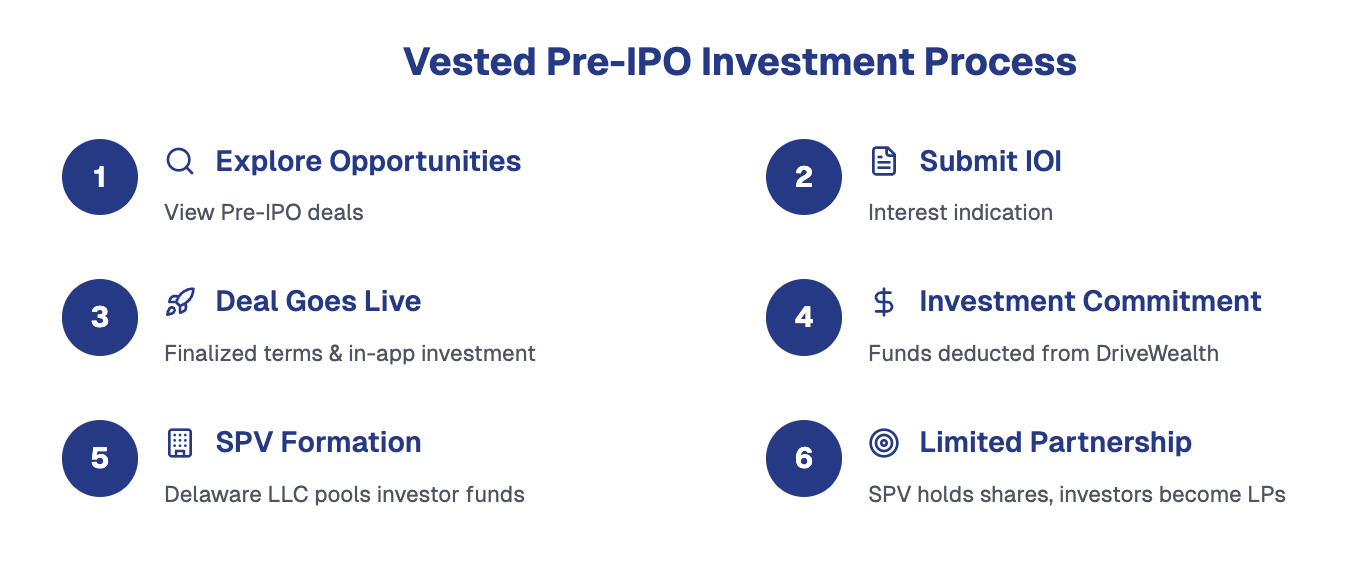
Step 4 — SPV Formation and Unit Allocation After the deal closes, the SPV is formed and you become a Limited Partner. Units are typically allocated within approximately two weeks of the deal closing.
Step 5 — Track Your Investment View your investment, signed documents, and ownership details anytime under the Private Markets section of the app.
Key Terms and Conditions
Eligibility
Private market opportunities on Vested are available to users who are fully onboarded, have completed KYC, and have sufficient buying power. The minimum investment per opportunity starts from $5,000.
Timelines
| Stage | Timeline |
| IOI submission | Anytime on the Vested app |
| Deal goes live | 2 to 4 weeks after sufficient interest |
| Investment window | 2 to 3 weeks |
| Unit allocation | ~2 weeks after deal closes |
Fees
- A one-time management fee is charged per deal
- Fees vary based on deal structure
- No ongoing management fees or performance fees (carry) at the SPV level
- All fees are clearly disclosed on the deal page before you invest
How You Get Your Money Back
There are three realistic exit paths:
IPO — If the company lists on a public exchange, the SPV’s shareholding converts into publicly listed shares. Subject to applicable lock-up periods, those shares can be transferred to your Vested account to hold or sell like any other US stock.
Acquisition — If the company is acquired, the SPV receives the consideration — cash or shares in the acquiring entity — and distributes proceeds proportionally to investors.
Secondary transaction — After an initial holding period, Vested may facilitate opportunities to sell SPV units to other buyers. This is not guaranteed and depends on buyer demand at the time.
None of these exits are on a fixed timeline. You are investing alongside the company’s journey, and the timeline is the company’s, not yours.
Tax Treatment for Indian Investors
- Conversion of SPV units into underlying shares is treated as a taxable event
- Any gain at this stage is taxable
- Your cost basis resets after conversion
- Future gains or losses are calculated from the new cost basis
- Long-term capital gains apply after 24 months at 12.5%
- Short-term gains are taxed as per your income tax slab
Conclusion: A Structural Shift Worth Taking Seriously
The shift of value creation from public to private markets is not a temporary trend — it is a structural change in how the world’s most ambitious companies choose to grow. The best companies are staying private longer, raising more capital privately, and reaching massive scale before they ever consider a public listing.
For Indian investors, this creates both a gap and an opportunity. The gap: if you only invest in public markets, you are accessing companies after their most explosive growth has already occurred. The opportunity: for the first time, eligible individual investors in India can participate in the private phase of globally significant companies — the phase where the most meaningful value is created.