




There’s a paradox at the heart of Apple’s latest earnings.
The company just posted its best March quarter in history. Revenue hit $111.2 billion, up 17% from a year ago. EPS came in at $2.01. Gross margins reached 49.3%. Every single segment beat analyst estimates except one: iPhone. And yet, the stock rose 4% after hours.
Something interesting is going on here. Let’s unpack it.
The Quarter That Almost Wasn’t
Apple’s March quarter should not have been this good. The company was fighting supply constraints on iPhones because the advanced chips powering the iPhone 17 family are manufactured on the same TSMC nodes that AI companies are fighting over. When Nvidia, Google, and Microsoft are all competing for the same chip supply, Apple gets caught in the crossfire.
CEO Tim Cook put it plainly: “The demand was off the charts. There’s just a little less flexibility in the supply chain at the moment for getting more parts.”
Despite this, iPhone revenue still grew 22% year over year, reaching nearly $57 billion. That number missed the $57.21 billion estimate by a whisker.
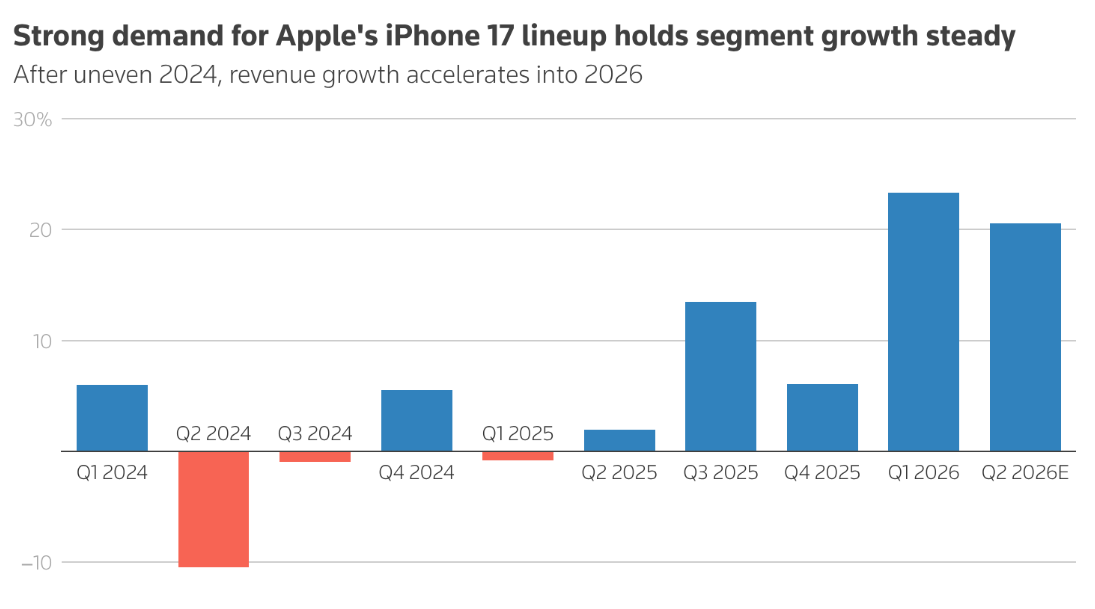
But here is the thing: Apple was supply constrained, not demand constrained. That is a fundamentally different problem. One you can fix.
The Number Nobody Was Talking About
While everyone watched the iPhone, Mac quietly stole the show.
Mac revenue came in at $8.4 billion, beating estimates of $8.02 billion. The driver was the MacBook Neo, Apple’s new $599 laptop aimed at students and budget buyers. This is the boldest product bet Apple has made in years.
At $599 (and $500 for students), the Neo goes head to head with Google Chromebooks in a market Apple has historically ignored. Analyst Ben Bajarin from Creative Strategies called it “a credible product in parts of the notebook market where Apple has historically been structurally absent.”
Cook revealed that demand for the Mac Mini, Mac Studio, and MacBook Neo was “happening faster than what we had predicted.” Kansas City Public Schools switched entirely to MacBook Neo. The device is creating genuine buzz in education and first-time buyer segments.
If the Neo really does unlock a new $20 billion annual market for Apple, as analysts believe, this could reshape how we think about the company’s revenue ceiling.
The Scorecard
Here is how every segment performed against expectations:
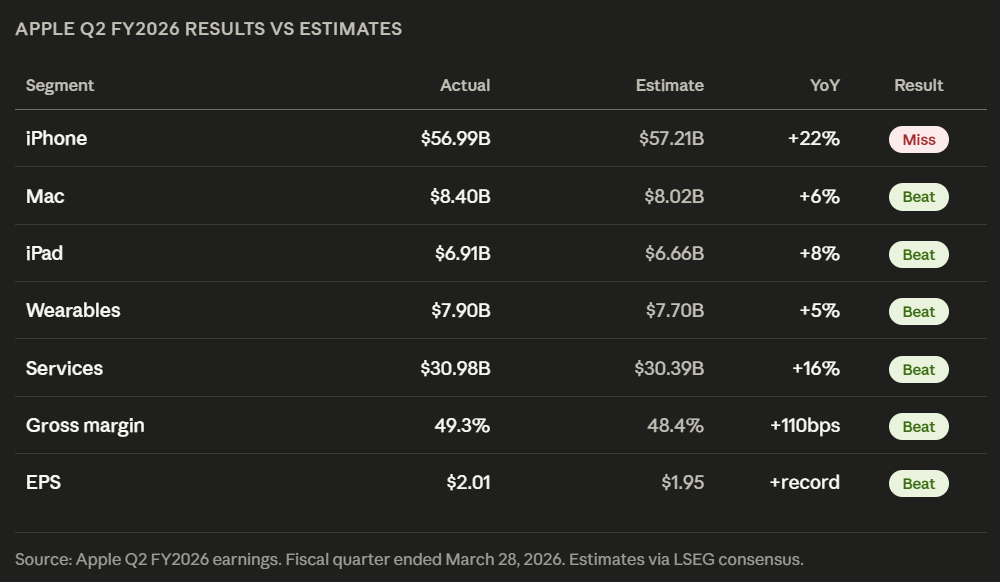
Six out of seven. The only miss was iPhone, and even that grew 22% year over year.
The Memory Problem Nobody Can Escape
Here is where the story gets complicated.
Apple’s strong gross margins this quarter were partly a mirage. The company had pre-purchased memory chips before prices surged, giving them a temporary buffer. That buffer is now gone.
Starting with the June quarter, Apple expects “significantly higher memory costs.” And Cook was unusually candid about what lies beyond: “We believe memory costs will drive an increasing impact on our business.”
This is the same pressure hitting Meta and Microsoft, both of which flagged higher memory costs in their results just a day before Apple reported. The global AI boom has created insatiable demand for high-bandwidth memory chips. Everyone needs them. Supply is tight. Prices are rising.
For Apple, this creates a genuine margin challenge. The June quarter guidance calls for gross margins between 47.5% and 48.5%, down from 49.3% today. Analysts are already asking what happens in the December quarter and beyond. Management, to their credit, did not pretend the problem away. They just said they would “look at a range of options.”
What does that mean? Possibly price increases. Possibly negotiating better terms with chip suppliers. Possibly absorbing some of the cost to protect market share. Apple did not say. But the ambiguity is intentional.
The Real Story: A Company at a Turning Point
Embedded in this earnings report are three signals that matter more than any quarterly number.
First, Tim Cook is leaving. He will step down as CEO on September 1, becoming Executive Chairman, with hardware chief John Ternus taking over. Ternus has been behind Apple’s shift to custom chips, the product line sharpening strategy, and now the MacBook Neo. The transition was announced before earnings, which analysts read as a deliberate signal: let the strong results speak for themselves, and introduce the new era under good conditions.
Second, Apple is quietly rethinking how it manages cash. Since 2018, the company had been working toward a “net cash neutral” position, meaning it wanted to reduce its cash pile until it equalled its debt. They have now abandoned that goal entirely. CFO Kevan Parekh said the company will “independently evaluate cash and debt” for better economic outcomes. With $54 billion in net cash still on the books and a fresh $100 billion buyback authorization, this signals that Apple may be getting more strategic about holding cash, possibly for acquisitions or AI investments it has not announced yet.
Third, China is roaring back. Greater China revenue grew 28% year over year to $20.5 billion, well above estimates. This defies the narrative that Apple is losing ground in China to Huawei. At least for now.
What This All Means
Apple is entering a new chapter. New CEO. New product categories. New capital allocation philosophy. And a memory cost headwind that will pressure margins through at least the next few quarters.
The guidance for 14% to 17% revenue growth in the June quarter smashed Wall Street’s 9.5% expectation. That is not a company stumbling into a transition. That is a company that still has significant momentum.
But the harder question is what Ternus does with AI. Apple has been deliberately slow, betting on privacy and ecosystem depth over raw model capability. The Google Gemini partnership for Siri is a pragmatic move. R&D spending is up 33% to $11.4 billion. The pieces are moving.
The quarter showed Apple can still execute at an extraordinary level. The next year will show whether the new leadership can reinvent the company for the AI era without breaking the things that made it extraordinary in the first place.
That is the real earnings story. Everything else is just numbers.
Banner Source – Google Gemini