





A stock that multiplies nearly fourteen times in twelve months seemingly produces two kinds of investors: those celebrating, and those kicking themselves for missing it. Put $10,000 into Bloom Energy last May and you’d be sitting on roughly $146,000 today. That kind of return belongs in the same conversation as early Bitcoin — except this one came with quarterly earnings reports, a genuine product, and an increasingly undeniable business case.
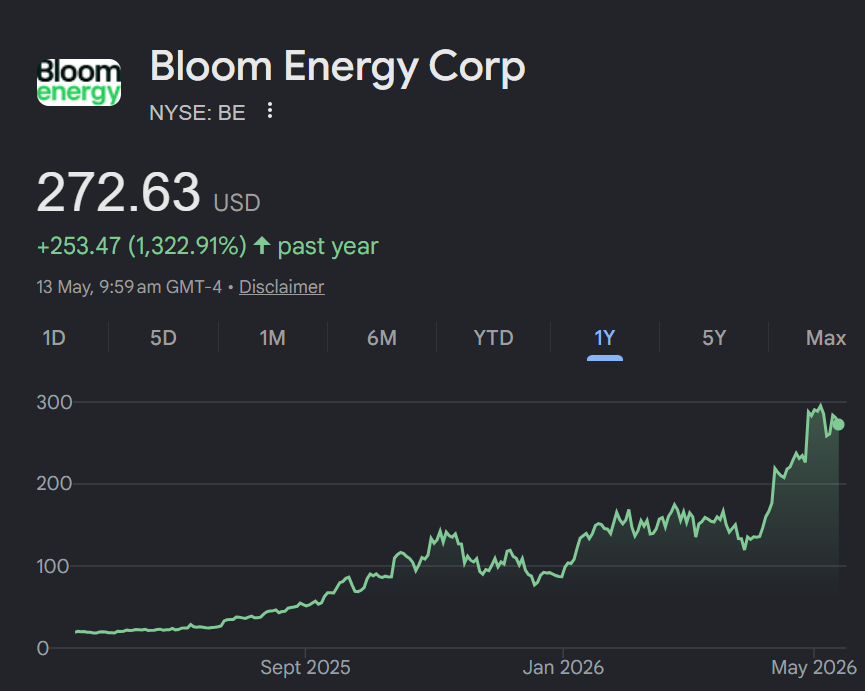
Google Finance
The question now is whether the story is over, or whether it has simply entered a new and more serious chapter.
What Bloom Energy actually does
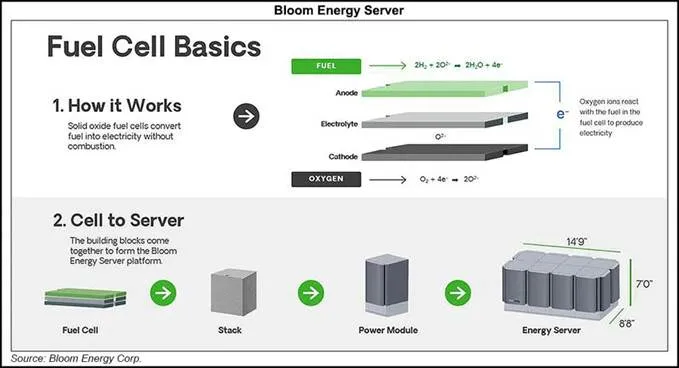
Bloom makes two products: the Bloom Energy Server — a solid oxide fuel cell (SOFC) system that converts fuel directly into electricity without combustion — and the Bloom Electrolyzer, which produces green hydrogen by splitting water using electricity.
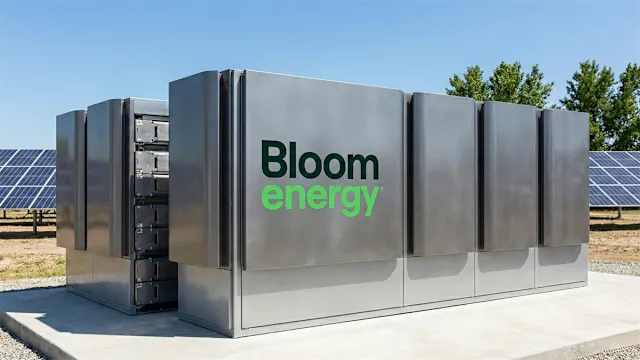
Installed Energy Server Systems
The Energy Server is the core business. It runs on natural gas today, but its fuel-agnostic architecture means customers can transition to hydrogen as supply scales. Unlike PEM fuel cells used in hydrogen cars, Bloom’s SOFC technology operates at 600–1,000°C and internally reforms natural gas into hydrogen — no pure hydrogen supply required. That’s the key competitive differentiator, and the core strategic pitch: sell natural gas-powered fuel cells now, transition to hydrogen later, staying relevant across the entire energy transition.
The technology is not new. Bloom was founded in 2001 by KR Sridhar, an aerospace engineer who worked with NASA on life-support systems for Mars missions.
Its SOFC platform has been developed over 20+ years, with 600+ patents and a team that includes 62 PhDs. Today roughly 1.4 GW of Energy Servers are deployed across 1,000+ locations in nine countries.
The advantages over conventional power are real: no combustion means minimal nitrogen oxide or particulate emissions; no moving parts means silent operation ideal for data centers; and efficiency runs at 50–60%+, versus 35–45% for gas turbines. With waste heat recovery, total energy utilisation can exceed 80–90%.
Why this stock just did 14x
For most of its public life, Bloom was a niche company investors filed by many under “interesting but unprofitable.” Then the AI infrastructure buildout arrived — hard.
The largest AI data centers now require 1 GW of continuous, reliable power — enough for a mid-sized US city. The grid can’t deliver that fast enough. The interconnection queue stood at 2,300 GW at end-2024, with timelines stretching years. Renewables can’t provide baseload. And hyperscalers cannot wait.
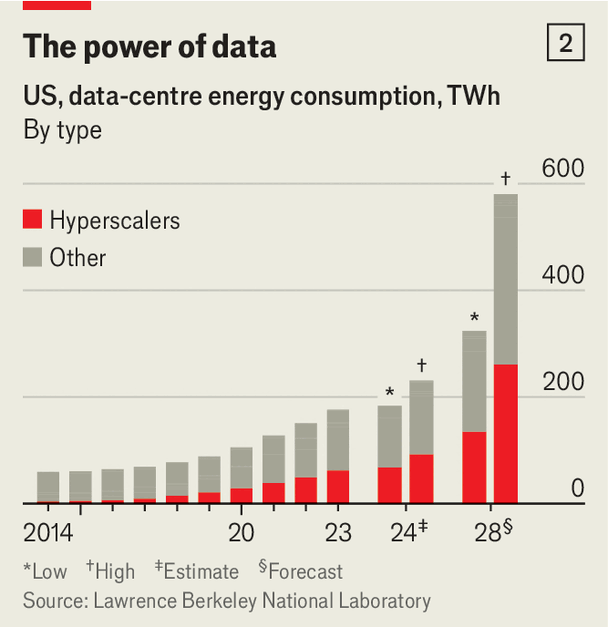
Bloom’s fuel cells can be deployed on-site, bypassing grid interconnection entirely, and can come online within months. The company demonstrated this credibly: it delivered one AI factory order in 55 days against a 90-day commitment, compared to 2+ years for utility grid upgrades. That speed advantage turned into a fundamental repricing. The stock moved from a 52-week low of $17.01 to an all-time high of $302.99.
The deals that changed everything
| Partner | Size | Structure |
| Oracle (Project Jupiter) | Up to 2.8 GW; initial 1.2 GW = $3.5–4B revenue | Full replacement of gas turbines; single microgrid campus in New Mexico; 92% lower NOx emissions |
| Brookfield Asset Management | $5B partnership | Power AI factories globally, including Europe |
| American Electric Power (AEP) | $2.65B, up to 1 GW | 20-year power purchase agreement |
| SK Ecoplant (South Korea) | Strategic partner since 2018 | Joint venture for Energy Server assembly for Korean market |
Between October 2025 and January 2026 alone, fuel cell agreements tied to data centers totalled $7.65 billion across the industry. Bloom entered 2026 with a backlog approaching $20 billion — roughly 6x its then-current revenue run rate — effectively sold out through 2026–2027.
The financial results
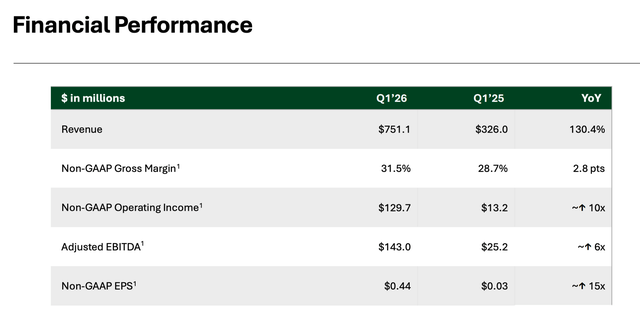
| Metric | Q1 2026 | Prior Year |
| Revenue | $751.1M | +130% YoY |
| Net income | $70.7M | Net loss |
| Product revenue growth | +208% | — |
| Non-GAAP gross margin | 31.5% | +2.8pp YoY |
| Operating cash flow | +$73.6M | -$110.7M |
Management raised full-year 2026 guidance to $3.4–3.8B (midpoint ~80% YoY growth) after a single quarter — something companies rarely do unless demand is materialising faster than their own models predicted.
Source: Company Filings
Revenue has grown at a 28% CAGR over the past ten years, but the AI inflection has turned this from a steady compounder into an exponential growth story being tested against real delivery.
The company also appointed Simon Edwards as CFO in April 2026, bringing nearly two decades of experience scaling technology companies including Groq, ServiceMax, and GE.
What Wall Street is saying
| Firm | Rating | Price Target |
| Morgan Stanley | Overweight | $310 (raised from $184) |
| RBC Capital | Outperform | $335 (raised from $143) |
| TD Cowen | Hold | $236 (raised from $160) |
| Consensus (26 analysts) | — | $153.27 avg; high $335 |
The wide gap between the consensus average and recent individual targets reflects how quickly the story has evolved and how many analysts haven’t updated their models yet. The most recent targets from JP Morgan, TD Cowen, and RBC average around $279, implying very modest downside from current levels.
One important caveat: Bloom typically moves 16% in a week, making it more volatile than 90% of American stocks. Position sizing may matter here.
The valuation reality
Bloom currently trades at over 28x sales. The 1-year forward P/E sits around 114x. The 1-year forward P/FCF is approximately 1,062x. These are not typos.
A DCF model projecting free cash flows through 2035 arrives at an intrinsic value of approximately $352/share — implying modest undervaluation on a long-horizon basis. But that model requires believing in a cash flow trajectory from roughly $109M in 2026 to over $11B by 2035. Analyst consensus for FY28 FCF is ~$1.1B; at today’s ~$60B market cap, that’s a two-year forward P/FCF of roughly 45x.
On manufacturing: Bloom is expanding its Fremont, CA facility from 1 GW to 2 GW capacity to meet Oracle and AEP demand. The share count has grown due to convertible issuances, but a $2.5B 0% convertible issued in November 2025 (maturing 2030) materially reduced interest expense. As free cash flows scale, dilution pressure should ease.
Two yellow flags worth monitoring. First, the $20B backlog cited entering 2026 did not appear prominently in the Q1 release. With product revenue up 208%, the pipeline may be converting to revenue faster than new orders are being added — not necessarily alarming, but worth watching at the July earnings call. Second, Director Mary Bush significantly trimmed her Bloom stake on May 8, 2026. Insiders sell for many reasons, but it’s a data point disciplined investors usually track.
The competitive landscape
Bloom’s main fuel cell competitors — FuelCell Energy, Doosan’s HyAxiom, and Plug Power — haven’t scaled anywhere near as fast. Bloom also benefits from a domestic manufacturing footprint at a time when the US administration is pushing onshoring, and it has a 20-year head start in stationary power while rivals focused on transportation fuel cells.
The broader competition comes from grid upgrades and small modular nuclear reactors. US utilities plan to spend $1.4T over five years, and grid capacity will eventually improve — but timelines are long. SMRs offer attractive long-term economics but development timelines are even longer. In the near term, fuel cells remain one of the few technologies capable of delivering gigawatt-scale reliable power in months.
So is it too late?
The honest answer depends on what kind of investor you are.
The case for patience is straightforward. A stock up 1,364% is priced for a future where almost nothing goes wrong. Geopolitical instability, a slowdown in AI capex, competition from grid-scale batteries, supply chain issues, or any execution stumble could send a stock at these multiples sharply lower.
The case for owning a position is also real. Bloom is no longer a speculative bet on unproven technology. It is a profitable, cash-generating business with landmark partnerships across Oracle, Brookfield, and AEP, an ~80% growth trajectory, and a product addressing one of the most urgent infrastructure problems of the decade.
The disciplined approach for investors not yet in is to treat the current price as a reference point, not an entry point. If the stock pulls back toward more reasonable multiples, or another quarter of results demonstrates that demand is broadening rather than concentrating, the risk-reward improves meaningfully. For those holding substantial gains, trimming into strength is not a failure of conviction — it is how you protect a return most investors will never see in a single year.
The business appears to have earned its moment. Whether the current price has gotten slightly ahead of even that extraordinary reality is the question every investor now has to answer for themselves.
This article is for informational purposes only and does not constitute investment advice. Readers are advised to conduct their own research before making any capital commitments.
Banner Image Source – Google Gemini