





SpaceX filed its S-1 with the SEC on May 20, 2026. After 24 years as a private company, it has applied to list Class A common stock on Nasdaq and Nasdaq Texas under the ticker SPCX, with Goldman Sachs, Morgan Stanley, BofA, Citi, and J.P. Morgan running the book.
The company going public isn’t just a launch business. After absorbing xAI in February 2026 (which had itself absorbed X Holdings in March 2025), SPCX will trade as a vertically integrated group spanning rockets, satellite broadband, frontier AI, a social media platform, and a planned orbital data-center business that doesn’t yet exist anywhere.
So the question for anyone considering the stock is: what are you actually buying?
This piece works through the answer using only what’s in the filing.
What’s on offer
The structural facts come first because they shape everything else.
SpaceX is offering Class A stock at $0.001 par value. Price range and share count haven’t been filled in yet. The company will use a dual-class structure: Class A carries one vote, Class B carries ten. Musk keeps enough Class B to control a voting majority and, separately, the right to elect a majority of the board for as long as any Class B shares exist. SpaceX will be classified as a “controlled company” under Nasdaq rules and plans to use exemptions from independent-director requirements on its compensation and nominating committees.
A 5-for-1 stock split took effect on May 4, 2026, and every share-count figure in the filing reflects it.
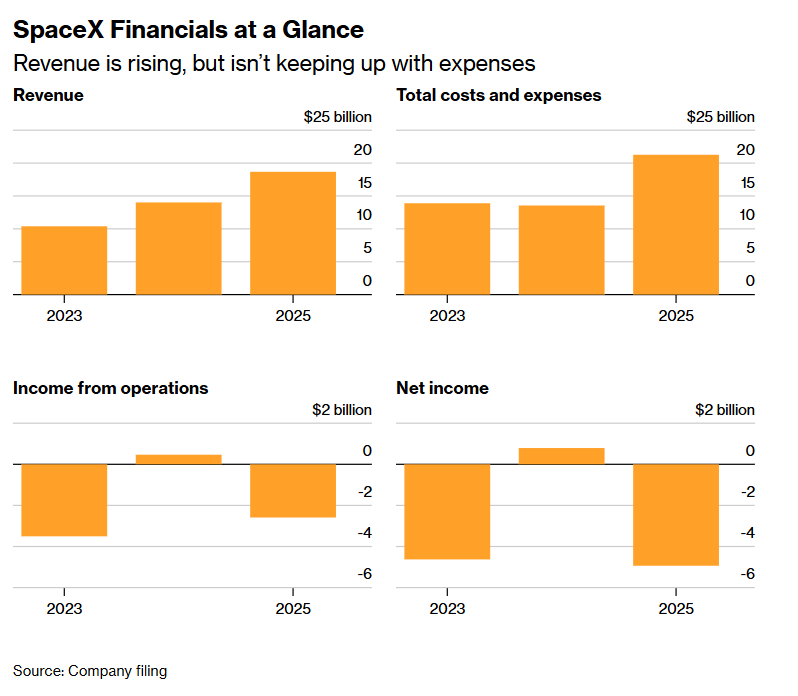
One note on the financials: SpaceX has retrospectively recast all historical numbers to include xAI and X, because the transactions were between entities under common control. So when you see 2023 revenue of $10.4 billion, that already includes the X platform Musk acquired in October 2022. It isn’t pure-play SpaceX.
The three-engine business
SpaceX reports in three segments, and they look almost nothing alike.
Space: the launch monopoly that funds the rest
By the company’s own disclosure, SpaceX has launched more than 80% of the world’s mass to orbit each year since 2023, at a mission success rate above 99% on Falcon. As of March 31, 2026, it had completed around 650 orbital launches. Over 540 of those used a Falcon booster that had flown before. One specific booster has now flown 34 times.
The segment financials surprise people:
- 2025 revenue: $4,086 million
- 2025 segment loss from operations: $(657) million
- 2025 segment Adjusted EBITDA: $653 million
- Q1 2026 revenue: $619 million
- Q1 2026 segment loss from operations: $(662) million
The losses are deliberate. The Space segment funded $3.0 billion of R&D in 2025 and another $930 million in Q1 2026, almost all of it going into Starship. Pull that out and the underlying launch business is profitable and scaling. Leave it in and the segment is consuming capital because the entire growth story rides on Starship working.
Connectivity: the only segment making real money
Starlink is the financial engine of SpaceX. The numbers are straightforward:
- 2025 revenue: $11,387 million (up 49.8% YoY)
- 2025 income from operations: $4,423 million (up 120.4% YoY)
- 2025 segment Adjusted EBITDA: $7,168 million (up 86.2% YoY)
- Q1 2026 revenue: $3,257 million; income from ops $1,188 million; EBITDA $2,087 million
Starlink had 10.3 million subscribers across 164 countries as of March 31, 2026, more than double the 5.0 million a year earlier. The constellation is now around 9,600 satellites, which the company says accounts for roughly 75% of all active maneuverable satellites in orbit. The direct-to-cell service runs across 30 countries through partnerships with about 30 mobile operators, reaching 7.4 million unique devices each month.
There’s one number in the metrics table that doesn’t fit the growth story: ARPU is falling fast. Starlink ARPU went from $99/month in 2023 to $91 in 2024 to $81 in 2025, and dropped to $66 in Q1 2026. A 33% decline in three years.
The S-1 doesn’t dwell on it, but the trajectory is consistent with a deliberate strategy: SpaceX is pushing into lower-income geographies and lower-tier consumer plans to land subscribers faster, accepting weaker per-unit economics for scale. How the unit economics hold up at $66 ARPU, and where the floor is, is one of the more important questions to put to this filing.
AI: the segment that may define the IPO
The AI segment was formed through the xAI acquisition in February 2026. It includes:
- Grok, which the S-1 says reached “frontier-level performance” on the GPQA Diamond reasoning benchmark within two years of its first release
- X, the social platform, with around 550 million monthly active users and 350 million daily posts
- COLOSSUS and COLOSSUS II, the company’s two flagship gigawatt-scale AI training data centers in Memphis and Southaven
- Terafab, a chip-manufacturing initiative with Tesla and Intel, currently at framework-agreement stage with no binding commitments
The financials reflect an early-stage business burning capital aggressively:
- 2025 revenue: $3,201 million
- 2025 segment loss from operations: $(6,355) million
- 2025 segment Adjusted EBITDA: $(1,237) million
- Q1 2026 segment loss from operations: $(2,469) million in a single quarter
AI capex in 2025 was $12.7 billion, more than Space and Connectivity combined. Q1 2026 AI capex alone was $7.7 billion, which annualizes to roughly $30 billion.
The S-1 also discloses two recent commercial moves worth flagging:
- A Cloud Services Agreement with Anthropic signed in May 2026 to provide compute capacity at $1.25 billion per month through May 2029, ramping in May and June 2026 at a reduced fee. Either party can terminate on 90 days’ notice.
- A compute-and-option agreement with Cursor signed in April 2026, giving SpaceX the option to acquire the developer-tools company at an implied $60 billion equity value, with a $10 billion combined break fee if SpaceX walks away ($1.5 billion termination fee plus an $8.5 billion deferred services fee).
Both deals say the same thing: SpaceX is treating its compute infrastructure as a monetizable asset class, not just an internal cost center for training Grok.
The headline numbers
Across all three segments:
| Metric ($ millions) | 2023 | 2024 | 2025 | Q1 2026 |
| Revenue | 10,387 | 14,015 | 18,674 | 4,694 |
| Loss from operations | (3,505) | 466 | (2,589) | (1,943) |
| Net income (loss) | (4,628) | 791 | (4,937) | (4,276) |
| Total capex | 4,415 | 11,163 | 20,737 | 10,107 |
Two things stand out.
The company was briefly profitable in 2024 ($466 million in operating income, $791 million net), but the xAI consolidation and the AI capex surge pushed it back into losses in 2025 and Q1 2026. Without the AI segment, SpaceX would be a profitable, fast-growing business. With it, it’s a high-burn growth story.
The capital intensity is also striking. Capex has roughly quintupled in two years, and Q1 2026 alone is approaching half of full-year 2025. As of March 31, 2026, SpaceX had $15.9 billion in cash against $29.1 billion of principal indebtedness. The Anthropic agreement and the IPO proceeds are clearly meant to fund what comes next.
What the IPO actually buys you
The S-1 makes the bet explicit. SpaceX is asking public-market investors to fund three specific things.
- Scaling Starship. Every major growth lever depends on it: V3 Starlink satellites with 1 Tbps per-satellite capacity (a roughly 20x improvement over current V2 Minis), V2 satellite-to-mobile broadband, lunar payload delivery, and orbital AI compute. The risk factors put it bluntly: “AI compute satellites at scale need full Starship reusability to be economically compelling.” If Starship slips, the growth thesis slips. The filing also notes that the FAA does not currently permit return-to-launch-site reentries for Starship, so a waiver will be required.
- Building orbital AI compute. This is the most ambitious claim in the document and the one that distinguishes SpaceX from any other AI-infrastructure investment. The company plans to begin deploying AI compute satellites in Sun-synchronous orbit “as early as 2028,” with a stated long-term goal of 100 gigawatts of orbital compute capacity per year. The S-1 estimates this would require “thousands of launches per year” and “approximately one million metric tons to orbit annually.” The thesis: solar energy in orbit is effectively unlimited, and radiative cooling into space removes the constraints currently strangling terrestrial data centers. None of this has been done. The S-1 itself calls orbital AI compute “an incredibly difficult technical challenge that only we can solve at scale in the near term.”
- Owning the AI stack vertically. Across Terafab (chips), COLOSSUS (training), Grok (model), X (data and distribution), and Cursor (developer applications), SpaceX is building what it pitches as the only fully vertically integrated AI company. The economic claim is that controlling every layer drives cost-per-token down faster than competitors and compounds the advantage over time.
It’s a coherent thesis. It’s also one where a meaningful share of projected returns sits beyond 2028, depending on technologies that either don’t yet work at scale (Starship) or don’t yet exist (orbital data centers).
The Musk question
Investors will need to be comfortable with the dual-class structure. After the IPO, Musk will hold a majority of voting power, control the election of a majority of the board through Class B shares, and continue as CEO, CTO, and Chairman. SpaceX will be a controlled company and intends to use exemptions from independent-director requirements on compensation and nominating committees.
The S-1 lists this as a risk factor in unambiguous terms: “Mr. Musk will be able to control the outcome of matters requiring shareholder approval… This will limit or preclude your ability to influence corporate matters and the election of our directors.”
None of this is unusual for a founder-led tech IPO. But the scale of capital allocation in play, with tens of billions per year across multiple unproven technologies and related-party transactions with Tesla (Terafab, Megapack) and X, makes the governance structure more material than in most filings. Investors are effectively underwriting Musk’s judgment on capital allocation at a scale most boards would not have authority to approve.
The risks worth pricing in
The risk factors section runs to about 40 pages. A few of them are more than boilerplate.
- Starship execution. Listed first in the summary risks, which is itself unusual. The filing is explicit that delays would cascade through V3 satellites, satellite-to-mobile, and orbital AI compute.
- AI segment losses. The segment is “recently formed, still being integrated, operates in a rapidly evolving industry and is subject to integration, execution, competitive and operational risks.” Translated: this is a new business inside a 24-year-old company, and the company is being honest that it doesn’t yet have full operational control over it.
- Regulatory exposure on AI products. The S-1 discloses an Irish Data Protection Commission inquiry into Grok’s GDPR compliance, an FTC inquiry into chatbot safety for children and teens, and active class-action litigation involving misuse of AI products for non-consensual explicit imagery. The filing flags features like “Spicy” Imagine Mode and “Unhinged” Voice Mode as carrying “heightened risks.”
- Spectrum dependency. The EchoStar spectrum acquisition, critical to V2 satellite-to-mobile, was FCC-approved on May 12, 2026, but is not expected to close until November 2027 and remains subject to closing conditions.
- Customer concentration. SpaceX launched 11 of 12 National Security Space Launch missions in 2025 and all five NASA crew and cargo missions to the ISS. Heavy U.S. government dependence creates political and contracting risk.
- Debt and capital needs. $29.1 billion in principal debt against $15.9 billion of cash, with capex running at $10 billion per quarter. The S-1 makes clear that additional debt or equity raises are likely.
- Insurance. SpaceX does not typically insure its satellites, payloads, or launch vehicles. Losses are borne directly.
The bottom line for investors
In financial terms, the SpaceX S-1 is a story about one mature cash engine (Starlink), one capital-intensive but globally dominant infrastructure business (Falcon launch), and one new, expensive bet on AI compute that may or may not work the way the company hopes.
What the IPO offers is exposure to all three at once, with the AI segment now driving most of the operating losses and most of the long-term upside. Investors buying SPCX aren’t just buying a rocket company at scale. They’re funding the next decade of attempts to vertically integrate the AI stack, scale Starship, and build the first data centers in orbit.
The Starlink business alone would arguably justify a substantial valuation as a public company. The rest is option value. Large, real, but priced into a valuation that public markets will set once the price range is filed.
For Indian investors, the practical considerations are familiar: lock-ups will dictate early liquidity, the dual-class structure means voting power doesn’t follow capital, and the long-dated nature of the growth thesis means anyone investing should be prepared to hold through multiple Starship launch cycles, regulatory cycles, and AI compute milestones. Most of those sit well beyond the typical retail investing horizon.
The S-1 is, in the end, a clear document about an unprecedented business. It’s worth reading on its own terms.
