 Skip to content





There is a moment every quarter when Wall Street holds its breath. Not because the numbers are bad. But because the numbers are almost too good to trust.
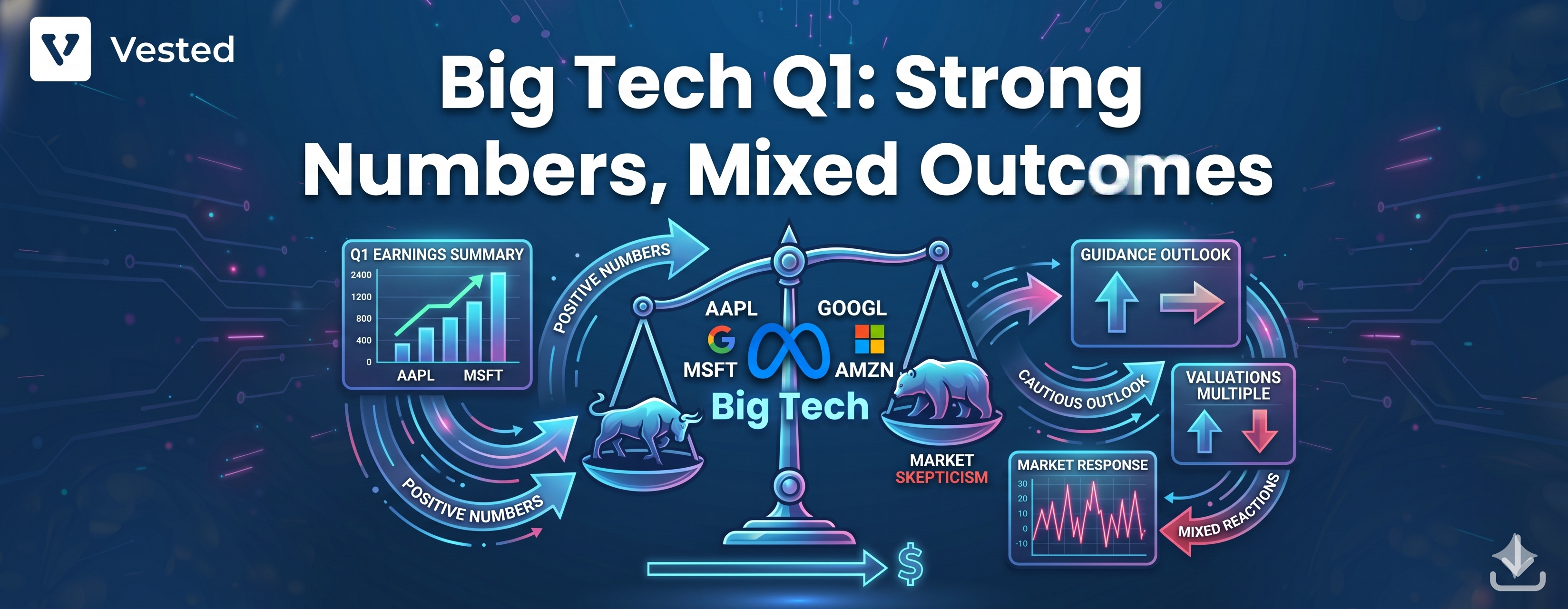
This week, four of the most powerful companies on the planet reported their earnings within hours of each other. Amazon, Microsoft, Meta and Alphabet, Google’s parent company, collectively posted earnings growth of about 60 percent compared to a year ago. Combined, they are worth north of $10 trillion. And yet all four are growing like scrappy startups still trying to find their footing.
But here is the part that will define the next decade: together, these four companies are planning to spend $725 billion this year on AI infrastructure. That is 77 percent more than the record $410 billion they spent just last year.

Let that number sit for a moment.
Q1 2026 Earnings at a Glance

After-hours stock reactions. Cloud growth refers to Google Cloud, AWS, and Azure respectively.
The Star of the Show
If this earnings season had a clear winner, it was Google.
Net income surged 81 percent to $62.6 billion. Revenue rose 22 percent to $110 billion. Both figures beat analyst estimates. But the real headline was Google Cloud, which posted a 63 percent increase in revenue, rising $7.7 billion from a year ago to reach $20 billion. Analysts had expected around $18 billion. Google did not just beat expectations. It embarrassed them.


For context, Google has spent years being teased as the company that invented modern AI and then somehow let OpenAI and Anthropic steal the spotlight. DeepMind, Google’s own research lab, incubated much of the foundational research that made large language models possible. And yet it was a scrappy startup with a chatbot that captured the world’s imagination in late 2022.
Google’s response, apparently, was to put its head down and build. The company claims a $460 billion backlog of contracts to rent data centre space, which doubled since the end of last year. That is not a vague pipeline. That is signed business waiting to be delivered. And Sundar Pichai, Google’s CEO, has a clear thesis about why Google is winning. The company owns its frontier models, owns the silicon for its chips, and that combination keeps it ahead of the curve.
Google Cloud boss Thomas Kurian attributed the company’s progress to a longstanding strategy to build its own custom AI chips, foundation models and products in-house, arguing this gave the company a cost and research advantage over peers who have struggled to build their own chips and frontier models.
The market agreed. Alphabet’s shares rose 7 percent in after-market trading, putting it on course to open at a record market value of $4.3 trillion.

Amazon’s Quiet Confidence
Amazon does not make headlines the way Google does. But the numbers are hard to ignore.
Revenue at Amazon Web Services jumped 28 percent to $37.6 billion in the first quarter, beating analysts’ average estimate for a 25 percent increase.

AWS remains the largest cloud provider in the world by a significant margin, and its growth is accelerating, not slowing. Amazon’s ad sales jumped 24 percent year over year to $17.2 billion, showing that the company’s sprawling empire of ecommerce, cloud, advertising and media is firing on all cylinders simultaneously.
What makes Amazon’s position particularly interesting is who it is betting on. Last week, Amazon struck a deal to invest up to $25 billion in Anthropic, while the Claude creator committed to spending more than $100 billion on AWS over the next 10 years. Days later, Amazon made OpenAI’s latest models available on AWS. In a single week, Amazon effectively became the preferred cloud home for both of the world’s most prominent AI labs, which happen to be bitter rivals of each other.
CEO Andy Jassy put it plainly: there is no one AI tool to rule the world, and customers want choice. Amazon is betting that whoever wins the AI model race, they will need AWS to run it on. It is an elegant position to hold.
Amazon’s contract pipeline rose from $244 billion in December to $364 billion by the end of the first quarter. The trajectory is steep, and it shows no signs of flattening.
Microsoft’s Complicated Quarter
Microsoft is the one that investors are most conflicted about right now, and this quarter did little to resolve that tension.
Microsoft’s Azure cloud business reported a 40 percent increase in revenue, helping push total sales to a record $82.9 billion.
That is an impressive number by any normal standard. The problem is that Google Cloud grew at 63 percent. When you are supposed to be the AI company, being outrun by a rival that the market previously considered behind you is not a comfortable position.
The deeper worry is Microsoft’s relationship with OpenAI. For years, that exclusive partnership was Microsoft’s trump card. It bet early, bet big and seemed to have locked in the world’s most famous AI lab as its partner. But this week, Microsoft ended its exclusive arrangement with OpenAI. Satya Nadella, Microsoft’s CEO, tried to frame this as a positive development, telling investors that Microsoft now has access to OpenAI’s frontier model royalty-free with full IP rights through 2032. Whether that framing holds up over time remains to be seen.
There is also the spending question. Microsoft outlined $190 billion in capital expenditure for the 2026 calendar year, well ahead of the analyst forecast of around $152 billion. CFO Amy Hood acknowledged that rising prices for memory chips and other components were responsible for $25 billion of the record capex budget. She also warned that even with these additional investments, Microsoft expects to remain supply-constrained at least through the end of 2026.
Microsoft’s free cash flow for the quarter came in at $15.8 billion, down almost $6 billion from a year ago. That is the number that made some investors uncomfortable. Revenue is growing. Profits are growing. But the cash being consumed by data centre spending is enormous, and the return timeline is long.
The stock wobbled, then steadied. The market has not given up on Microsoft, but it is asking harder questions than it was a year ago.
Meta’s Uncomfortable Truth
And then there is Meta, which had a genuinely good quarter by almost any conventional measure, and still watched its stock fall six percent in after-hours trading.
Meta reported first-quarter revenue of $56.3 billion, beating analyst estimates. Net income increased significantly. The company used AI to boost advertising pricing and user engagement, and it showed. Ad prices on Facebook and Instagram rose 12 percent year on year. The core business is healthy.
So why did the stock fall?
Two reasons, and they are related. First, Meta raised its expected 2026 capital expenditure to between $125 billion and $145 billion, up from its previous range of $115 billion to $135 billion.

Second, Mark Zuckerberg could not give investors a clear timeline for when any of this spending would translate into a specific AI product breakthrough. When pressed on the timeline for releasing promised AI models, he said he cared more about quality than hitting a deadline.
That answer might be philosophically correct. But it is not what nervous investors want to hear when you are asking them to stomach an extra $10 billion in spending with a shrug.
Meta also reported its first-ever quarterly decline in Daily Active People since it started using that metric, attributing the decline to internet disruptions in Iran and restrictions on WhatsApp in Russia. These are arguably temporary and external factors, but the timing was unfortunate. A drop in users, rising capex and a vague AI roadmap is a difficult combination to sell.
One analyst described the situation bluntly: investors are not interested in growth at any cost. And Meta, at this moment, looks like a company spending heavily on a future it cannot yet describe with precision.
The Memory Problem Nobody Is Talking About Enough
Buried inside the earnings calls of multiple companies was a detail that deserves more attention than it got.
Memory chips are getting expensive. Very expensive. Microsoft said $25 billion of its record capex budget was driven by higher component costs, particularly memory pricing. Meta’s Zuckerberg cited the same reason for raising the company’s spending forecast. Qualcomm, which reported earnings on the same day, issued a soft outlook specifically because AI data centre builders have been consuming memory chips from a small group of global suppliers at a pace that has left the rest of the market short.
This is the infrastructure crunch hiding inside the AI gold rush. Nvidia gets all the headlines for its GPU dominance. But memory is the silent bottleneck, and right now, every major tech company is competing for the same constrained supply. The companies building AI data centres are essentially in a bidding war for components, which is why capex forecasts keep rising even when the underlying investment thesis has not changed.
The hyperscalers are not sitting still. Google is planning to sell servers fitted with its in-house AI chips to outside customers, moving beyond simply renting chip capacity hosted in Google’s own facilities. Amazon’s CEO mentioned plans to sell chip racks directly to customers as well. These moves signal that the cloud giants want a share of Nvidia’s margin, not just Nvidia’s products.
The Bigger Picture
Zoom out from the individual company stories and a remarkable pattern emerges.
The AI gold rush has created a world where the biggest near-term beneficiaries are not necessarily the AI companies themselves. They are the picks-and-shovels businesses: the cloud providers renting compute, the chip makers selling hardware, the data centre operators leasing space. The AI economy, in the words of one Jefferies analyst, is healthy. The bear thesis is garbage.
But there is a tension building beneath the surface. All of this spending is predicated on the assumption that AI demand will continue to grow, that enterprises will eventually deploy these tools at scale, and that the economics will work out. So far, the cloud revenue numbers suggest the bet is paying off. Google Cloud’s 63 percent growth is not a fluke. AWS growing at its fastest pace in four years is not an accident. These are real workloads being run by real customers paying real money.
Anthropic struck cloud deals with Google and Amazon in recent weeks worth potentially hundreds of billions over the coming years. OpenAI similarly has relationships spread across multiple providers. The AI labs are not loyal to any single cloud. They are playing the field, and the cloud giants are competing fiercely for their business. This dynamic is, quietly, one of the most consequential competitive battles in technology right now.
Goldman Sachs analysts have noted that three quarters of the S&P 500’s value now comes from cash flows more than ten years in the future. For high-growth tech stocks, that figure is even higher. This means that vague indications of future AI dominance move stock prices more than last quarter’s revenue ever could. It is why Google’s stock surged on a backlog number and why Meta’s fell on a timeline that Zuckerberg could not articulate clearly.
What This All Means
Here is the honest summary: Big Tech just had one of its best quarters in years, announced some of the largest capital spending plans in corporate history, and the market’s reaction ranged from euphoria for Google to mild panic about Meta.
The divergence tells you something important. Investors are not just rewarding growth. They are rewarding growth with a visible return on investment and a coherent story. Google has the story: full-stack AI, custom chips, cloud momentum, and a backlog that doubled in six months. Amazon has the story: every major AI lab runs on AWS, and the business metrics confirm it. Microsoft and Meta have the spending, but the story is murkier, and in this market, a muddled story is almost as bad as bad numbers.
The $725 billion being spent this year is not a sign of recklessness. It is a sign of how high the stakes have become. Every one of these companies has decided, independently, that the cost of underinvesting in AI is higher than the cost of overinvesting. They would rather build too much and find demand to fill it than be caught short when the moment arrives.
Whether they are right will take years to know. But one thing is already clear: the AI economy is no longer a bet on the future. It is a present-tense arms race, and the companies that flinch first will have a very difficult time explaining that decision to their shareholders.
The race is on. And it is costing $725 billion just to stay in it.
Banner Image Source – Google Gemini
