




The Morgan Stanley State of the Workplace 2025 Financial Benefits Study reports that 48% of employees consider equity compensation the most effective way to stay motivated and engaged at work.
More than 4 in 5 employees (84%) say they would be interested in receiving equity compensation. Having a real stake in the company’s success is the most important factor for employees today. Yet many feel unprepared to exercise their reward. In fact, 1 in 4 HR leaders report that employees have expressed confusion about how to fully understand and utilise equity benefits, including RSUs.
So, if you are one of the many, this article fills the gap in understanding. The sections below cover everything about how RSUs vest and will help you convert a line in your offer letter into real wealth.
RSUs: The Basics
Restricted Stock Units (RSUs) are company shares granted to employees as part of their compensation, usually at no cost. These shares are subject to vesting conditions such as completing a certain period of service or achieving performance targets.
In India, RSUs are taxed twice — first as salary at the time of vesting based on the fair market value, and later as capital gains when the shares are sold.
But why does RSU vesting matter?
This ownership period, during which shares gradually become yours, is referred to as vesting. RSUs are not transferred immediately. Vesting determines when the RSUs convert into actual shares that can be kept or sold by the employee, as per company rules.
Vesting plays a twofold role. For companies, it serves as a retention and motivation tool, encouraging employees to contribute long-term. For employees, vesting determines when the equity converts into real compensation that adds monetary value to their portfolio.
Once vested, the shares are automatically transferred to the employee and become taxable income as part of the salary. Understanding your employer’s RSU vesting process can make a real difference to your financial planning and tax liability.
How RSU Vesting Works: The Core Mechanism
Vesting of shares follows 5 main steps.
- Grant Date It is the date on which the company awards RSUs to you. At this stage, you do not own the shares, so no tax liability is triggered.
- Vesting Period The vesting period is the time over which RSUs convert from a promise on paper into actual shares.
- Vesting Conditions To keep employees motivated and retain them long-term, organisations require certain conditions to be fulfilled. Three types of stock-based conditions are:
- Market Condition: For instance, when the company achieves a desired market capitalisation, the awards vest.
- Performance Condition: For instance, if a sales target of $1 million is achieved, or as a result of a financing event like an IPO.
- Service Condition: RSUs vest if an employee completes a minimum of 3 years of service, or it may vest on the death or disability of an employee.
- Conversion to Shares In the shares vesting process, once the period and conditions are complete, RSUs convert to actual shares. Tax is triggered on this date.
- Taxation Event In the case of RSUs, tax is triggered at vesting, not at grant. Here is what happens:
- The Fair Market Value (FMV) of the shares on the vesting date is treated as income.
- It is taxed as a perquisite — part of salary — at your applicable income tax slab rate.
- The employer is required to deduct TDS (Tax Deducted at Source) under Section 192 at this stage.
- If the employee decides to sell the shares, capital gains tax is triggered separately.
Note: Your tax liability in India depends on your residential status. If you hold RSUs of a foreign company, it must be disclosed under Schedule FA of your income tax return.
Common Vesting Schedules (With Examples)
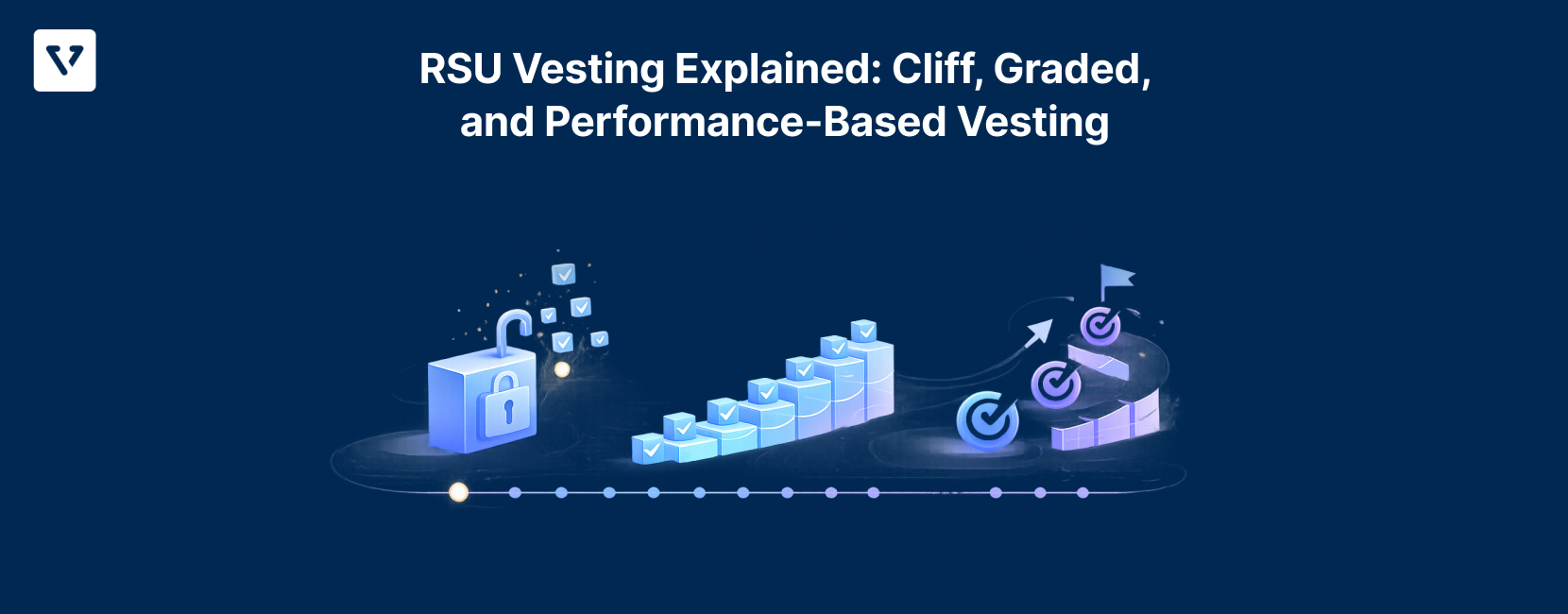
There are different types of vesting schedules, and each one affects how much equity you actually earn, when you earn it, and what you may lose if you leave early.
- Time-Based Vesting
Under time-based vesting, RSUs vest based on your duration with the company.
- Cliff Vesting
With cliff vesting, no RSUs vest until you complete a minimum service period.
Example:
- 1-year cliff, 1,000 RSUs allotted
- You leave before 12 months: no RSUs vest
- You complete 12 months: vesting begins
Cliff vesting improves employee retention during initial growth phases, making it one of the most commonly used structures by startups.
- Graded Vesting
Graded vesting allows RSUs to vest gradually over time after an initial cliff.
Example:
- 4-year vesting with a 1-year cliff
- End of Year 1: 25% shares vest
- Years 2–4: Remaining 75% vests either monthly, quarterly, or annually
This is the most common RSU vesting schedule globally, used especially in large multinational companies.
- Performance-Based Vesting
Under a performance-based vesting schedule, RSUs vest only when specific company targets are achieved. These targets could be individual employee sales goals or share price milestones.
In case targets are not met, vesting may be delayed or cancelled entirely, making this type of reward less predictable for employees.
- Hybrid Vesting
A hybrid vesting schedule combines conditions from both time-based and performance-based vesting. It is usually designed for a company’s senior leadership as a long-term incentive plan, where retention and performance are equally important.
How it works:
- Employees must complete a minimum service period.
- Employees must also achieve defined performance milestones.
Key Terms Every Employee Must Know
Understanding your equity starts by learning the terms used in the agreements. The terms below appear commonly in offer letters, company agreements, and vesting schedules.
Grant Date: The date on which shares are officially granted to you by the company.
Vesting Date: The date on which your allotted RSUs convert into actual shares and become yours.
Cliff: A minimum service period that must be completed before any of the allotted RSUs vest.
Graded Vesting: A type of vesting structure where a company’s shares vest gradually over time after the cliff.
FMV (Fair Market Value): The price of your share at which it can be sold in the open market. It is also used to calculate tax.
Double-Trigger Vesting: A type of vesting schedule where your stock option vests only after two conditions are met — a liquidity event and a service or time condition.
Blackout Window: A period when employees are restricted from selling shares, usually around earnings or major announcements.
Tax Implications of RSU Vesting
RSU vesting rules and timelines trigger two major tax events.
Tax Event 1: At Vesting
On vesting of RSUs, the employees get the actual ownership rights to the shares. It is considered a perquisite — part of salary — in the financial year it is vested, and taxed at the applicable income tax slab rate.
How it works:
- On the date your shares vest, the Fair Market Value (FMV) is calculated.
- For shares of a foreign company, the exchange rate on the vesting date is also applicable.
- This value is added to your taxable salary for that year.
- Your employer deducts TDS under Section 192 on this amount.
Example:
- 200 RSUs vest
- FMV on vesting date: ₹1,500 per share
- Taxable income added to salary: ₹3,00,000
- Tax deducted at your applicable slab rate (20% or 30%)
There are three ways TDS is typically handled at vesting:
- Sell to Cover: The employer sells a portion of vested shares on your behalf to cover the TDS liability. For example, if you receive 1,000 shares and fall in the 30% tax slab, the company sells 300 shares on your behalf and deposits the proceeds as tax. You receive 700 net shares.
- Same-Day Sale: All vested shares are sold on the vesting day. The applicable tax is paid to the government and you receive the remaining cash proceeds. No actual shares are held.
- Upfront Payment: You pay the tax liability yourself and receive all vested shares in your account.
Proceeds from the sale of RSUs are reflected in Form 16 and Form 12BA.
Tax Event 2: At Sale of Shares (Capital Gains)
Once your shares vest, they are treated like any other investment asset. The capital gain is the difference between the sale price and the FMV at the time of vesting (your cost of acquisition). The holding period is counted from the date of vesting.
The rate of taxation depends on whether the shares are listed on an Indian stock exchange or not. For most employees receiving RSUs from US-based or other foreign companies, the shares are treated as unlisted securities under Indian tax law, regardless of whether they are listed on a foreign exchange.
| Shares Listed on Indian Stock Exchange | Shares NOT Listed on Indian Stock Exchange (Foreign RSUs) | |
| Short-Term Capital Gain (STCG) | Held for less than 12 months — taxed at 20% | Held for less than 24 months — taxed at applicable slab rate |
| Long-Term Capital Gain (LTCG) | Held for more than 12 months — taxed at 12.5% | Held for more than 24 months — taxed at 12.5% (no indexation) |
| Exemption | LTCG up to ₹1.25 lakh is tax-exempt | No exemption |
| Indexation | No | No |
Important: Most employees at MNCs hold RSUs of foreign-listed companies (e.g., US stocks). These are classified as unlisted securities under Indian tax law. This means the 12-month STCG period and the flat 20% STCG rate do not apply. The correct holding period threshold is 24 months, and STCG is taxed at your income tax slab rate.
Factors That Affect RSU Taxation in India
-
Residential Status
Your income is taxable in India according to your residential status. If you are a resident, all your income from anywhere in the world is taxed in India. If you are a non-resident or resident but not ordinarily resident, and have sold your shares outside India, you may not be liable to pay tax in India. Determination of residential status is therefore crucial.
-
Disclosures
If you hold RSUs of a foreign company, you must disclose your foreign holdings under Schedule FA of your income tax return. These disclosure requirements apply to resident taxpayers. Note that Schedule FA reporting follows the calendar year, not the Indian financial year.
-
When Shares Are Not Sold
On the vesting date, you gain ownership of the shares. You can choose to hold them and not sell. In such a case, capital gains tax does not apply — only the perquisite tax at vesting is triggered.
Strategic Implications and Best Practices
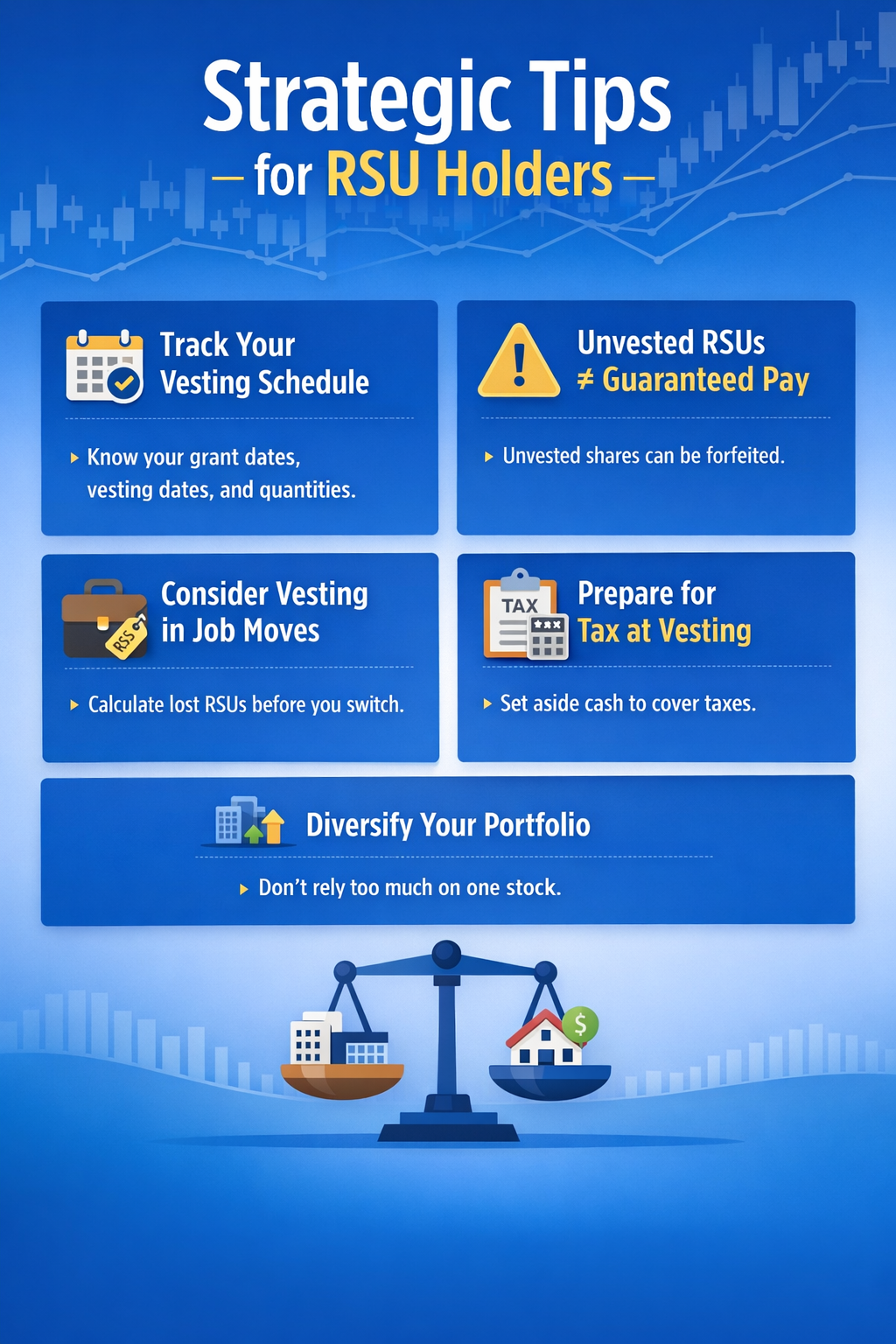
RSUs are a powerful wealth-building tool, but only when managed carefully. Use these tips to stay in control of your RSUs from grant to sale.
- Understand your vesting schedule from day one. Know exactly when shares vest and plan your finances around those dates.
- Plan for tax at vesting. Since TDS is deducted at source, check your Form 16 to verify the amount deducted and ensure it matches your actual liability.
- Track the holding period carefully. Holding foreign RSU shares for more than 24 months qualifies them for LTCG at 12.5%, which can be significantly lower than your slab rate.
- Avoid selling immediately unless liquidity is needed. A holding period strategy can reduce your capital gains tax substantially.
- Disclose all foreign RSU holdings under Schedule FA annually to remain compliant with Indian tax law.
- Consult a tax advisor if you have multi-country RSU vesting history, as apportionment rules and DTAA (Double Taxation Avoidance Agreement) relief may apply.
Conclusion
Compared to other forms of equity compensation such as stock options, RSUs offer both stability and guaranteed ownership. But while this equity compensation is widely used by companies today, it is also widely misunderstood — with many employees treating it as a simple, straightforward reward.
RSU vesting is a multi-layered compensation tool governed by timelines, rules, taxation, and liquidity constraints. Understanding each aspect that influences the vesting of shares is important to make informed career and financial decisions.
Treat vesting as a process that rewards patience and long-term planning.
Frequently Asked Questions
What is vesting of shares?
Vesting of shares is the process through which an employee gradually earns ownership of equity over time or after meeting specific conditions. Until shares vest, they are not legally owned by the employee.
What does RSU vesting mean?
RSU vesting is the point at which restricted stock units convert into actual shares. Once RSUs vest, they are transferred to the employee and the fair market value is taxed as perquisite income — part of salary — in India.
How does vesting work in employee stock plans?
Vesting works according to a predefined stock vesting schedule, such as time-based, performance-based, or hybrid. Shares vest only when the defined conditions are fulfilled.
What is a stock vesting schedule?
A stock vesting schedule outlines when and how shares vest over time. Common schedules include a one-year cliff followed by gradual vesting over three or four years.
What happens to unvested shares if you leave a company?
In most cases, unvested shares are forfeited when an employee leaves the company. The exact treatment depends on the company’s equity plan and exit terms.
What is the difference between vesting and exercising?
Vesting is the process by which RSUs convert into actual shares over time. Exercising applies to stock options, where an employee pays a strike price to buy shares. RSUs vest automatically — no exercise or payment is required.
How are RSUs of foreign companies taxed in India?
RSUs of foreign companies are taxed as perquisite income at vesting, at your applicable slab rate. On sale, they are treated as unlisted securities — STCG applies if sold within 24 months (taxed at slab rate), and LTCG at 12.5% if held beyond 24 months.
