






Welcome back to a new edition,

The World in a Week: How Major Markets Moved
U.S. | U.S. equities rallied for a third straight week as easing Middle East tensions, upbeat bank earnings, and solid economic data lifted risk appetite, with AI-linked large-cap growth leading the move. The S&P 500 (+4.70%) and Nasdaq (+6.40%) advanced to record levels while oil slid after the Strait of Hormuz was declared open, supporting a broad risk-on tone.
Europe | European equities climbed as investors welcomed corporate earnings and positive geopolitical signals, with the STOXX Europe 600 up 1.91% for the week. Major bourses advanced across the board with DAX +3.77%, FTSE MIB +2.65%, CAC 40 +2.00%, and FTSE 100 +0.63% as Iran pledged to open the Strait of Hormuz, easing energy risk concerns and supporting a broad risk-on tone.
Japan | Japanese equities advanced as easing geopolitical risks and renewed AI optimism supported sentiment, with the Nikkei 225 rising 2.73% to a record high and the TOPIX up 0.56%. Strength in AI-linked names, solid earnings, and ongoing corporate governance reforms helped markets regain pre-conflict momentum.
China | Firmer macro data helped Chinese equities rebound despite lingering geopolitical caution, with the CSI 300 Index up 1.99% and the Shanghai Composite Index gaining 1.64%. In Hong Kong, the Hang Seng Index rose 1.03% as investors balanced improving domestic signals against oil-driven volatility.
India | The NIFTY 50 climbed 3.18% to 24,353.55 as easing global tensions and strength in IT, financials, and energy stocks lifted sentiment. Foreign inflows and optimism around AI-linked tech demand supported the rally, with broader risk appetite returning to Indian equities.
Commodities | Gold rose 3.45% to 4,831.61 as softer yields and lingering geopolitical caution supported safe-haven demand. Meanwhile, Bitcoin gained 5.82% to $77,239, buoyed by renewed risk appetite and sustained flows into digital assets alongside the broader equity rally.
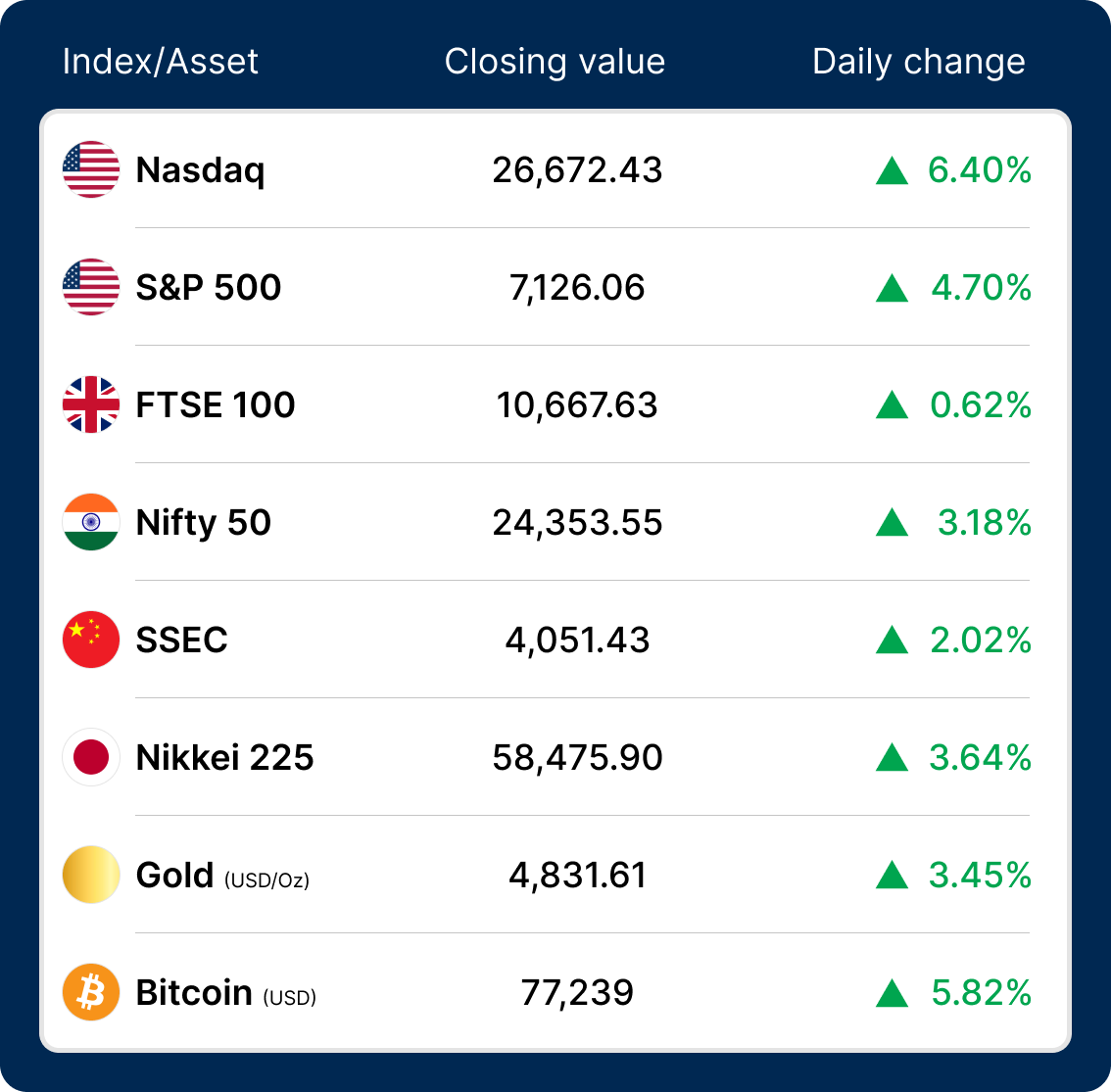
Stock market closing data for the week of Apr 13 to Apr 17, 2026
Index information: STOXX 600 (tracks 600 large, mid- & small-cap EU firms), DAX (top 40 German blue chips), CAC 40 (leading French stocks), Nikkei 225 (225 top Japanese stocks), CSI 300 & SSEC (mainland China A-shares), and Hang Seng (large-cap Hong Kong-listed firms). For these indices, we track 1-week returns to capture how global sentiment is shifting.
News Summaries
Apple Upgraded as Memory Price Spike Could Drive Market Share Gains
Apple was upgraded to outperform by BNP Paribas, which sees the company benefiting from rising memory chip prices across the industry.
Memory prices have surged in recent months due to strong demand from AI infrastructure buildout, increasing costs for consumer electronics manufacturers. While this pressures most smartphone players, Apple is better positioned to absorb these costs.
The reason is scale and supply chain control. Apple’s pricing power and shift toward premium devices allow it to manage input cost increases more effectively than competitors, especially in the low and mid range segments.
BNP Paribas raised its price target to $300 from $260, citing Apple’s ability to use the current environment to gain smartphone market share.
Shares have risen about 9% since late March, though the stock remains below its previous peak and has underperformed broader tech indices so far this year.
Microsoft Shares Rise 14% This Week on Strong AI Demand and Earnings Momentum
Shares of Microsoft climbed ~14% this week as investors leaned into companies best positioned to monetize enterprise AI adoption through cloud and software.
The rally follows a strong fiscal quarter where revenue rose 17% YoY to $81.3B and operating income increased 21% to $38.3B, implying a ~47% operating margin.
A key driver was the Azure and Intelligent Cloud segment, which generated $32.9B in revenue (+29% YoY), with Azure and other cloud services growing 39% YoY as enterprises ramped AI workloads and data infrastructure spending.
However, the cloud race is intensifying. Alphabet’s Google Cloud posted 48% YoY growth, while Amazon’s AWS reaccelerated to 24% YoY, as both rivals plan $175B–$200B in capex largely tied to AI compute.
Why it matters: Microsoft’s full-stack position across cloud, copilots, and enterprise software is attracting capital, but surging AI capex from rivals signals a more competitive phase in the cloud-AI cycle.
Netflix shares plummeted more than 8% in a single day
Shares of Netflix dropped 8% after the company reported Q1 2026 revenue of $12.25 billion (+16% YoY) and EPS of $1.23, both beating expectations, but issued a cautious forecast for Q2 revenue (~$12.57 billion, ~13.5% growth) and margins below street estimates.
The quarter was also marked by the announcement that co-founder and Chairman Reed Hastings will step down in June, adding uncertainty to direction even as core metrics exceeded forecasts. Netflix’s profit was boosted by a one-time $2.8 billion fee from terminating its Warner Bros. deal, underscoring that underlying trends are being weighed heavily by markets.
Investors dialed back enthusiasm as guidance fell short of analyst expectations, and full-year revenue forecasts (~$50.7–$51.7 billion) came in slightly below the consensus, raising questions about growth momentum relative to the company’s premium valuation.
Why it matters: Strong current results weren’t enough to offset soft forward outlook and leadership changes, highlighting a market shift where investor focus is more on future growth signals than historic performance. — this dynamic is especially pronounced for high-multiple tech and media names.
Palo Alto Networks +8% This Week as AI Security Partnerships and Recurring Revenue Strengthen Outlook
Shares of Palo Alto Networks rose ~0.5% this week as investors focused on AI-aligned security demand and strategic collaborations that position the company in front of the next wave of enterprise risk management. The stock’s movement came alongside broader rotation into resilient, subscription-heavy software names.
In its latest quarterly results, Palo Alto reported ~$2.59 billion in revenue (+15% YoY), with subscription and support revenues (~80% of total) up ~13% YoY and product revenue +22% YoY, reflecting continued adoption of SASE, next-gen firewalls, and XSIAM platforms. The recurring revenue mix remains a core strength, providing predictable cash flow amid tech spending shifts.
Strategically, Palo Alto has been strengthening its AI security footprint through partnerships with major AI players such as Anthropic and OpenAI — including initiatives to integrate advanced threat defense and model monitoring into AI-powered environments. These partnerships aim to help enterprises secure generative models and hybrid cloud deployments against emerging adversarial risks.
Why it matters: As AI adoption surges across cloud, data, and enterprise systems, demand for AI-aware cybersecurity is rising in parallel. Palo Alto’s high recurring revenue base, solid growth metrics, and early AI collaboration footprint position it as a key beneficiary in the expanding AI security market, even as broader tech rotation produces more measured near-term price action.
Private Markets Pulse | Stripe’s Blockchain Push & Validator Role Broadens Payments Infrastructure
Stripe made strategic progress this week as its Tempo blockchain ecosystem (co-founded by Stripe and Paradigm) went live with external validators including Visa and Standard Chartered, signaling growth in crypto-native rails for payments and agentic commerce. Tempo, designed to power instant settlement and predictable fees, also supports Stripe’s Machine Payments Protocol (MPP), an open standard enabling autonomous AI agent payments.
The move builds on Stripe’s recent $159 billion valuation in a tender offer, up ~70% from earlier, reinforcing the company’s standing as the payment infrastructure benchmark for fintech and digital commerce.
Integrating Visa and institutional players into Tempo’s validator set not only strengthens network security and credibility but also positions Stripe at the center of blockchain-enabled payments innovation, beyond traditional card rails.
For markets and enterprise developers, the development underscores Stripe’s continued evolution from a payment processor to a cross-rail fintech platform, bridging traditional finance, blockchain settlement, and next-generation commerce ecosystems.
For investors tracking Stripe closely, Vested provides access to invest in Stripe through a Private Markets offering.