 Skip to content





Welcome back to a new edition.
Before we get into this week, we wanted to take a moment to share something special from our side.
Vested crossed $1 billion in assets under administration.
What makes this meaningful for us is not just the number. It is what has gone into getting here. Thousands of investors are choosing to go global, taking that first step, staying invested through uncertainty, and building over time.
That is really what this milestone represents. We are genuinely excited for what comes next.
Now, let’s get into what moved this week.

The World in a Week: How Major Markets Moved
U.S. | U.S. equities extended gains for a second week as easing Middle East tensions and a sharp pullback in crude improved risk appetite, lifting AI-linked tech and semiconductor names. The S&P 500 and the Nasdaq Composite advanced with energy lagging as oil cooled and Treasuries firmed on softer yields, reinforcing the broad risk-on tone.
Europe | European equities advanced as a U.S.–Iran ceasefire boosted risk sentiment across the region, lifting the STOXX Europe 600 3.05% for the week. Major benchmarks followed higher, with the DAX at +2.74%, the CAC 40 at +3.73%, and the FTSE 100 at +2.26%, despite a shortened week due to Easter Monday.
Japan | Japan rebounded sharply on ceasefire relief, with the Nikkei 225 up almost 7% and the TOPIX rising 2.60%, led by exporters and tech. Oil’s pullback eased pressure, though inflation signals remained firm as the CGPI rose 2.6% YoY and the 10-year JGB yield edged up to 2.42%, near multi-decade highs. The yen stabilised around ¥159/$, with markets watching energy risks and BoJ policy cues.
China | China equities rose in a holiday-shortened week on ceasefire optimism and firmer factory-gate prices, with the CSI 300 up 4.41% and the Shanghai Composite gaining close to 2%. In Hong Kong, the Hang Seng Index advanced 3.09%, despite multiple market holidays.
India | Indian markets rallied on improved global risk sentiment and easing oil pressures, with the NIFTY 50 rising 6.41%. Broad-based gains across financials, IT, and autos reflected renewed FII interest and strength in domestic cyclicals amid a favourable macro backdrop.
Commodities | Commodities advanced, with safe-haven and risk assets both seeing gains, as Gold rose 1.53% to 4,748.18, reflecting improved sentiment alongside continued hedging demand.
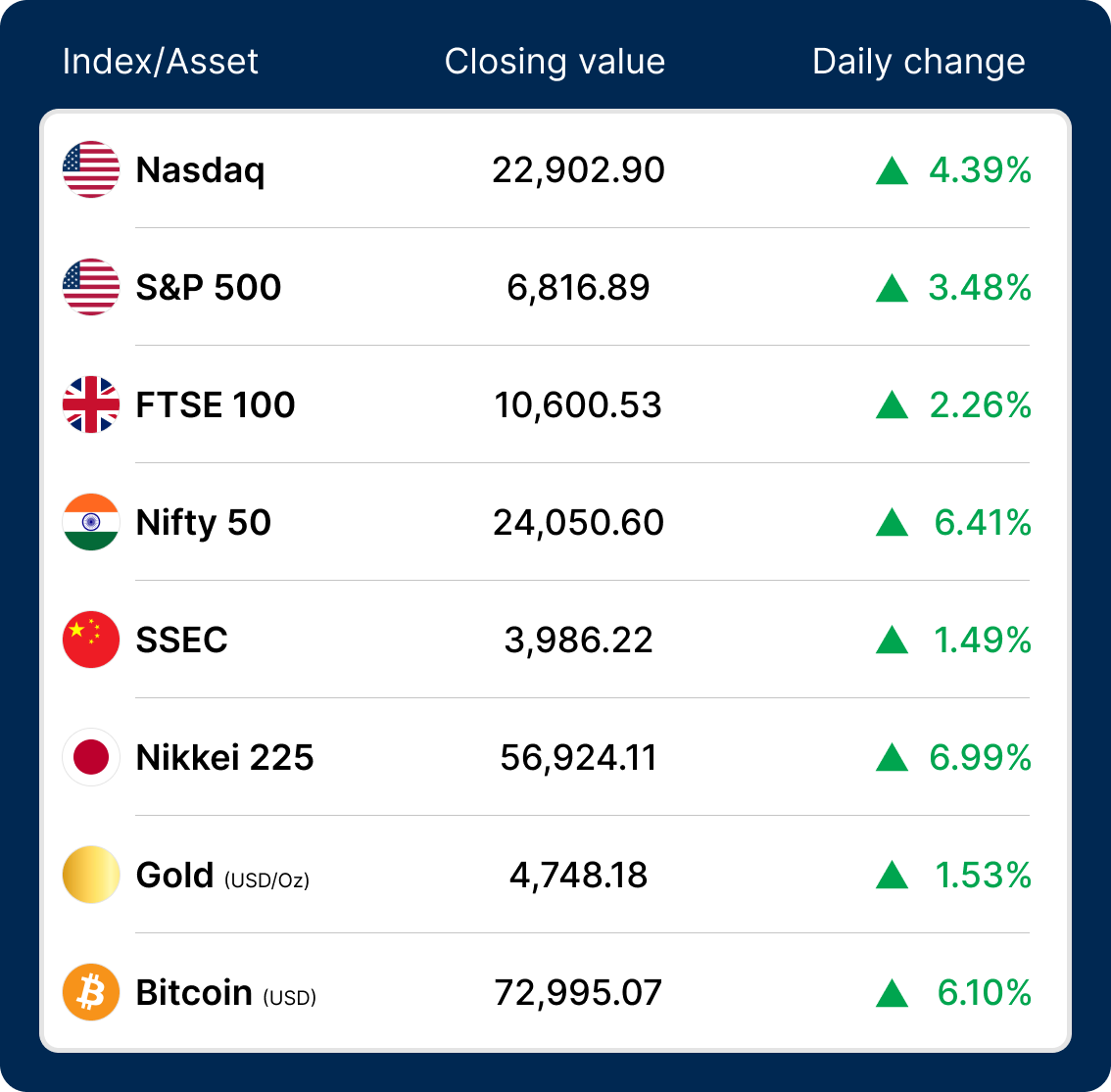
Stock market closing data for the week of Apr 6 to Apr 10, 2026
Index information: STOXX 600 (tracks 600 large, mid- & small-cap EU firms), DAX (top 40 German blue chips), CAC 40 (leading French stocks), Nikkei 225 (225 top Japanese stocks), CSI 300 & SSEC (mainland China A-shares), and Hang Seng (large-cap Hong Kong-listed firms). For these indices, we track 1-week returns to capture how global sentiment is shifting.
News Summaries
AMD +12%, Broadcom +18% as AI Capex and Cloud Networking Spend Accelerate
Shares of Advanced Micro Devices (AMD) climbed ~12% this week, as investors leaned into the AI server cycle expected to drive hundreds of billions of dollars in data-center capex over the next two years. AMD’s data center segment has already been growing at 40%+ YoY, and markets are pricing it as a major beneficiary of AI accelerator deployments beyond its traditional CPU base.
Comments from Andy Jassy indicated Amazon could potentially commercialize its own AI chips, highlighting how hyperscalers are seeking tighter control over AI hardware stacks. With Big Tech projected to spend $450B–$600B annually on AI infrastructure by 2026, this raises competitive intensity for established GPU and accelerator vendors.
At the same time, Broadcom outperformed with an ~18% weekly rally, supported by strong demand for networking and infrastructure silicon critical to AI data center scaling. Broadcom derives a significant share of revenue from switching, interconnect, and custom silicon that enable high-bandwidth AI data traffic, an often overlooked but essential layer of the AI stack.
The moves show that the AI cycle is lifting not only compute chip makers but also the high-speed connectivity backbone required to move massive AI workloads across cloud infrastructure. Together, AMD and Broadcom reflect how both processing power and data movement are becoming equally critical and increasingly well-funded in the AI era.
Nebius +35%, CoreWeave +26% as AI Cloud Deals and M&A Buzz Re-rate GPU Infra
Shares of Nebius surged over 35% this week, climbing to multi-month highs as speculation around a potential acquisition by AI21 Labs gained traction. Nebius is now trading at a trailing 12-month revenue multiple well above peers, reflecting investor appetite for companies with immediate GPU capacity and scalable AI compute.
The rally comes as estimates suggest global AI infrastructure spending could exceed $450 billion annually by 2026, with GPU cloud and specialised compute growing fastest. Nebius’s rising valuation signals markets are valuing GPU-dense capacity as a strategically scarce asset, especially for training and inference of large language models.
At the same time, CoreWeave climbed ~26% this week after signing a multi-year GPU cloud services deal with Anthropic. The agreement provides CoreWeave with revenue visibility as customers commit to sustained GPU usage, with enterprise contracts in the tens of millions annually – a rare level of forecastable demand in the AI infra universe.
Together, the moves in Nebius and CoreWeave illustrate how markets are beginning to differentiate between generic cloud compute and AI-optimised GPU infrastructure — rewarding companies that can deliver high-density GPU clusters and long-term utilisation, rather than just theoretical growth. With enterprise AI adoption accelerating, these names are increasingly seen as direct proxies for the expanding AI compute economy.
Palantir Slid as Burry, Trump-Linked Views Add to AI Rotation Pressure
Shares of Palantir Technologies slid approximately 14% this week, underperforming broader tech as investors rotated out of high-growth software amid macro headwinds and sector rebalancing.
The weakness accelerated after hedge fund veteran Michael Burry was reported to have significant short exposure in several mega-cap tech names, highlighting growing scepticism on stretched valuations in AI-linked equities.
At the same time, political noise amplified uncertainty. Former President **Donald Trump’s ongoing commentary on regulatory scrutiny and defence spending has refocused attention on government/defence budgets — a key part of Palantir’s revenue base — contributing to volatile sentiment in names tied to public contracts and intelligence analytics.
Despite the stock decline, Palantir continues to post strong growth metrics, including ARR expansion in the low-30s% range, with stable commercial and government contracts in AI governance and analytics. However, markets appear to be discounting these fundamentals amid broader rotation to more infrastructure-orientated plays.
Why it matters: The price action underscores how macro narratives, hedge fund positioning, and political commentary are increasingly influencing the performance of AI and analytics stocks, even when core growth metrics remain healthy.
Private Markets Pulse | Tata Power Partners with Databricks to Accelerate Energy Transition
Tata Power, one of India’s largest integrated power firms with a diversified portfolio spanning 16 GW+ of generation and renewable assets, announced an enterprise-wide partnership with Databricks to deploy a unified data and AI platform aimed at accelerating its digital transformation and energy transition strategy.
Under the collaboration, Tata Power will adopt Databricks’ platform across all business clusters from smart grid management and renewable forecasting to power planning, billing optimisation, and customer analytics enabling near-real-time insights at scale. A key part of the rollout is the integration of Databricks’ Genie AI agent, which allows employees to “talk to data” and generate dashboards, insights, and analytics faster.
Management says this unified data infrastructure will improve operational efficiency across solar manufacturing, rooftop solar, and grid distribution while supporting Tata Power’s commitment to Net Zero before 2045. The platform aims to eliminate data silos and democratize analytics across the organization.
For the broader energy and AI markets, the tie-up underscores how enterprise AI adoption is moving beyond tech sectors into industrial transformation, with data and AI platforms becoming core to sustainability, grid flexibility, and next-generation energy systems.
For investors tracking Databricks closely, Vested provides access to invest in Databricks through a Private Markets offering.
