 Skip to content





Welcome to Vested Shorts,

The World in a Week: How Major Markets Moved
United States | U.S. equities ended mixed. The S&P 500 briefly crossed 7,000 before pulling back to finish slightly higher. Large-cap value outperformed, while small- and mid-caps lagged. Consumer confidence fell sharply to 84.5, the lowest since 2014. Jobless claims stayed low. Durable goods orders rebounded, producer prices rose more than expected, and the Fed held rates steady at 3.50%–3.75%.
Europe | European stocks edged higher, with the STOXX Europe 600 up 0.44%, as earnings optimism offset trade and geopolitical concerns. Economic growth in the eurozone beat expectations, while confidence improved. UK data showed weaker labor conditions and falling mortgage approvals.
Japan | Japanese equities declined, with the Nikkei 225 down 0.97%. Technology stocks weakened on AI spending concerns, while yen strength pressured exporters. The 10-year JGB yield eased to 2.23% after softer inflation data.
China | China’s markets were largely flat. The CSI 300 rose marginally, while the Shanghai Composite slipped. Several provinces lowered their 2026 GDP growth targets, signalling a cautious outlook.
India | Indian equities ended slightly lower. Foreign investors were net sellers in Jan, the rupee stayed weak near 92, and bond yields hovered around 6.70%.
Commodities | Oil stayed range-bound. Metals slipped on Friday amid uneven global growth signals.
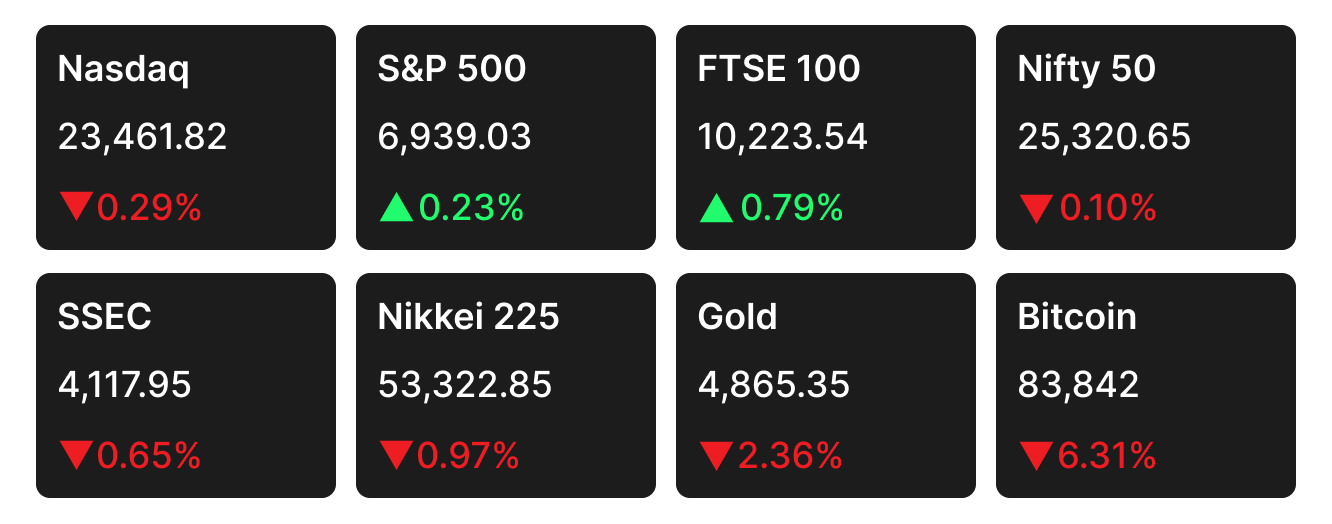
Stock market closing data for the week of Jan 26 to Jan 30, 2026
Index information: STOXX 600 (tracks 600 large, mid- & small-cap EU firms), DAX (top 40 German blue chips), CAC 40 (leading French stocks), Nikkei 225 (225 top Japanese stocks), CSI 300 & SSEC (mainland China A-shares), and Hang Seng (large-cap Hong Kong-listed firms). For these indices, we track 1-week returns to capture how global sentiment is shifting.
News Summaries
AI Spending Gets Two Very Different Reactions
This earnings season is showing two very different reactions to artificial intelligence spending.
Meta shares jumped over 10% after the company showed that AI investments are helping its business. Strong guidance and steady ad growth gave investors comfort that the spending is paying off.
Microsoft shares fell about 10% after the company reported slower growth in its Azure cloud business and higher spending on AI and infrastructure. The stock saw its sharpest fall since 2020.
Meta said it plans to spend $115 to $135 billion on AI this year. That is almost double what it spent last year. Investors were comfortable with that because revenue grew 24% year over year and profits remained strong. The stock added more than $176 billion in market value.
Microsoft told investors demand is still strong, but execution is the problem. Azure growth slowed, capital spending jumped 66%, and the company said it is facing compute capacity limits. Even with a large order backlog, investors want clearer signs that spending will translate into earnings.
The message from the market is simple. AI demand is real. But spending alone is no longer enough. Companies now need to show results.
Also read: Why Meta Rose on Earnings and Microsoft Fell
Fed Holds Rates, Powell Defends Independence
The US Federal Reserve voted to keep interest rates unchanged at 3.5% to 3.75%, saying the economy is expanding at a solid pace. Markets had widely expected the pause after three rate cuts last year.
Fed Chair Jerome Powell used the press conference to strongly defend central bank independence, saying credibility is hard to restore once it is lost. His comments came amid political pressure and a federal investigation linked to testimony on Fed building renovations.
Powell said the economy continues to surprise on the upside. Job growth is slow but unemployment has eased, while inflation remains above the Fed’s 2% target. Policymakers said recent data gave them confidence to hold rates steady.
Two officials dissented in favor of a cut, but the broader message was patience. The Fed said it will stay data dependent, leaving room for cuts later this year if conditions allow.
The bigger signal was not about rates. It was about credibility. With Powell stepping down in May and political pressure rising, markets are watching closely to see whether the Fed can remain independent as leadership changes approach.
Key Headlines of the Week
Costco Takes Instacart Tech to Europe | Costco will use Instacart’s white-label technology for online grocery ordering and same-day delivery in Spain and France, extending their partnership beyond North America. The move supports Instacart’s push into higher-margin enterprise services, now nearly 30% of revenue, while helping Costco strengthen its digital presence. Instacart shares rose, while Costco fell.
Apple’s China Sales Jump on iPhone 17 | Apple reported a 38% surge in China revenue to $25.5 billion, its strongest quarter in the region since 2021, driven by demand for the iPhone 17. Upgrades and new users lifted the installed base to record levels, while India also posted record quarterly sales.
Amazon in Talks for Major OpenAI Investment | Amazon is in discussions to invest up to $50 billion in OpenAI and expand its cloud partnership, potentially integrating OpenAI’s models across its platforms. The talks highlight OpenAI’s growing capital needs and the deepening ties between AI developers and cloud providers.
