 Skip to content





Welcome to Vested Shorts,

The World in a Week: How Major Markets Moved
United States | U.S. equities slipped in the holiday shortened week, with light volumes and tech lagging the most. Energy was one of the few bright spots as oil prices firmed early in the week, while Fed minutes reinforced that policymakers are split on how soon further rate cuts should come.
Europe | European stocks pushed to fresh highs, with the STOXX Europe 600 up about 1.3% on the week as sentiment improved and major indexes advanced.
Japan | Japanese equities eased, with the Nikkei 225 down 0.3% and TOPIX down 0.4%. Bond yields stayed elevated as expectations of gradual Bank of Japan tightening persisted, keeping the yen in focus.
China | Mainland markets were mixed in a shortened week, while Hong Kong gained. December manufacturing PMI moved back into expansion at 50.1, supporting the view that Beijing may lean toward measured support rather than a large stimulus burst.
India | Indian markets took comfort from RBI liquidity support, with the central bank set to inject about ₹2.90 trillion via bond purchases and a $10 billion USD/INR swap, helping ease funding stress even without immediate rate cuts.
Commodities | Gold stayed elevated after a record 2025 and started 2026 strong, while silver remained volatile but supported by tight supply and strong demand trends. Oil hovered around the low $60s for Brent amid ample supply and a cautious demand outlook.

Stock market closing data for the week of Dec 29, 2025 to Jan 2, 2026
Index information: STOXX 600 (tracks 600 large, mid- & small-cap EU firms), DAX (top 40 German blue chips), CAC 40 (leading French stocks), Nikkei 225 (225 top Japanese stocks), CSI 300 & SSEC (mainland China A-shares), and Hang Seng (large-cap Hong Kong-listed firms). For these indices, we track 1-week returns to capture how global sentiment is shifting.
News Summaries
Tesla is asking investors to underwrite its next identity
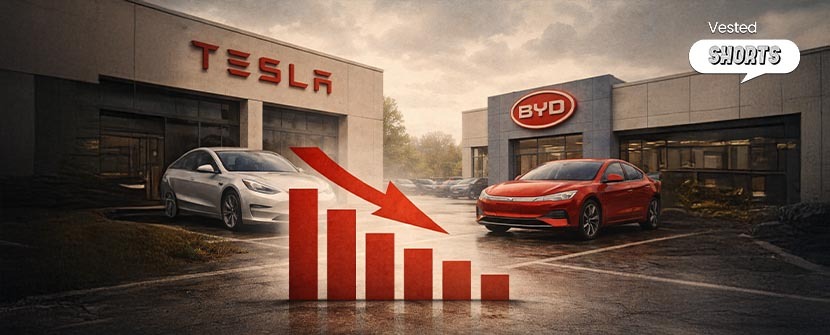
Tesla is no longer winning on what built its business. Vehicle deliveries have fallen for two years, and BYD now sells more electric cars annually. Europe is weak, China is competitive, and US demand was temporarily supported by incentives that are gone.

This is not about a bad year. It is about a missing product cycle. Tesla has not launched a genuinely new, affordable mass market vehicle in years. The Cybertruck did not solve that gap. Cheaper versions of existing models did not either.
Yet the market still values Tesla at roughly $1.5 trillion. That tells you what investors are really buying. Not cars. Not margins. They are backing a reinvention led by Elon Musk into autonomy and robotics.
The risk is clear. If that future arrives late or smaller than promised, the valuation has nothing to fall back on. Tesla is no longer a company being priced on execution. It is being priced on conviction.
India is moving upstream in electronics
India has approved $4.6 billion in electronics component investments, and the signal is clearer than the headline suggests. These approvals focus on components, not finished devices. Camera modules, display parts, enclosures, and other sub assemblies that decide cost, reliability, and control in electronics supply chains.
Assembly was never the hard part. Components are. That is where delays happen, margins sit, and dependencies build. Bringing players like Samsung and Tata Electronics into this layer changes India’s role from assembler to supplier.
This also explains why the timing matters. As Apple shifts more iPhone production to India, assembly alone does not anchor supply chains. Components do. Localising high value sub assemblies and starting fab linked production reduces exposure to external shocks and makes India harder to replace.
For investors, the compounding opportunity sits upstream in component makers, precision manufacturing, and suppliers that scale quietly over time.
Meta is choosing certainty in an uncertain AI race
Meta Platforms is acquiring Manus at a valuation above $2 billion, and the real story is not cross border politics or another AI headline. It is impatience. Meta has spent billions building models, hiring researchers, and laying infrastructure. What it has not had is a widely adopted AI agent that businesses already pay for.
Manus changes that immediately. It is not a research bet. It is a commercial product with roughly $125 million in annualised revenue and a clear use case. That matters because AI models alone do not create businesses. Applications do. Meta is effectively buying proof that AI agents can be sold, deployed, and scaled today, not promised tomorrow.
The clean exit from Chinese ownership is tactical, but secondary. The real intent is to shorten the distance between AI spend and AI returns. Meta is no longer asking whether agents will become the interface for work. It is deciding that they will, and paying to skip the learning curve.
This is Meta moving from belief to execution.
Reflecting on 2025: A Year of Building

As we start 2026, we took some time to look back at 2025 at Vested.
Throughout the year, most investors stayed invested even during volatility, with over 42% adding to their portfolios more than once. Portfolios became more balanced too, with 41% holding both stocks and ETFs, and average global portfolio sizes continuing to grow steadily.
Behind the scenes, we focused on improving the investing experience, expanding global investing options, and building with a growing team across product, operations, and support.
We have captured the full picture, including key platform updates and community milestones, in our 2025 year-end review.
Key Headlines of the Week
Citadel vs Millennium Shows Alpha Is Harder | Citadel’s Wellington fund returned 10.2% in 2025, slightly behind Millennium at 10.5%. Both lagged peers like Balyasny and D.E. Shaw, highlighting how tougher market conditions are squeezing even the largest multi strategy funds.
Lexus Benefits From Product Discipline | Toyota’s Lexus brand is set to deliver over 360,000 vehicles in the U.S. in 2025, with SUVs making up more than 80% of sales. A steady focus on hybrids and refreshed models is paying off as rivals struggle with EV demand.
ITC Hit by Policy Shock | ITC lost over $7 billion in market value after India raised cigarette excise duties. Analysts warn sharp price hikes may be needed to protect margins, risking lower volumes and reminding investors how quickly policy can reset expectations.
