 Skip to content







The World in a Week: How Major Markets Moved
United States | U.S. markets advanced in a holiday-shortened week, with the S&P 500 and Dow hitting record highs. Sentiment was supported by strong GDP growth of 4.3% and AI optimism, though consumer confidence weakened. Small caps lagged, while gold and silver extended their rally.
Europe | European equities ended mixed. Germany’s DAX edged higher, while France, Italy, and the UK slipped. The Bundesbank projected a gradual German recovery from 2026, though business surveys remained cautious. UK data pointed to softer growth and expectations of further rate cuts in 2026.
Japan | Japanese equities gained, led by technology stocks amid AI optimism. Bond yields rose as expectations of further Bank of Japan tightening persisted. The yen strengthened modestly after officials warned against speculative currency moves.
China | Chinese markets rose despite weak underlying data. Retail sales growth slowed and fixed asset investment remained under pressure, but policymakers signaled continued support without announcing fresh stimulus.
India | Indian markets responded positively after the RBI announced a ₹2.9 trillion liquidity injection. Government bond yields fell, reflecting the central bank’s focus on easing funding stress through liquidity measures rather than rate cuts.
Commodities | Gold held near $4,500 an ounce and silver remained elevated, while Brent crude hovered around $60 amid ample supply.
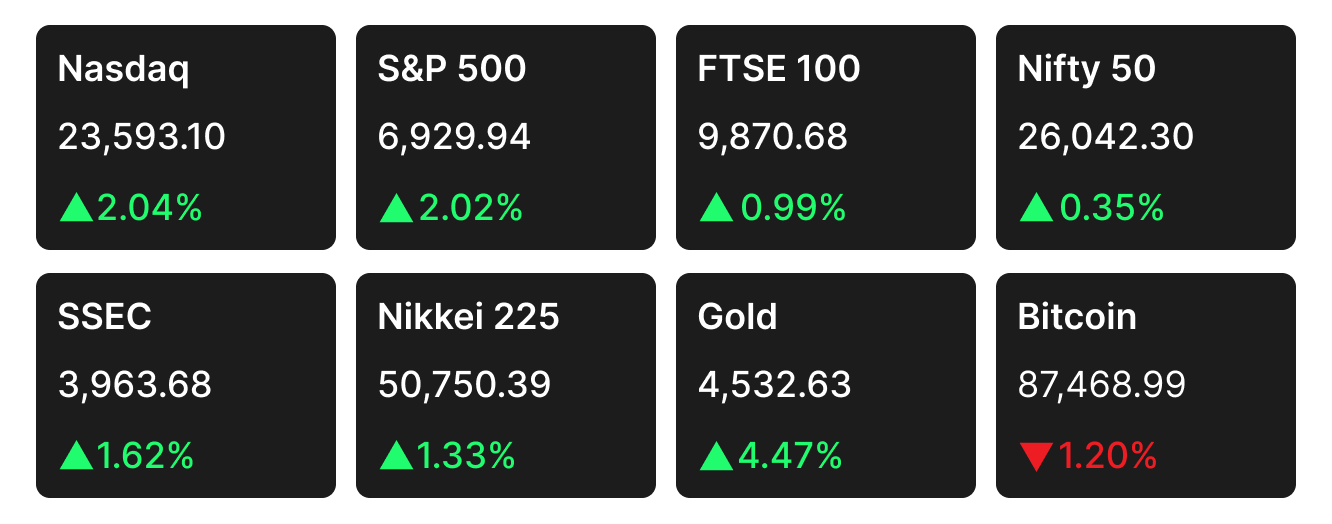
Stock market closing data for the week of Dec 22 to Dec 26, 2025
Index information: STOXX 600 (tracks 600 large, mid- & small-cap EU firms), DAX (top 40 German blue chips), CAC 40 (leading French stocks), Nikkei 225 (225 top Japanese stocks), CSI 300 & SSEC (mainland China A-shares), and Hang Seng (large-cap Hong Kong-listed firms). For these indices, we track 1-week returns to capture how global sentiment is shifting.
News Summaries
Nvidia is trying to absorb what Groq represents
Nvidia has signed a licensing agreement with AI startup Groq, giving it the right to integrate Groq’s low latency chip design into future products.
As part of the deal, several senior Groq executives, including its chief executive, will join Nvidia. Groq will continue to operate independently, and financial terms were not disclosed.
On paper, this looks like another move in the crowded AI partnership landscape. In reality, it reveals how Nvidia is thinking about the next phase of AI computing.
Training large models made Nvidia dominant. Running those models at scale, cheaply and fast, is the next pressure point. That is where companies like Groq were building alternatives, especially in inference focused workloads.
Nvidia is not responding by fighting every new chip with its own. It is selectively pulling new designs and talent into its ecosystem.
This is how Nvidia protects its position. Not by owning every breakthrough, but by making sure most AI workloads still end up running on Nvidia’s terms.
U.S. GDP growth came in hot
The U.S. economy grew at a 4.3 percent pace in the third quarter, far stronger than expected. Consumer spending did most of the work, accelerating to 3.5 percent growth. Corporate profits also jumped sharply, while exports and government spending added support.
At the same time, inflation moved higher. The Fed’s preferred inflation gauge rose close to 3 percent, staying well above target. This growth did not come with price relief.
That combination matters more than the headline number.
This is not an economy overheating because of new investment or productivity gains. It is one still being carried by consumers spending through higher prices and higher interest rates. That is resilient, but it is not comfortable.
For policymakers, this data removes pressure to act quickly. Rate cuts become harder to justify when demand keeps surprising on the upside.
For investors, this reinforces a slower, uneven adjustment ahead. Growth is holding up, but it is also making inflation stickier than markets would like.
ETFs had a flawless 2025
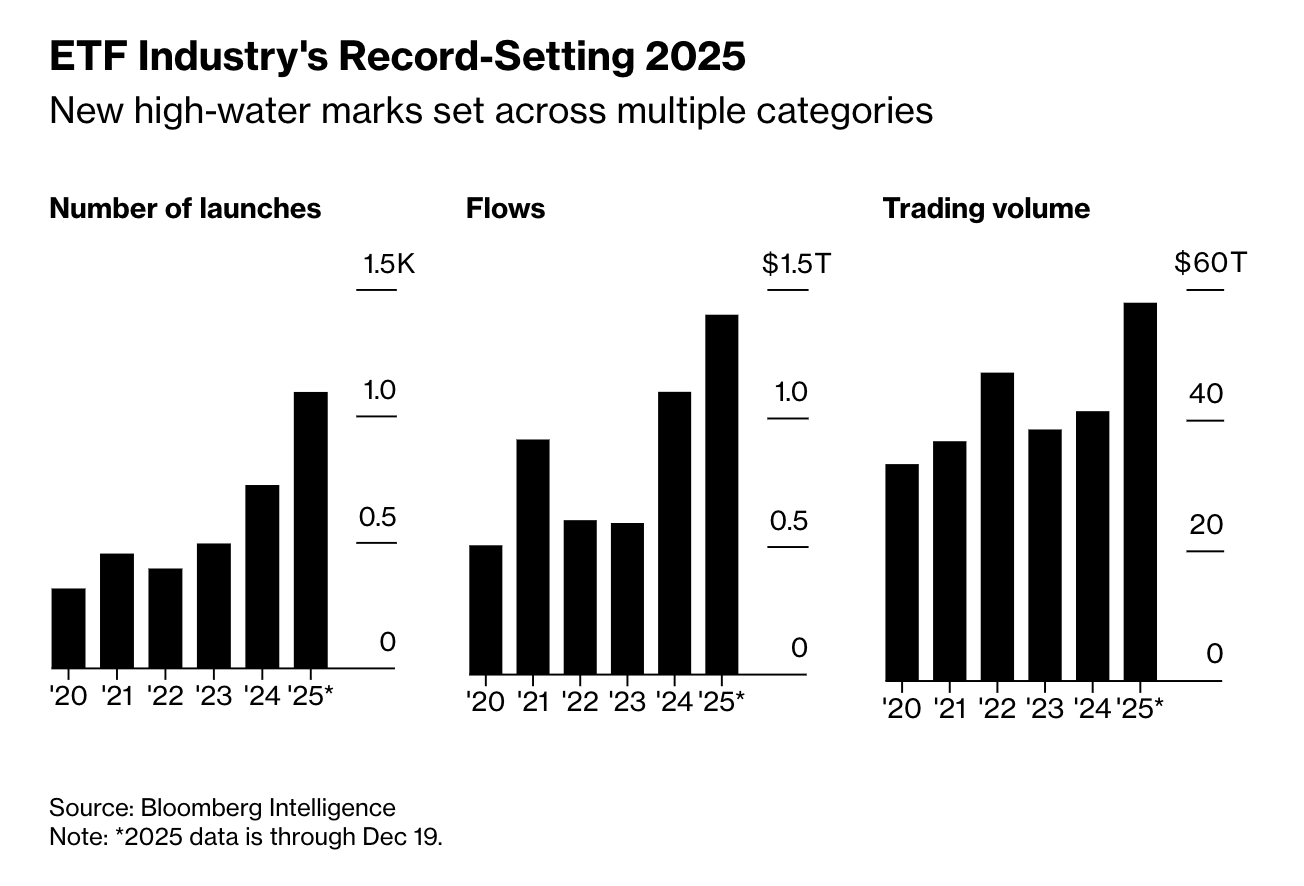
The U.S. ETF industry is closing 2025 with records everywhere. $1.4 trillion in inflows. More than 1,000 launches. Trading volumes at all time highs. The last time all three peaked together was 2021.
That memory should not be ignored.
Back then, flows slowed sharply once markets turned. This time feels similar, not because ETFs are broken, but because behavior is changing. A growing share of launches are leveraged, options based, or single stock products. These are not built for holding. They are built for activity.
Here is the practical takeaway.
When product creation accelerates faster than long term capital formation, investors need to slow down, not chase innovation. Broad, low cost ETFs still do the heavy lifting. Everything else is noise layered on top.
The ETF wrapper is not the risk. How it is being used is.
Perfect years create confidence. Good investors use those moments to simplify, not add complexity.
New on Vested: Asset Transfer Module
Asset Transfer module is now live on Vested
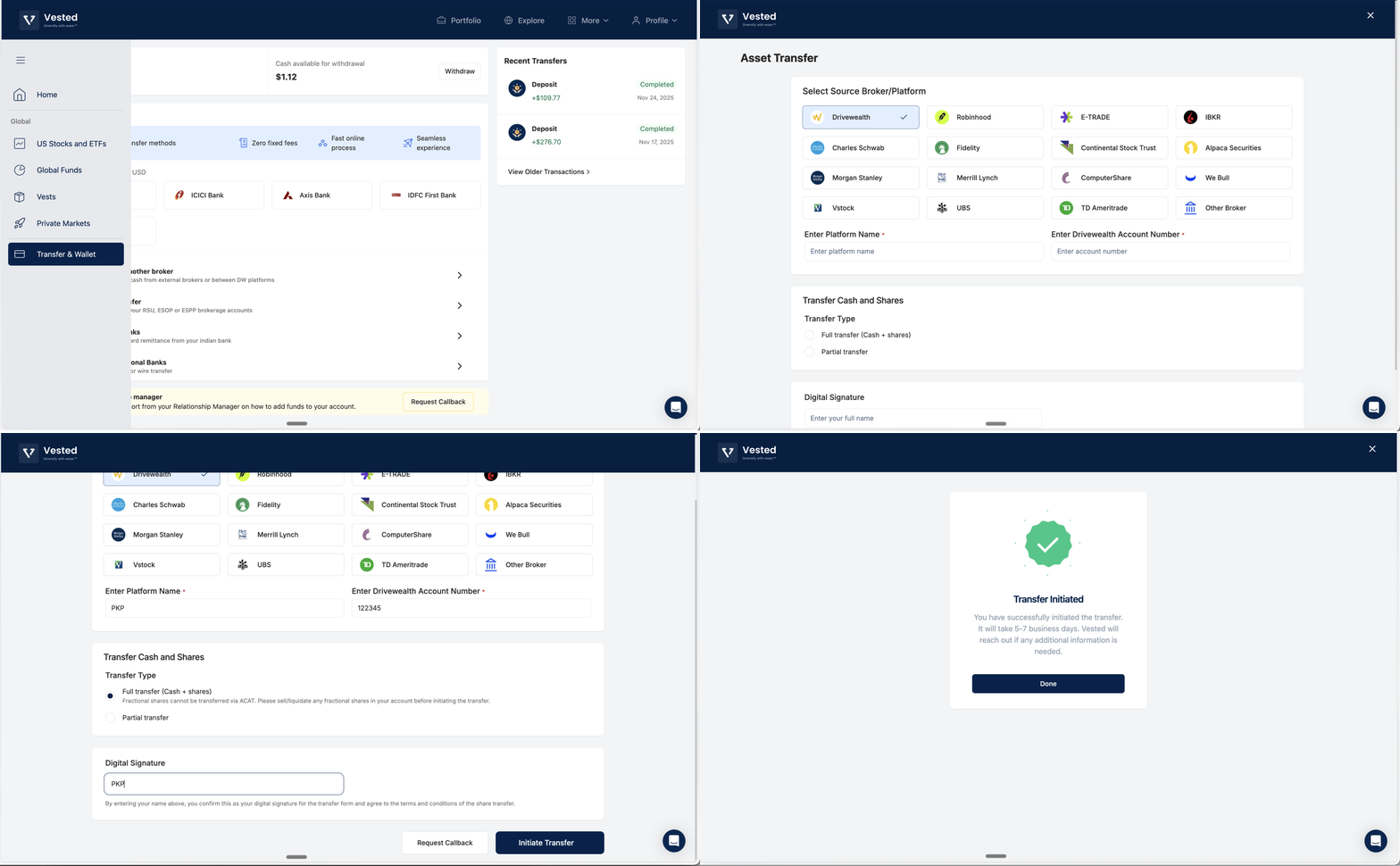
You can now initiate asset transfers directly from the Vested app.
If you hold US stocks, cash, or US-listed RSUs on another platform, you can bring them into Vested and manage everything in one place.
This is useful if you are looking to:
- reduce single-stock concentration (common with RSUs)
- consolidate your US assets
- invest across more options available on Vested
Read the announcement to know more about the Asset Transfer module.
Key Headlines of the Week
Trump Renews Push for U.S. Control of Greenland | President Donald Trump again called for U.S. control over Greenland, citing Arctic security and the presence of Russian and Chinese ships. Denmark and the EU pushed back, reaffirming Greenland’s sovereignty.
Musk’s Net Worth Jumps to $749B After Tesla Pay Ruling | Elon Musk’s fortune surged after a U.S. court reinstated Tesla stock options worth $139 billion, restoring his 2018 pay package and widening his lead as the world’s richest individual.
Gold and Silver Funds Lead 2025 Returns | Precious metals funds topped performance charts in 2025 as gold surged about 60 percent to over $4,300 an ounce and silver hit record highs. Regulators warned that gold and U.S. equities are showing signs of speculative excess.
