 Skip to content






Welcome back to Vested Shorts.

The World in a Week: How Major Markets Moved
U.S. | Stocks rose in a holiday-shortened week after the Supreme Court overturned sweeping global tariffs. Nasdaq gained 1.44%, S&P 500 rose over 1%+, while Dow added 0.25%. Core PCE inflation accelerated to 3.0% YoY, and Q4 GDP slowed sharply to 1.4%. Fed minutes showed policymakers divided, with persistent inflation risks still flagged.
Europe | STOXX 600 hit another record, gaining 2.08%, supported by improving earnings outlook and diversification flows away from U.S. tech. Eurozone industrial production fell 1.4%, but PMI readings surprised on the upside. UK inflation eased to 3.0%, raising March rate-cut expectations.
Japan | Nikkei slipped 0.20% as GDP growth disappointed at 0.2% annualized in Q4. Core CPI cooled to 2.0%, the slowest pace in two years. The yen weakened toward 154 per dollar, while 10-year bond yields eased to 2.10% amid moderated fiscal concerns.
China | Mainland markets were closed for Lunar New Year. Hong Kong’s Hang Seng fell 0.58% on reopening. IMF projects 4.5% growth for 2026 and urged a shift toward consumption-led growth.
Commodities | Oil firmed on rising U.S.–Iran tensions. Treasury yields slipped late week after the equity rally cooled earlier bond gains.
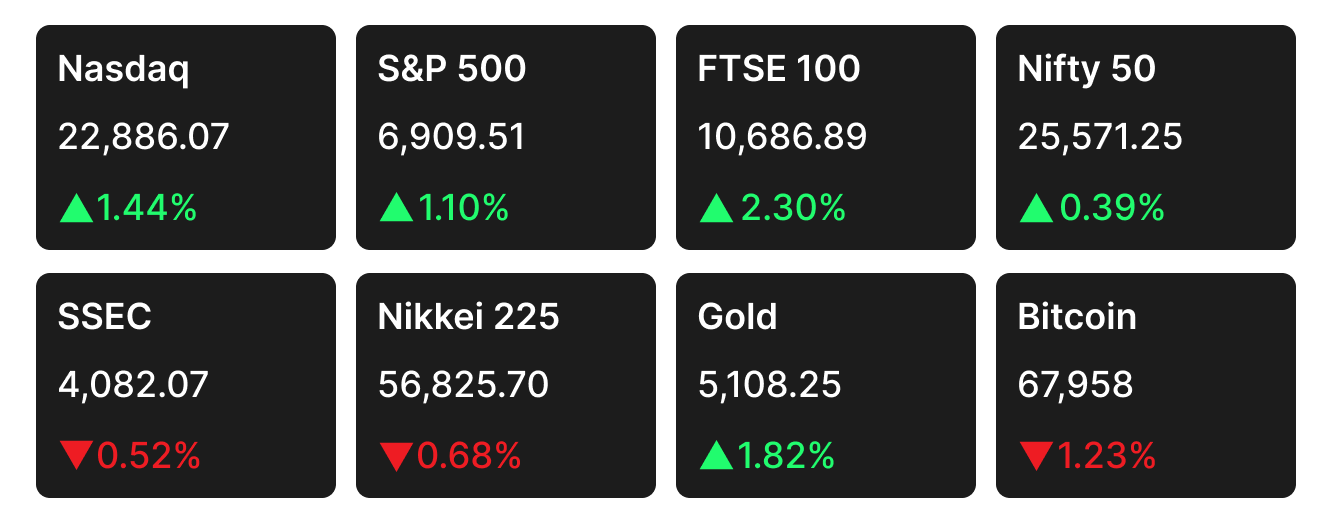
Stock market closing data for the week of Feb 16 to Feb 20, 2026
Index information: STOXX 600 (tracks 600 large, mid- & small-cap EU firms), DAX (top 40 German blue chips), CAC 40 (leading French stocks), Nikkei 225 (225 top Japanese stocks), CSI 300 & SSEC (mainland China A-shares), and Hang Seng (large-cap Hong Kong-listed firms). For these indices, we track 1-week returns to capture how global sentiment is shifting.
News Summaries
Supreme Court Tariff Ruling and 10% Duty Raise Inflation Risks
The Supreme Court of the United States ruled that the President lacks broad emergency authority to impose global tariffs, striking down key trade measures.
The decision removes a major pillar of recent U.S. trade policy.
Markets initially reacted positively, with global equities and export-heavy sectors rising on expectations of lower trade friction. But volatility returned after Donald Trump proposed a temporary 10% global tariff to replace the blocked duties.
This suggests alternative legal routes to sustain trade pressure. During the prior tariff cycle, U.S. customs revenues reached nearly $200 billion annually, though much of the cost was passed on to consumers and businesses.
The ruling could trigger refund liabilities estimated at $130 to 175 billion, potentially widening the fiscal deficit. While a lower trade-weighted tariff rate may ease near-term inflation, renewed proposals risk offsetting those gains and keeping inflation expectations elevated.
For investors, sectors such as semiconductors, autos, and industrials remain highly sensitive to policy signals. Currency markets and emerging economies could also see heightened volatility as trade policy uncertainty re-emerges as a key macro driver in 2026.
Cyber Stocks Fall 6–10% After Anthropic Unveils Claude Code Security
Cybersecurity and cloud software stocks declined after Anthropic introduced new security features in its Claude coding platform, raising concerns about AI-driven disruption. Shares of CrowdStrike and Cloudflare fell about 6–10% intraday, reflecting investor worries that advanced AI agents could automate software development and threat detection workflows.
The move highlights a broader shift in enterprise technology. Cybersecurity spending has grown at 10–15% annually, and the sector delivered 40–60% stock returns over the past year. However, valuation multiples remain elevated, with several companies trading above 15–20 times forward revenue, making them sensitive to disruption risks.
AI-native platforms are increasingly embedding coding, monitoring, and security tools into cloud ecosystems. This could reduce demand for point-solution vendors and compress margins over time. Analysts expect R&D spending and competition to increase as companies invest in AI-driven automation and platform integration.
At the same time, the development reinforces strong demand for AI infrastructure. Global spending on AI compute and data centres is projected to grow 30–40% annually, supporting chipmakers, cloud providers, and networking firms. For investors, the key focus is shifting from software growth to durable platform advantages and infrastructure exposure.
Oil Hits Six-Month High on U.S.–Iran Tensions
Oil rose to a six-month high as tensions between the United States and Iran increased fears of supply disruptions. Brent crude crossed $70–75 per barrel, while WTI traded near $65-70, gaining about 3 to 6% in the last month.
Escalating military and political friction in the Middle East raised concerns over shipping routes like the Strait of Hormuz, which handles nearly 20% of global oil trade. Traders priced in a higher geopolitical risk premium.
Production cuts from OPEC and resilient global demand supported prices. Lower U.S. crude inventories and steady consumption in Asia added upward pressure, tightening short-term supply expectations.
Analysts expect oil to remain in the $70 to $85 range if tensions persist, but any diplomatic progress or supply increase could cap gains. Investors are watching inflation, central bank policy, and global growth for the next directional move.
Private Markets Pulse | OpenAI Targets $280 Billion Revenue by 2030
OpenAI is projecting revenue to exceed $280 billion by 2030, according to the news reported by CNBC.
The company’s annualized revenue crossed $20 billion in 2025, up sharply from roughly $6 billion the year before. Growth is coming from paid subscriptions across consumer and enterprise AI products. OpenAI has also started testing advertising for select users, adding another potential revenue stream.
To support this scale, OpenAI plans to spend about $600 billion on infrastructure by 2030. The company is also close to finalizing the first phase of a funding round expected to raise more than $100 billion, with valuation potentially crossing $850 billion.
For investors tracking OpenAI closely, Vested provides access to invest in OpenAI through Private Markets offering.
