






Welcome back to a new edition,
Markets this week wrote a chapter most allocators will reread for a while.
Cerebras pulled off the biggest US tech IPO since Uber in 2019, soaring 68% on debut Thursday before giving back 10% Friday – a one-week distillation of how exuberant and skittish the AI trade has become.
Trump and Xi met for two days in Beijing, sealed an order for 200 Boeing jets, and parted with no breakthrough on Taiwan or Iran, enough theatre to keep markets hopeful, not enough substance to keep them bid.
April CPI printed at 3.8% annually, the highest reading since May 2023, PPI delivered the biggest monthly increase since early 2022, and on Friday, with Powell’s last day as Fed Chair, odds of a rate hike by December swung to over 34%.
Before we dig in, a quick heads-up: next Saturday, we are hosting a webinar on Global Funds (UCITS) – making sense of the offerings by the world’s biggest fund managers (BlackRock, Fidelity, JPMorgan AM and the rest), how to read across the major fund categories (equity, multi-asset, fixed income, thematic, alternatives), and what an Indian investor with a global portfolio should actually do in a market that just gave us record IPOs, fresh inflation prints, and a leadership change at the Fed in the same five sessions. Details and registration at the bottom of this edition.
Now, let us get into what moved this week.

The World in a Week: How Major Markets Moved
U.S. | U.S. markets ended mixed as optimism around AI and large-cap tech stocks was offset by concerns over rising inflation, higher Treasury yields, elevated oil prices, and geopolitical uncertainty. Energy stocks outperformed, while consumer discretionary, real estate, and materials lagged. Meanwhile, the U.S. 10-year Treasury yield rose to ~4.59%, its highest level in over a year, following hotter-than-expected inflation data.
Europe | European markets declined as geopolitical tensions and concerns over higher energy prices weighed on sentiment, despite broadly robust corporate earnings. The STOXX Europe 600 fell 0.85%, with France’s CAC 40 (-1.97%) and Germany’s DAX (-1.59%) leading losses, while Italy’s FTSE MIB (-0.35%) and the U.K.’s FTSE 100 (-0.37%) posted milder declines.
Japan | Japanese markets delivered mixed performance as profit taking in semiconductor and AI-related stocks weighed on the Nikkei 225 (-2.08%), while the broader TOPIX gained 0.90% amid strength in financials and other value-oriented sectors. Rising domestic bond yields and expectations of further Bank of Japan policy normalisation supported sentiment, though concerns over higher oil prices and rising import costs pressured Japan’s economic outlook.
China | Chinese equities ended lower as early optimism from the Trump-Xi summit and stronger-than-expected macro data faded later in the week. The CSI 300 slipped 0.25%, while the Shanghai Composite declined 1.07%. Hong Kong markets underperformed, with the Hang Seng Index falling 1.63% amid continued caution toward internet and export-sensitive sectors. Investor sentiment was initially supported by hopes of improving U.S.-China relations and resilient trade and inflation data, though the lack of major policy breakthroughs capped gains.
India | Indian markets ended lower amid global risk-off sentiment, persistent foreign investor outflows, and concerns over elevated oil prices and global inflationary pressures. The Indian rupee remained under pressure against the U.S. dollar as rising U.S. Treasury yields supported dollar strength.
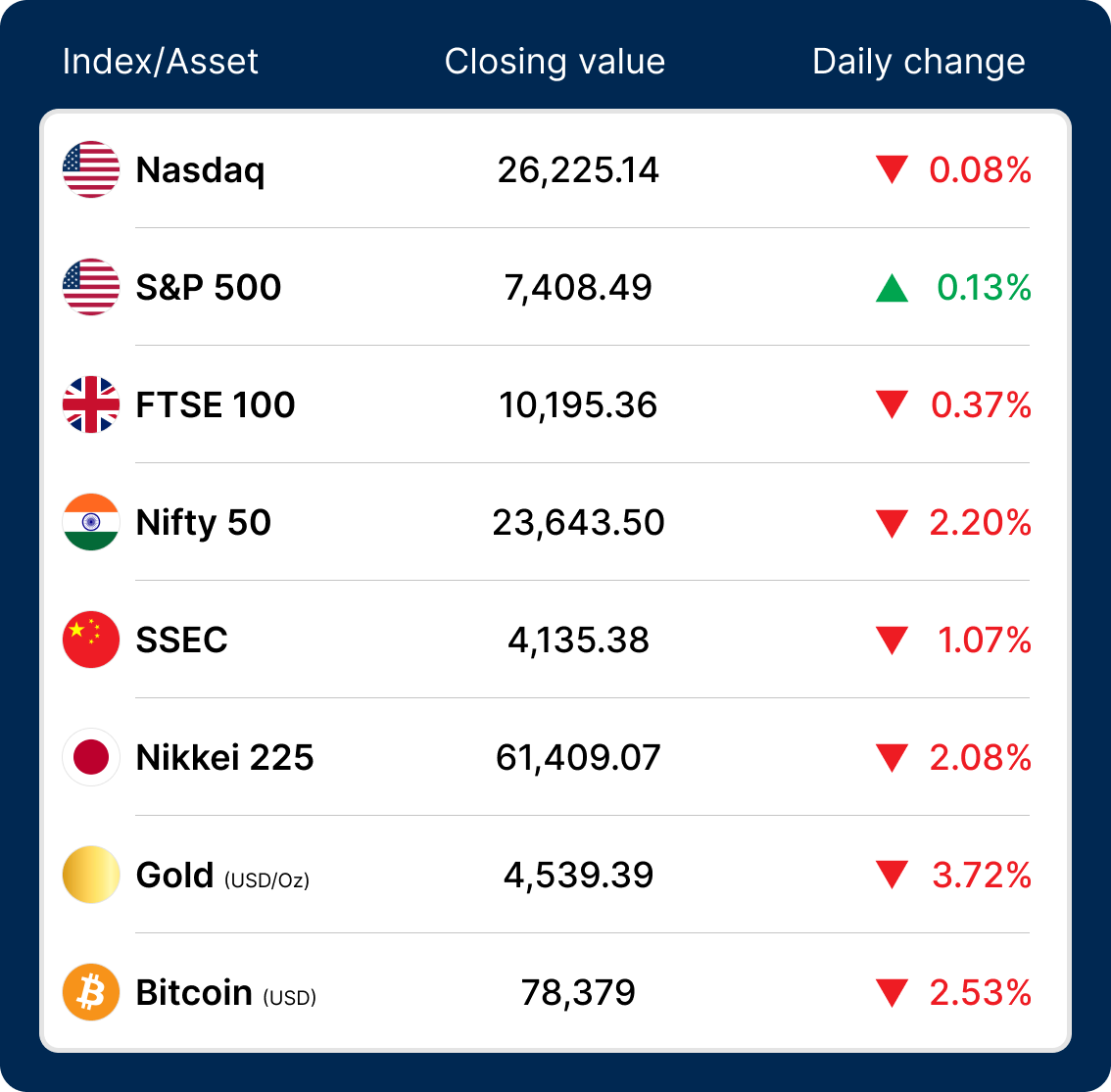
Stock market closing data for the week of May 11 to May 15, 2026
Index information: STOXX 600 (tracks 600 large, mid- & small-cap EU firms), DAX (top 40 German blue chips), CAC 40 (leading French stocks), Nikkei 225 (225 top Japanese stocks), CSI 300 & SSEC (mainland China A-shares), and Hang Seng (large-cap Hong Kong-listed firms). For these indices, we track 1-week returns to capture how global sentiment is shifting.
News Summaries
AMD Declined by 8% This Week as China Summit, Chip Selloff Weigh
Shares of AMD fell roughly 8% this week, underperforming broader markets as semiconductor stocks saw profit-taking after the U.S.–China summit ended without meaningful tech or chip trade progress. The pullback included a roughly 6% intraday drop in one session as Treasury yields rose and risk-off sentiment hit high-beta AI names.
The weakness mirrored a broader chip retreat, with the Philadelphia Semiconductor Index (SOX) down ~5%+ for the week, reflecting pressure across AI accelerators, memory, and foundry names. When macro and geopolitical signals fade, stocks like AMD tend to amplify sector moves due to their AI-cycle positioning.
Fundamentally, AMD remains strong. In its latest quarter, the company delivered $5B+ in revenue, with Data Center contributing $2B+, driven by MI-series AI GPUs and EPYC server CPUs. Gross margins held near ~50%, while data-center and embedded segments posted mid-20% YoY growth, supported by hyperscaler demand and long-term AI server deployments.
Why it matters: Despite multi-billion-dollar revenues, expanding margins, and accelerating AI adoption, AMD’s stock shows how quickly sentiment can turn when geopolitics and yields overshadow execution, a reminder that semiconductor leaders remain tightly linked to macro and trade narratives in the AI era.
Nebius +21% This Week on $200M+ Cloud Contracts & 7x Revenue Explosion
Shares of Nebius climbed ~21% this week, significantly outperforming broader tech as the market rewarded clear revenue acceleration and enterprise cloud demand. The rally was accompanied by well-above-average volume, signaling institutional interest in the company’s AI compute positioning.
According to the latest trading commentary, Nebius’s annual revenue has surged over 7x year-over-year, climbing from roughly $35 million to ~$250 million+ in the most recent four quarters, a rare growth trajectory in the AI cloud infrastructure niche. This has coincided with a sharp raise in booked contracts and reserved GPU capacity commitments.
Market sources note Nebius has secured multiple six-figure to low-seven-figure annual contracts with AI developers and enterprise labs, several of which exceed $10 million per year for dedicated GPU clusters and optimized inference capacity. These reserved books help support forward revenue visibility well into next year.
At the same time, analysts point out this demand is tied to major shifts in how AI models are deployed, with high-throughput GPU compute now critical for training LLMs and generative workloads. Unlike commodity cloud usage, Nebius’s contracted revenue stream is becoming a larger share of total bookings, enhancing both recurring revenue and cash flow durability.
Why it matters: Even in a week when broader semiconductor and cloud markets were choppy, Nebius’s $250M+ annualized revenue run-rate, 7x YoY growth, and multimillion-dollar customer contracts stood out as a real growth story lifting the stock as both growth investors and infrastructure allocators re-rated its valuation.
CrowdStrike +14% This Week as Cyber Demand Surges and Earnings Impress
Shares of CrowdStrike climbed ~14% this week, outperforming broader tech as investors rotated into cybersecurity names amid rising global cyberattack trends and strong financial performance.
In its most recent quarter, CrowdStrike delivered $1.86 billion in revenue (up ~28% YoY) and subscription revenue of ~$1.8 billion (+30% YoY), reflecting the stickiness of its cloud-native security platform. Annual Recurring Revenue (ARR) now exceeds $2.7 billion (+30%+ YoY), underscoring robust demand for its next-gen endpoint and threat analytics solutions. (Coin Central)
At the same time, industry data shows cyberattacks have climbed roughly 43% year-over-year, highlighting that enterprises and governments are expanding budgets for advanced threat detection, incident response, and AI-augmented security tooling all areas where CrowdStrike holds meaningful share.
CrowdStrike’s non-GAAP operating margin has been steadily improving, approaching ~20%+, and its free cash flow run rate now tops $600–$700 million, giving it both growth and profitability levers that appeal to quality-growth investors.
Why it matters: As global security budgets rise alongside escalating threats and AI-driven attack surfaces, CrowdStrike’s multi-billion-dollar ARR and accelerating quarter-over-quarter topline put it in a strong position to capture enterprise spend, a dynamic reflected in its strong weekly stock performance.
Private Markets Pulse | Stripe’s Strategic Stack Deepens Across Fraud, AI Voice, and Agent Core Partnerships
This week, Stripe pushed deeper into the AI-native economy through two strategic integrations that extend its role beyond payments into AI monetization infrastructure.
Stripe partnered with ElevenLabs to power billing and monetization for voice-AI applications, enabling developers to seamlessly charge for synthetic voice usage across global markets. As voice interfaces become core to AI agents, this positions Stripe as the default revenue layer for a fast-growing category of AI-native products where usage-based pricing is essential.
In parallel, Stripe announced integrations with Amazon Web Services AgentCore and Privy, allowing AI agents and applications built on AWS to directly embed identity, wallet, and payment capabilities.
This effectively connects agent execution → identity → wallet → payment into a single programmable flow for developers building autonomous commerce experiences.
These moves signal Stripe’s evolution from a payments processor to a foundational AI commerce layer enabling monetization for voice AI, agent-driven apps, and wallet-native interactions without merchants needing to stitch together separate billing, auth, and settlement systems.
For private markets observers, the takeaway is clear: Stripe is positioning itself at the center of agentic commerce, where AI systems don’t just recommend purchases but execute transactions, and Stripe becomes the financial infrastructure those agents rely on.
For investors closely tracking Stripe, Vested provides access to invest in Stripe through a Private Markets offering.