 Skip to content




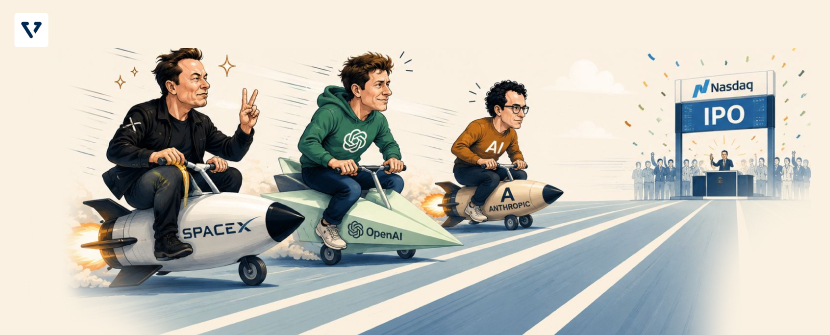
Last month, SpaceX published its IPO prospectus targeting a $1.75 trillion valuation — potentially the largest public offering in history.
The ink was barely dry when Anthropic filed confidential paperwork with the SEC on June 1st. OpenAI is expected to follow within weeks.

Goldman Sachs is reportedly left-leading all three deals with separate internal teams, because even one bank cannot trust its own people not to talk to each other.
Most coverage treats this as three exciting stories that happen to coincide. It is not. It is one story: a race against a very specific deadline, driven by a problem all three companies share. They are all running out of road in the private markets. And the company that gets there last will regret it.
The $200 Billion Queue
Building a frontier AI company costs an extraordinary amount of money, and the bills do not wait. Anthropic is paying a reported $1.25 billion per month just to lease data centre capacity from SpaceX.
That is $15 billion a year for one compute arrangement. OpenAI expects to spend $115 billion on infrastructure over the next four years. These are not companies with a capital problem another private round can solve. Anthropic’s last raise was $65 billion, and investors say it is likely its last.
The early backers — Sequoia, Google, Amazon, and dozens of others — have been sitting on paper gains for years. A public listing converts paper into real money and opens the door to pension funds, sovereign wealth funds, and retail investors who cannot participate in private rounds at all.
But here is the real urgency. SpaceX, Anthropic, and OpenAI are targeting over $200 billion in combined fundraising. There is only so much oxygen in the room. SpaceX eats first on June 12th. Each company that follows fishes from a smaller pond, with investors who have already written large cheques for the category. Go first, get the best terms. Go third, get the leftovers.
There is also a strategic prize nobody talks about. Whichever of Anthropic or OpenAI lists first gets to set the template for how a frontier AI lab reports its financials, framed to suit its own numbers. The first to list writes the playbook. The second inherits whatever narrative the market has already formed. That framing advantage alone is worth billions before a single share changes hands.
Anthropic filed June 1st. OpenAI followed days later. The race ended before most people noticed it had started.
This dynamic has precedent. In 2019, Lyft and Uber went public in the same season. Lyft went first, stumbled, and two months later Uber had to cut its own target valuation — even though the broader market was perfectly healthy. One company’s bad debut became the other’s ceiling, simply because investors had already decided what they thought about ride-hailing valuations as a category. Anthropic has filed ahead of OpenAI. If the market greets Anthropic’s prospectus with scepticism, that mood does not reset before OpenAI prices.
But going first is not automatically safe either. Facebook lost more than half its value in three months after its 2012 IPO. Yet Facebook had the capital, let employees cash out, and recovered from a position of strength. Twitter waited and watched — and never recovered the narrative momentum. The lesson: even a bad debut beats waiting.
The Company at the Centre of All This
If you follow consumer tech, Anthropic feels like the quieter cousin of OpenAI. ChatGPT has cultural presence. Claude is less visible in everyday life. But in the enterprise world, this perception has completely reversed. Anthropic is now winning new business customers at a rate that should worry OpenAI deeply.

The engine driving this is Claude Code — not a coding assistant that autocompletes your Python, but an agentic tool that takes a task, works autonomously through an entire codebase, writes and tests code, fixes its own errors, and ships working software. Developers hand it a problem and walk away.
It launched in May 2025. By November it had crossed $1 billion in annualised revenue, the fastest any enterprise software product has ever done that. Business subscriptions quadrupled in the first six weeks of 2026. Some estimates put Claude Code at 4% of all public GitHub commits today.

The revenue trajectory that followed is genuinely unlike anything in corporate history. In January 2024, Anthropic had an annualised run rate of $87 million.
By December 2024, $1 billion. By July 2025, $4 billion. By December 2025, $9 billion — a level Salesforce took 20 years to reach.

By April 2026, $30 billion, with no historical parallel. By May 2026, $47 billion, at which point the company closed its last private round at a $965 billion valuation and filed for its IPO within days. That is 540x revenue growth in 28 months. Researchers who study corporate history professionally went looking for any comparable case across any industry, in any era. They found nothing.

What the IPO Actually Looks Like
Anthropic has not set a price yet. Investors expect a valuation above $1 trillion. At $47 billion in run-rate revenue, that is roughly 21x. Expensive, until you look at the competition.

Anthropic’s 21x is the relative bargain in a very expensive room, and that framing is part of every institutional pitch being made right now. The company expects $10.9 billion in Q2 2026 revenue, more than double Q1, and is on track for its first ever operating profit of roughly $559 million. All of this lands into an AI market that has already outperformed the world by 80 percentage points since ChatGPT launched in late 2022.

The margins problem sits underneath all of this. In 2024, Anthropic’s gross margin was negative 94% — for every rupee earned, it spent nearly two rupees just to deliver the service. By 2025 this improved to around 40%, still 10 points below its own internal forecast because cloud costs from Google and Amazon ran 23% higher than expected.

Mature software companies operate above 70%. Anthropic targets 77% by 2028. Inference costs have already fallen 90% year over year and revenue is scaling against a relatively fixed cost base, so the direction of travel is real.
But getting from 40% to 77% requires everything to go right simultaneously. Anthropic also counts gross revenue through cloud partners, so the real net figure is likely lower than the headlines.
The Pentagon overhang adds further uncertainty. The US Department of Defense designated Anthropic a supply-chain risk — a label normally reserved for foreign adversaries. Anthropic is fighting it in court and says it could jeopardise billions in revenue. It has not dented momentum so far, but it sits unresolved above the prospectus.
The lock-up time bomb is the risk getting the least attention right now but will matter most twelve to eighteen months from now. When a company goes public, insiders cannot sell immediately. Goldman Sachs has run the numbers: IPOs with floats under 10% historically reach 46% float one year later as lock-ups expire. Applied to all three AI IPOs, that is nearly $500 billion in new stock supply hitting markets through 2026 and 2027.

History is pointed here. Lock-ups from the dot-com boom expired between October 1999 and April 2000, suspiciously close to when markets turned. Blackstone listed in 2007, just before the property sector collapsed. Glencore listed in 2011 at the exact top of the commodities supercycle. Insiders tend to know when public investors are overvaluing the business.
If AI is going to transform the world and these companies will be worth multiples of today’s prices, why are the people who know them best choosing right now to share the wealth with everyone else?
Why This Affects You Even If You Never Buy a Share
When Anthropic joins the S&P 500, every index fund is structurally required to buy its shares automatically. Trillions in passive investment will be redistributed without you touching a thing. Index providers have also shortened the seasoning period before new listings join benchmarks — in some cases down to five days. You get the exposure faster than ever, with less time to assess what you are buying. AI companies already account for two-fifths of the S&P 500’s value. When Anthropic and OpenAI join, that concentration deepens. Bad news for AI will not stay contained to AI stocks. It lands in every pension fund and retirement account in the world.
The Bottom Line
Anthropic is rushing because it has to. The compute bill is real. The private market is tapped. The capital queue has three companies in it and whoever goes last gets the worst deal. Filing right after SpaceX but before OpenAI is the most important strategic decision Anthropic has made since launching Claude.
What it is asking investors to believe: the fastest revenue growth in corporate history will continue, gross margins will nearly double, inference costs will keep falling, and Claude Code will become the default infrastructure for how the world writes software. Some of those things will happen. The IPO is asking which ones, and at what price you are willing to find out.
Dario Amodei once said a twelve-month delay in AI progress would make his company bankrupt. The filing is in. The cakes are being baked. Whether they rise is a question for the rest of 2026.
