





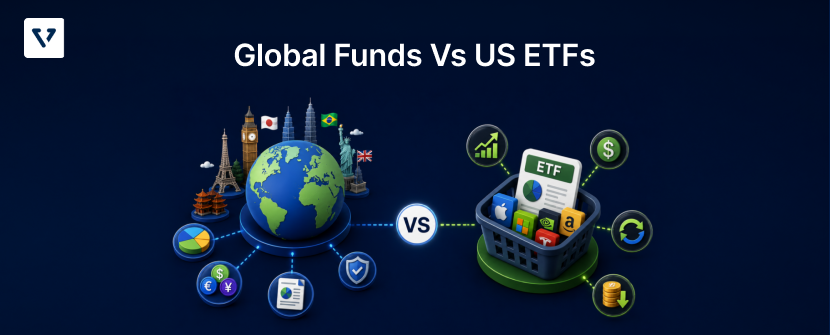
Key Takeaways
- UCITS funds and US ETFs are designed for different investing needs.
- UCITS funds can invest across multiple countries and asset classes, whereas most US ETFs are passively managed and follow an index.
- Consider brokerage charges, forex conversion costs, and other fees to understand the total cost of investing overseas.
- US ETFs may attract US estate tax for large holdings, while UCITS funds generally avoid this risk.
- UCITS funds suit investors seeking a hands-off, diversified approach, while US ETFs are ideal for those who prefer low-cost, passive investing with greater control.
Today, investing internationally has become much easier for Indian investors. Many global investment platforms allow you to invest internationally right from your smartphone.
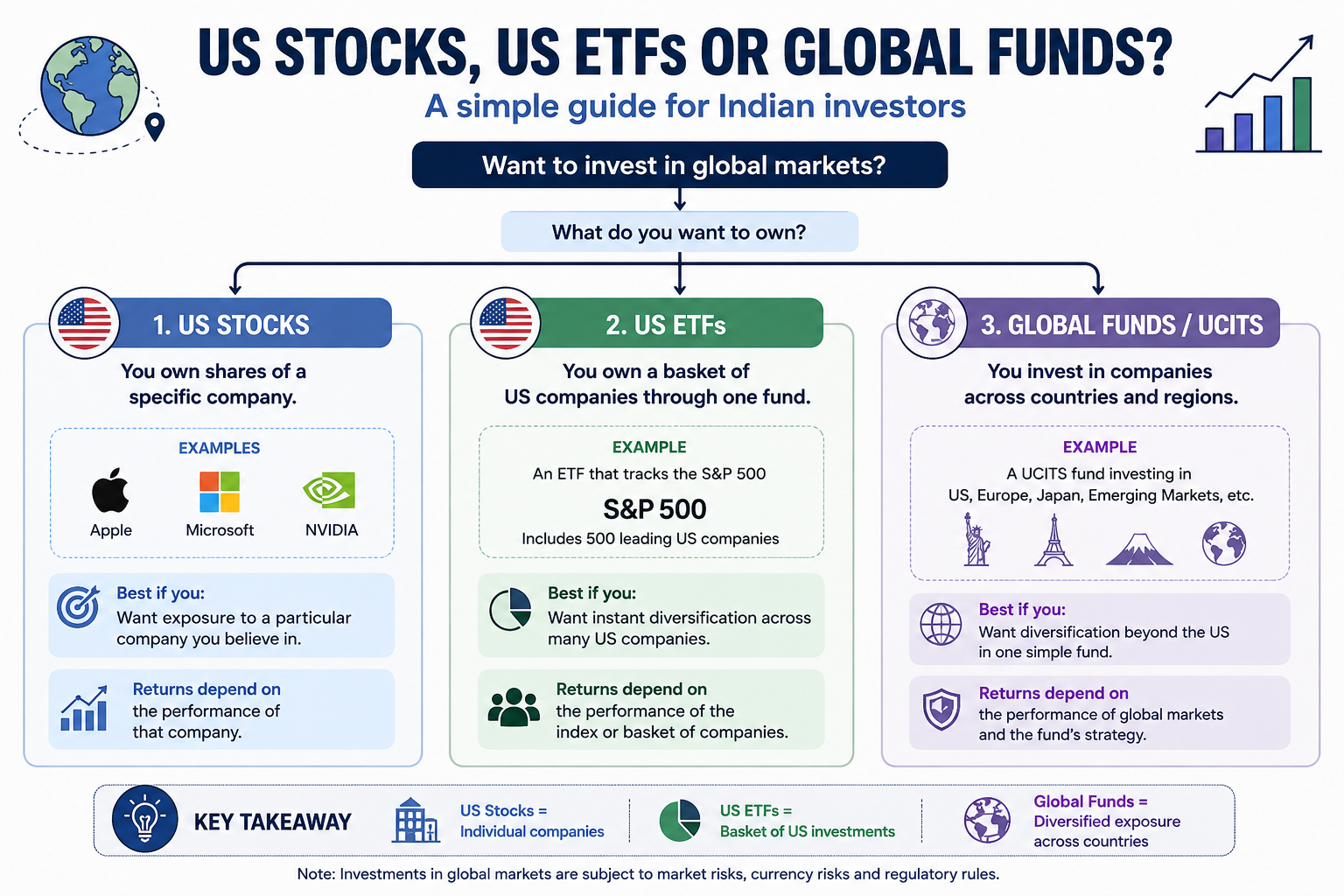
Therefore, for most investors, the question is no longer how to invest internationally. But where to invest? The choices broadly come down to three options: investing directly in US stocks, using a US-listed ETF, or investing through global funds that provide exposure across multiple geographies.
Of the three options, US ETFs and global funds can offer a simpler way to diversify internationally while reducing the risk of getting an individual stock wrong. Also, you don’t have to spend hours researching and tracking individual companies when directly investing in stocks.
In this article, we will look at how global funds and US ETFs can help you invest beyond Indian markets in the most effective way.
What are Global UCITS Funds?
Global UCITS funds are investment funds regulated under the European UCITS (Undertakings for Collective Investment in Transferable Securities) framework, with funds registered in Ireland and Luxembourg. UCITS is not an investment type; a UCITS fund can be structured as either an ETF or a traditional mutual fund.
You can think of global UCITS funds as the global equivalent of mutual funds, where a professional fund manager manages the investments.
Depending on the fund’s objective, the fund manager can invest in securities across markets such as the US, Europe, and Asia, giving a diversified global exposure through a single investment.
They have become popular among international investors because they offer access to multiple markets, a well-established regulatory framework, favorable taxation, strong investor protections, transparency, and professional portfolio management
BlackRock, Fidelity, JPMorgan, and Franklin Templeton are the leading global asset managers offering global UCITS funds to investors.
What are US ETFs?
US ETFs, or US Exchange Traded Funds, are investment funds that hold a basket of securities in their portfolio, just like a mutual fund. But the difference is, unlike mutual funds, ETF units are traded on the stock market. ETFs are most preferred in the US for long-term investing. The total market size of ETFs in the US stands roughly at $15.8 trillion at the end of March 2026.
For example, if you want to invest in top US companies, rather than spending time researching stocks, you can simply buy units of the S&P 500 ETF. It includes all the companies present in the S&P 500 index in the same weight as they are in the index. So, when you are buying a S&P 500 ETF, you are indirectly gaining exposure to 500 of America’s largest listed companies.
Some of the largest US ETFs by AUM include Vanguard S&P 500 ETF (VOO), iShares Core S&P 500 ETF (IVV), and Invesco QQQ Trust (QQQ).
What’s the difference between global funds vs ETFs?
| Factor | UCITS Global Funds | US ETFs |
| Diversification | Can invest across the US, Europe, Asia and other global markets, depending on the fund mandate | Often provide targeted exposure to the US market or a specific US sector/index |
| Cost | Generally higher, especially for actively managed funds; expense ratios can be around 1-2% or more | Generally lower, particularly for passive ETFs; broad US ETFs can have expense ratios below 0.20% |
| Liquidity & Investing | Bought and redeemed at the fund’s end-of-day Net Asset Value (NAV) | Traded on stock exchanges during market hours; price can trade at a premium or discount to NAV |
| US Estate Tax | Generally, outside the US estate-tax framework | US-domiciled assets held by non-US investors can potentially be subject to US estate tax above the applicable $60,000 threshold |
Both UCITS funds and US ETFs provide instant diversification, but UCITS global funds have a distinct advantage.
Most US ETFs are passively managed, tracking a US market index and investing primarily in stocks listed in the country. For example, a Nasdaq-100 ETF gives exposure only to companies listed on the Nasdaq exchange. Likewise, the Vanguard Health Care ETF (VHT) invests exclusively in US healthcare companies.
On the other hand, UCITS funds have no such limitations. If the fund’s objective allows, the fund manager can invest in securities listed across the US, European, and Asian countries. For example, the Fidelity Global Technology UCITS Fund invests in technology companies listed globally and has exposure in the US, Taiwan, the Netherlands, China, and Japan.
If you want diversified exposure across countries through a single investment, UCITS funds are better suited. But if you want targeted exposure to the US market, US ETFs are better.
Costs: Are UCITS Funds More Expensive Than US ETFs?
When you are choosing to invest through ETFs and global funds, cost should be one of the key considerations. While most US ETFs are passively managed and follow an index, they have lower costs. UCITS funds, which are mostly actively managed, have higher costs as they have dedicated fund managers and research teams to manage the investments.
For example, the Invesco NASDAQ 100 ETF (QQQM), a primary proxy for investing in tech stocks in the US, has an expense ratio of just 0.15%. On the other hand, Fidelity Global Technology UCITS Fund has an expense ratio of around 1.9%. More than 10 times higher.
Besides the expense ratio, brokerage and foreign exchange conversion markups also add to the total cost of investing globally. Therefore, comparing the total cost of ownership provides a more accurate picture than looking at the expense ratio alone.
Liquidity and Ease of Investing
US ETFs trade just like any other stock, allowing investors to buy or sell at prevailing rates during market hours. However, if there is not enough liquidity, buying and selling often happens at a premium or discount.
Global UCITS funds are bought and redeemed at the day’s closing NAV. This means investors don’t need to find a buyer or seller on an exchange. The fund itself processes the purchase or redemption and manages the underlying securities accordingly. However, the fund’s ability to meet redemptions can still depend on the liquidity of its underlying assets.
The Hidden Tax Difference: US Estate Tax
One of the major differences that separates US ETFs and UCITS structured global funds is the US estate tax.
Under US tax jurisdiction, if a non-US resident and non-US citizen passes away holding over $60,000 in US-domiciled assets, including US stocks and ETFs, their estate could face US estate taxes ranging from 18% to 40%.
As UCITS funds are domiciled in EU states, they fall outside the purview of US estate tax rules. If you’re building a massive long-term global portfolio, this tax rule alone can be a deciding factor.
Should You Choose UCITS Funds or US ETFs?
As an investor, your decision to choose between the two should be based on the following framework:
| Choose UCITS Funds | Choose US ETFs |
| Global diversification across multiple countries | Focused exposure to the US, sectors or themes |
| Fund manager-led portfolio decisions | Index-led investing with minimal manager intervention |
| One-fund simplicity for your global allocation | Build-your-own portfolio using multiple ETFs |
| Long-term core holding in global markets | Lower-cost, flexible exposure with intraday trading |
When comparing UCITS funds and US ETFs, you cannot simply say that one is better than the other. Each serves a different purpose in your investment portfolio. One offers broad global diversification, and the other offers low-cost exposure and simplicity.
How Can Indian Investors Invest in UCITS Funds and US ETFs?
Indian residents can invest in both options through platforms like Vested Finance. You can invest up to $250,000 per financial year under the Reserve Bank of India’s Liberalised Remittance Scheme (LRS).
After completing KYC and funding your account on the platform, you can invest in US-listed ETFs or explore Global Funds for UCITS funds across categories such as technology, multi-asset strategies, and sustainable investing.

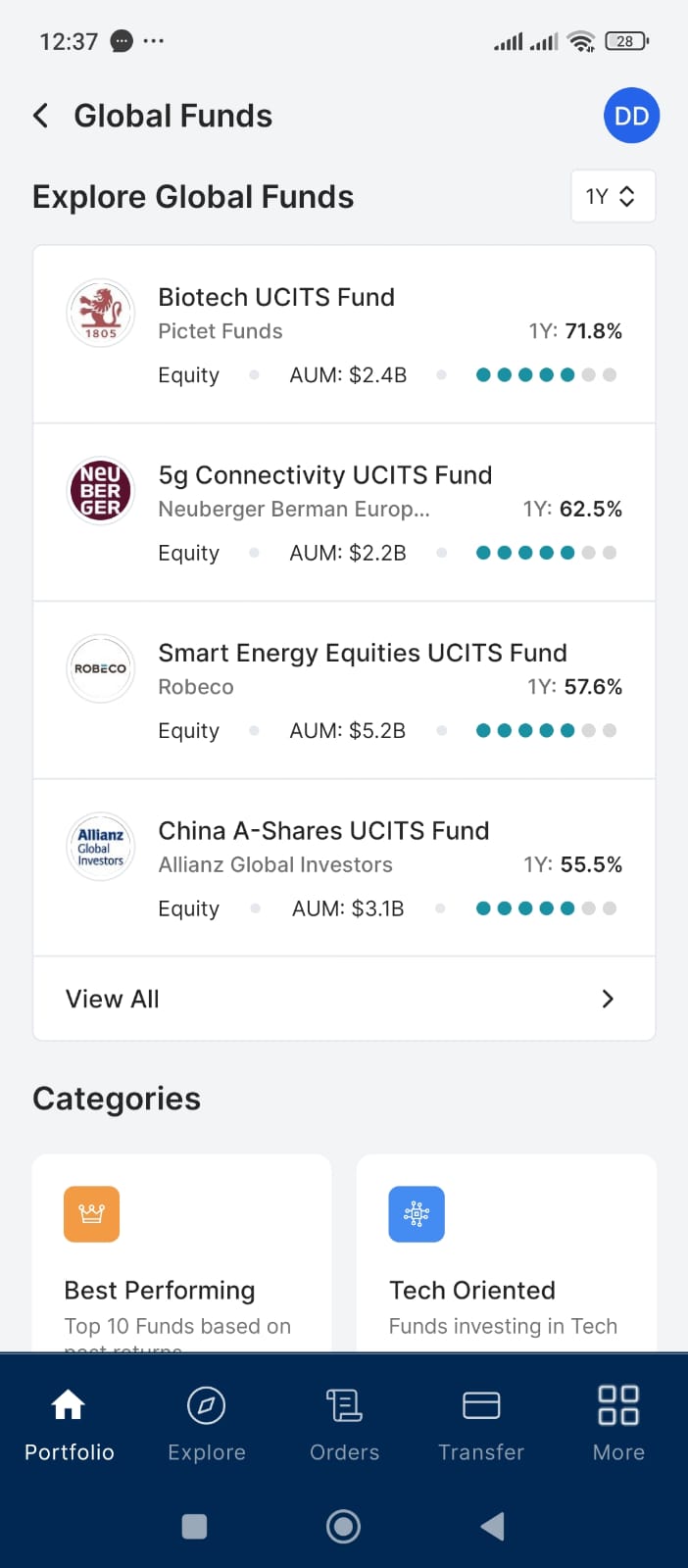
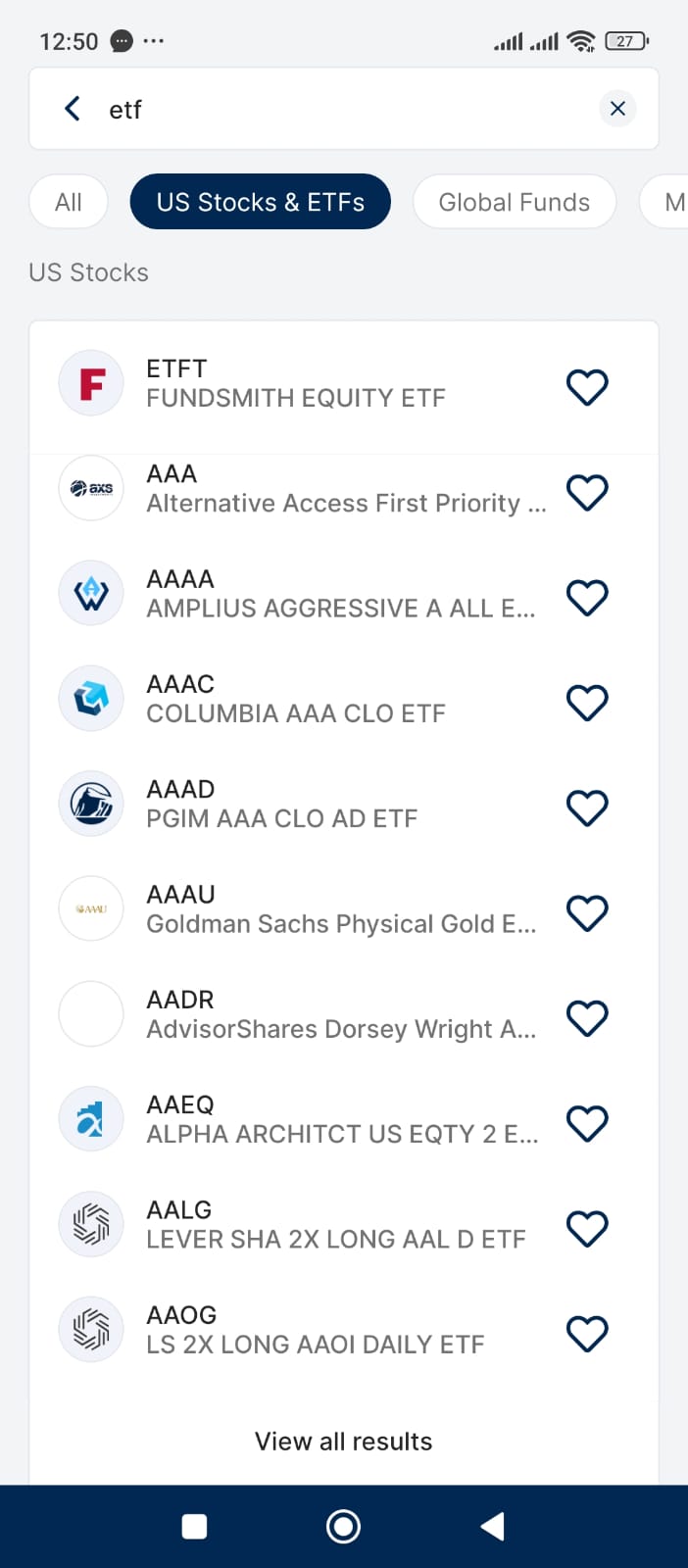
If you’re new to the platform, learn for a step-by-step guide to opening and funding your Vested Finance account.
The Bottom Line
Beyond directly investing in US stocks, US ETFs and UCITS Funds are the two most popular options for investing globally. Their ability to provide instant stock and geographical diversification, along with low costs and high transparency, is making them a core component of a modern investment portfolio.
So, which option should you choose? It depends on your long-term investment objective, risk appetite, taxation, and how you plan to invest. Understanding these differences is crucial before investing overseas.
Frequently Asked Questions
Are global funds and US ETFs the same?
No. Global funds invest across multiple countries and regions, while most US ETFs primarily invest in only US-listed stocks or other US assets.
Which has lower cost: global funds or US ETFs?
US ETFs generally have lower costs. They typically charge lower expense ratios than global mutual funds, although the total cost also depends on brokerage fees, taxes, and currency conversion charges.
Which is more suitable for beginner international investors: US ETFs or global funds?
For most beginners, global funds are often the better choice. They offer instant diversification across countries and are professionally managed. US ETFs can be a good option for investors who want lower costs and more control over their investments, but they may require greater knowledge of markets, taxation, and portfolio management.
