






| Quick Answer- Indian residents can invest in global equities by using India-based international funds, GIFT City funds, or by buying overseas stocks and ETFs through the RBI’s Liberalised Remittance Scheme (LRS). Pick a mix that matches your current portfolio, and make sure to check the total costs, currency risk, taxes, and reporting requirements before you invest. |
| Item | Practical point |
|---|---|
| Routes | India-domiciled international funds; GIFT City outbound funds; direct overseas stocks or ETFs |
| LRS ceiling | US$250,000 per resident individual per Indian financial year for permitted remittances |
| Domestic fund constraint | SEBI overseas securities industry ceiling of US$7 billion; separate overseas ETF ceiling applies |
| GIFT City minimum | Product-specific; DSP Global Equity Fund lists US$5,000 initially |
| Watch before investing | Underlying holdings, overlap, FX spread, fees, taxes, reporting and access limits |
Most Indian investors focus on building an equity portfolio around Indian stocks. They own a few large caps, perhaps some mid-caps and small caps. Or they entirely invest in mutual funds spread across market caps or sectors. Although there is nothing wrong with this approach, one important layer of diversification gets overlooked: geographical.
When you invest only in Indian stocks and mutual funds, you are betting on one country that represents a small slice of the world’s investable equity market. This is why building a global portfolio can add another layer of diversification. And the numbers make the case interesting too.
India is a Small Part of the Global Market
Indian stock market is one of the largest stock markets in the world, with a market capitalisation of nearly $5 trillion, as of September 2026. But it is still a fraction of the global market. The US stock market capitalisation is around $75 trillion; the market cap of the China stock market is more than $15 trillion.
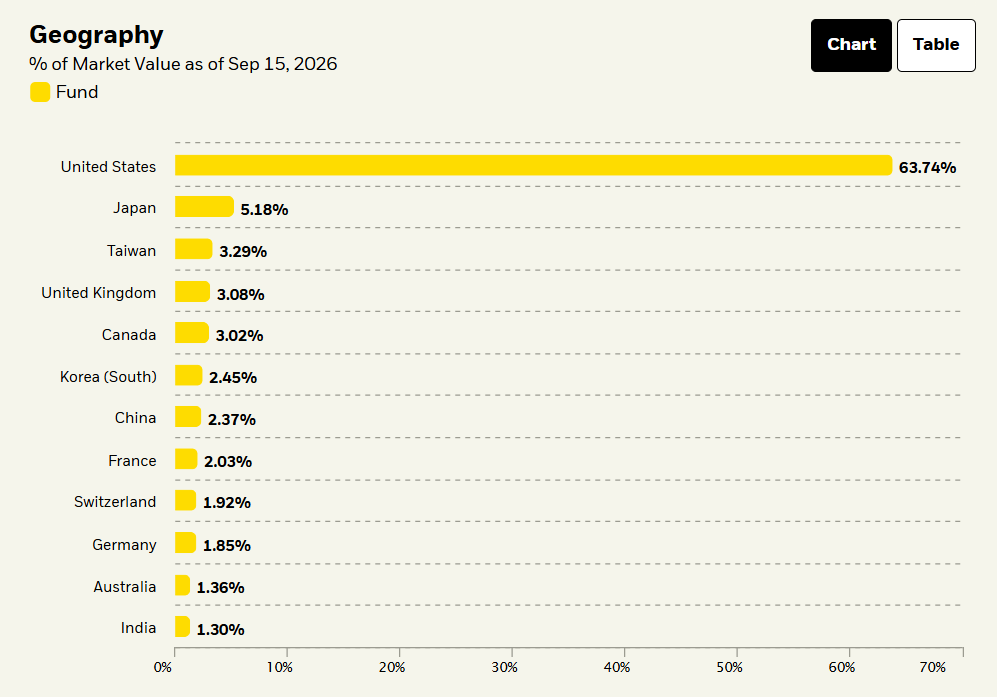
The difference becomes more evident when we look at the MSCI All Country World Index (ACWI), which covers 23 developed and 24 emerging markets. As of September 2026, the approximate country weights are:
The MSCI ACWI index includes large and mid-cap stocks from 23 developed and 24 emerging markets. On 17 September 2026, the iShares ACWI ETF held approximately 1.30% in India; however, this reflects an outdated level of ETF holdings rather than India’s share of the global equity market. Source: MSCI and iShares.
iShares MSCI ACWI ETF Geographical Distribution
Source: iShares MSCI ACWI ETF
The chart above puts India’s position in the global equity market into perspective. An investor owning only Indian stocks or mutual funds is concentrated in a small fraction of the world’s listed equity opportunity. That’s where most of the world’s corporate earnings power is. Almost all the world’s biggest technology, semiconductor, and platform companies are outside Indian markets.
Long-Term Return Data: Nifty 50 vs S&P 500
The table below shows a historical snapshot of the S&P 500 and Nifty 50. Make sure you compare the same return type, currency, end date, and dividend treatment before making any investment decisions based on these indexes.
Long-term Index Returns
| Index | 5 years | 10 years | 15 years |
| S&P 500 | 11.04% | 13.44% | 12.95% |
| Nifty 50 | 6.92% | 11.55% | ~12.1% |
Source: Morningstar and Nifty Indices (as of 16th Sept 2026)
In all timeframes, the S&P 500 index has delivered superior returns compared to the Nifty 50. This doesn’t mean Nifty 50 is a weaker investment. The two indices represent different markets, economies, and sector compositions, and their performance can vary across market cycles. S&P 500 leads because of a higher weight of global IT companies, which operate in high-growth verticals.
This is where a global portfolio can add another layer of diversification. It expands the investment opportunity set beyond India and gives investors access to businesses and markets that may be driven by very different growth trends.
How to Build a Global Portfolio From India
Building a diversified global portfolio from India requires you to identify the right investment routes based on investment objective, cost, and taxation. There are three broad routes through which Indian investors can build an international portfolio.
1. International Mutual Funds and FoFs
Some regular Indian mutual funds provide global exposure through feeder funds or funds of funds (FoF) that track global indices. These funds can be bought in INR through SIP or lump sum, with no LRS limit for the investor, just like regular mutual funds.
However, the mutual fund industry has an aggregate overseas investment limit of $7 billion. When this limit gets exhausted, fund houses may pause fresh investments or SIPs until headroom becomes available. This has been a key limitation for investors seeking global portfolio diversification through this route.
2. GIFT City (IFSC) International Mutual Funds
GIFT City offers a newer route to international investing through funds registered in GIFT IFSC. These funds can invest in global assets and are typically denominated in foreign currency. The investments are routed via the RBI’s LRS framework. Indian investors can invest up to $250,000 in a financial year in funds registered in GIFT City.
However, the bigger limitation through GIFT City can be the minimum investment requirement. The minimum investment amount is $5,000, making it less accessible for smaller investors.
3. Direct Investment in Foreign Stocks/ETFs via the RBI’s Liberalised Remittance Scheme (LRS)
For investors who want greater control over their international portfolio, direct investment in foreign stocks and ETFs can be a more flexible option. Instead of investing through a mutual fund, you can directly invest in US stocks, ETFs, or global UCITS funds and decide how much to invest in each.
For example, platforms such as Vested allow Indian investors to access US stocks and ETFs through the RBI’s LRS framework. You can start investing with as little as $1 through fractional investing. Similarly, you can invest in actively and passively managed global UCITS funds, which are structured similarly to mutual funds.
Compare the routes before you invest
| Route | What you hold | Main trade-off |
| India-domiciled fund / FoF | Units of an Indian scheme | INR access; fund availability and layered costs can vary |
| GIFT City outbound fund | Units in an IFSCA-regulated fund | LRS remittance; product-specific minimum, fee and tax structure |
| Direct foreign stocks / ETFs | Foreign securities through a broker | Control over holdings; FX, custody, tax reporting and instrument-domicile questions |
What Should Be Your Global Asset Allocation?
There is no fixed percentage that works for every investor. The right global asset allocation for India depends on multiple factors, like your investment horizon, risk appetite, income, existing assets, etc.
That said, 10-30% of the equity portfolio in international markets is a commonly suggested range for Indian investors. The idea is not to replace Indian equities, but to reduce the concentration that comes from investing only in one country.
A Simple Way to Think of Global Asset Allocation
| Investor profile | Indian equities | Global equities |
| Conservative | 90–95% | 5–10% |
| Moderate | 75–90% | 10–25% |
| Growth-oriented | 70–80% | 20–30% |
These are illustrative ranges, not recommendations. The appropriate allocation can be different for each investor. For someone with a long-term global investing horizon, a higher global allocation may provide greater diversification across countries, currencies, and sectors.
Check overlap and rebalance periodically
It is possible that a global fund already holds shares in Indian companies, and at the same time several global funds may have the same major holdings in US technology firms. When you compare the proportions of countries, sectors and the top ten holdings with those of your current portfolio, you should regularly review your allocation. Rebalancing can be achieved by making additional investments or by selling shares when the allocation has moved away from your target, thus restoring the level of risk you had planned for, though such sales might result in costs and tax.
Global Portfolio Diversification Reduces Volatility
A study by Vanguard Research on Global Equity Investing found that adding international equities reduced portfolio volatility most significantly as the global asset allocation increased. The study found that portfolio volatility was generally minimised when 35-55% of equities were allocated to international markets, although the optimal allocation varied across countries.
However, Vanguard noted that there is no single global asset allocation rule that suits every investor. It suggests that global market-capitalisation weights can serve as a starting point to construct a global portfolio.
Cost of Constructing a Diversified Global Portfolio
The difference between global investment options is not only about convenience- cost matters too.
Expense Ratios: International FoFs can have two layers of expenses. One is the expense ratio of the Indian fund. Second, the cost of the underlying overseas fund. This can push the total cost of the fund higher.
Currency Conversion Spread: When you invest in global securities, your INR is converted into foreign currency and back again when you sell. The rate that you receive from the bank or platform for currency conversion may include a spread over the current market rate. This difference raises the overall cost of investing and may affect your returns, especially if you trade frequently.
Tracking Error: Tracking error is a measure of how well an index fund or ETF tracks its benchmark index. The higher the tracking error, the more the fund’s returns can differ from the index due to factors like expense ratio, cash holdings, and portfolio differences.
Currency Risk: Currency movements can amplify or reduce returns on your international portfolio. For example, if you earn a 10% return on a US investment and during the period the rupee depreciates by 5% against the dollar, your total return on investment would be around 15.5%, before costs and taxes. But if the rupee strengthens by 5%, the total return would decrease to about 4.5%. So the same currency move that can create a tailwind can also become a headwind.
Tax and Reporting Checklist for Indian Residents
How your investments are taxed depends on whether you have an India-domiciled fund, units of a GIFT City fund, a US-listed security, or a fund based in another country. Do not assume the same tax rules apply to all types. If you have foreign assets or income, review Schedule FA and related return schedules. The Income Tax Department’s guidance explains how to use Form 67 for claiming a foreign tax credit.
If you send money abroad under LRS for reasons other than education or medical treatment, the Income Tax Department currently says that tax collection at source (TCS) usually applies at 20% on amounts over ₹10 lakh in a financial year. TCS is just a way to collect tax, not the final tax on your investment gains. Check the latest rules and your remittance history with your authorised dealer and tax adviser before sending funds.
If you invest in US-listed securities, check how US dividend withholding and possible US estate taxes might affect you. The fund’s country of registration can also change your tax situation. Keep records of your remittances, purchases, dividends, sales, and any foreign taxes paid. Since tax results differ for each person, always confirm the latest rules with a qualified adviser.
Global Portfolio Diversification: Expanding Your Investment Opportunity Set
Building a global portfolio is not about India versus the rest of the world. It’s about expanding your investment opportunity set and reducing dependence on one market.
The point is not only how much you invest globally, but how you invest. Taxes, currency costs, LRS rules, and the investment route chosen can materially affect the returns. So, your goal should not be about predicting which market or sector will do better next, but to build an exposure to businesses and economic cycles that an India-only portfolio cannot capture.
For long-term investors, that means global equities are less about chasing returns and more about broadening where those returns can come from.
Frequently Asked Questions
What is global portfolio diversification?
Global portfolio diversification means investing across countries and markets instead of having your entire equity portfolio concentrated in one country. A global portfolio provides exposure to different companies, sectors, currencies, and economic cycles.
How much should an Indian investor allocate to international markets?
There is no fixed global asset allocation number. It depends on your investment horizon, risk appetite, and your financial objectives. 10-25% of the equity portfolio is the reference range often mentioned in research and industry frameworks.
How can Indians invest in US stocks from India?
Indian investors can invest in US stocks through platforms such as Vested. The platform allows investors to access US stocks and ETFs through the RBI’s LRS framework.
Does an India-domiciled international mutual fund use my personal LRS limit?
Investing in an India-domiciled international mutual fund with Indian rupees usually does not require a personal remittance under the LRS. The fund is still governed by the relevant overseas investment limits and the availability of the scheme may vary.
Do I need to report foreign shares in an Indian tax return?
Indian residents who have foreign assets to report or foreign income should refer to Schedule FA and the relevant return schedules. You should retain copies of the statements and consult the current Income Tax Department instructions or a tax advisor to find out your status and the details of your holdings.
How often should I rebalance a global equity allocation?
Check the weight from time to time or if it moves significantly away from your target. If new contributions are made, the allocation could be restored without having to sell; be sure to take into account transaction costs and tax before deciding to trade.
Is a global fund the same as a US fund?
Not at all; a global fund can include companies from both developed and emerging markets, whereas a US fund concentrates on US securities. You should check the benchmark and the current holdings, since it is possible for a global fund to have a significant weight in US companies.