






Executive Summary
August 2026 opened where July left off: unresolved, and looking for a reason to break one way or the other.
The month opened with the S&P 500 and the Dow pushing to fresh record highs in the first two weeks of August – the Dow crossing 54,000 for the first time on August 4, the S&P 500 closing above 7,800 for the first time on August 12 – as Q2 earnings season finished with the highest blended growth rate the index has posted since 2021. It closes with the S&P 500 up 2.62%, the Nasdaq up nearly 4%, and the Dow logging a fifth consecutive winning month, even after the US and Iran traded fresh strikes near the Strait of Hormuz in the final two trading days of the month.
In between: a July jobs report so weak it missed every single forecast tracked by Bloomberg, a cooler-than-expected CPI print that helped drive the S&P to that record above 7,800, a bond-market scare that forced the Treasury to double the size of its debt buybacks, and a new Fed chair’s most closely watched speech yet, delivered from Jackson Hole with a message investors weren’t fully prepared for.
Then, in the last week of the month, three things landed almost on top of each other. On August 26 and 27, Nvidia, Salesforce, and CrowdStrike each reported results that sent their stocks up double digits in a single session, the clearest sign yet that the AI trade the market spent July pricing company by company still has new winners to find. On August 28, Fed Chair Kevin Warsh used his first major Jackson Hole address to make clear that, weak jobs report or not, inflation remains “the predominant focus” for a central bank that has now run above its 2% target for 65 straight months. And on August 30 and 31, the 60-day US-Iran ceasefire that had already broken down and been rebuilt twice in July finally gave out for good, with American forces striking an Iranian island in the Strait of Hormuz and Iran hitting two US bases in Jordan.
The Dow fell nearly 400 points on the news. It still closed out the month higher.
Layered underneath all of it: Walmart beat on every headline number and still posted its worst earnings-day stock reaction in ten quarters, because the margin cushion behind the beat had already been spent on price cuts management admitted were “borrowed from Q3.” Defense and security stocks, which might have been expected to catch a bid as the Iran conflict reignited, instead spent the month giving ground – weighed down by Lockheed Martin’s ongoing execution problems and a market more interested in funding AI infrastructure and critical minerals than fighter jets.
August did not resolve the Fed’s inflation-versus-growth debate, the Iran conflict, or the question of which AI-adjacent trades still have room to run. It just added a chairman’s warning, a broken ceasefire, and a fresh set of earnings winners and losers to the pile July left behind.
What Actually Happened in August: The Big Picture
Index Performance
US equities finished August the way the month’s first two weeks promised they would, only choppier. Every major index closed higher, led by the Nasdaq’s near-4% gain as a second wave of AI-driven earnings reactions – Nvidia, Salesforce, and CrowdStrike all in the space of two sessions – more than offset a rough back half of the month for bonds and a geopolitical shock at the very end of it. The Dow’s gain was more modest, but still enough to extend its winning streak to a fifth straight month even after tumbling nearly 400 points across the final two trading sessions.
| Index | August 31 Close | August Return | YTD Return |
|---|---|---|---|
| S&P 500 | 7,686.14 | +2.62% | +12.28% |
| Nasdaq | 26,370.89 | +3.93% | +13.46% |
| Dow Jones | 53,185.90 | +1.34% | +10.66% |
| Russell 2000 | 2,956.45 | +0.86% | +19.12% |
The S&P 500 and Dow both set fresh records in the first two weeks of August – the Dow crossing 54,000 on August 4, the S&P closing above 7,800 for the first time on August 12 after a cooler-than-expected CPI report. A bond-market wobble around August 18–19, tied to the Iran ceasefire’s expiration and a jump in long-dated Treasury yields to levels last seen in 2007, pulled the market back down before Nvidia, Salesforce, and CrowdStrike’s blowout earnings reactions in the final week pushed indices higher again. Then, in the last two sessions, fresh US-Iran strikes near the Strait of Hormuz knocked nearly 400 points off the Dow. Few months have packed a record high, a bond-market scare, an earnings-driven rally, and a geopolitical shock into 31 days quite like this one.
The Second Wave: AI Software Earnings and a Retail Warning Sign
July’s earnings season was about banks, chips, and the Magnificent 9. August’s was a second, smaller wave – but it carried just as much information. Nvidia, Salesforce, and CrowdStrike closed out Q2 with results the market rewarded emphatically. Walmart delivered a headline beat the market didn’t believe.
What the Numbers Mean
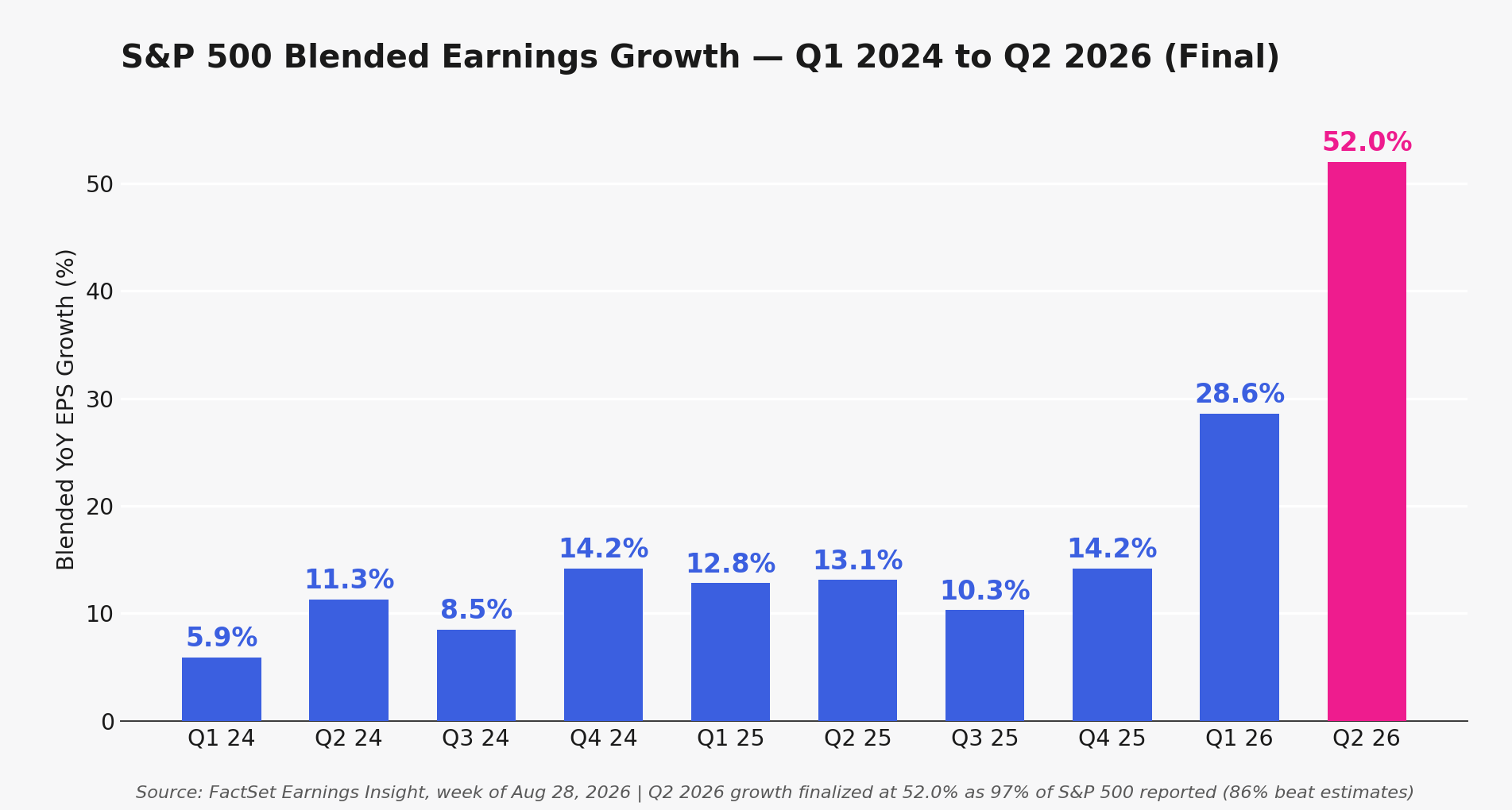
By the final week of August, the Q2 2026 season was essentially complete, and the picture was even stronger than it looked on July 31:
- 52.0%: the final blended year-over-year EPS growth rate for the S&P 500 in Q2 2026, up from the 47.4% still-developing figure at July’s close, with 97% of the index having reported and 86% beating estimates – the highest earnings growth rate the index has posted since Q2 2021.
- The number remains a story about a handful of very large surprises – Alphabet’s one-time GAAP gain, Amazon’s late-quarter beat – more than it is a description of the median company’s results, but the breadth of the 86% beat rate suggests the strength wasn’t confined to a few names.
Nvidia (NVDA): Data Center Crosses $89 Billion (August 27)
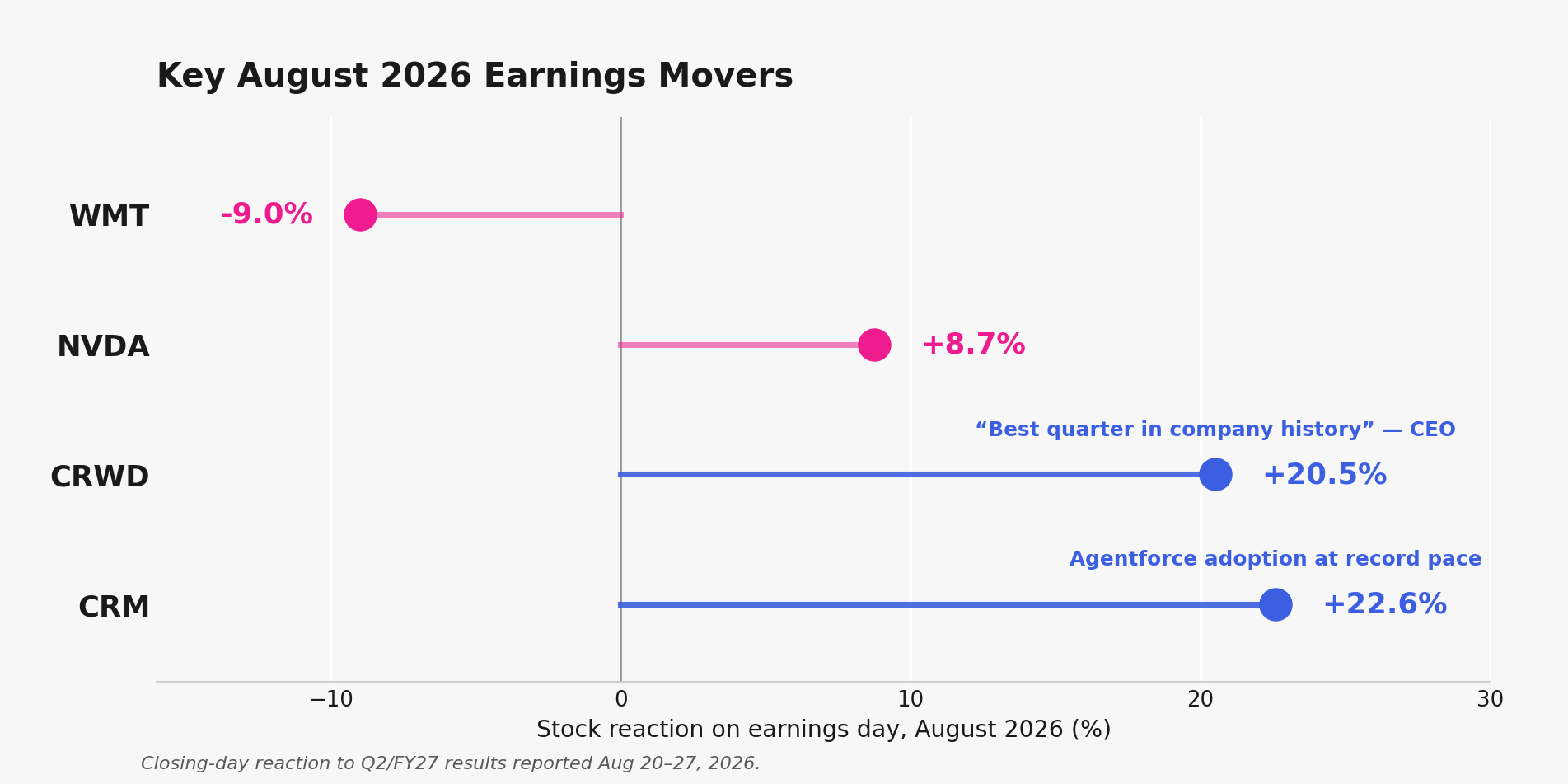
Nvidia’s fiscal Q2 revenue of $96.2 billion more than doubled year-over-year (+106%), with data center revenue alone reaching $89.0 billion, up 117%. Non-GAAP EPS came in at $2.22, and management guided Q3 revenue to $108.0 billion, plus or minus 2%, notably without assuming any China data-center compute revenue. CEO Jensen Huang said AI has “reached its inflection point” and that the Vera Rubin platform is now in full production. The stock jumped 8.74% on the day, adding roughly $435 billion in market value, and the company returned $26.0 billion to shareholders during the quarter.
Salesforce (CRM) and CrowdStrike (CRWD): “The Best Quarter in Company History” (August 26)
Salesforce posted adjusted EPS of $5.90 on revenue of $11.35 billion, beating estimates as its Agentforce AI platform converted deals at “materially higher average selling prices” than traditional contracts, particularly in professional services and retail. The stock surged 22.6%. CrowdStrike lifted its annual revenue forecast on rising AI-driven cybersecurity threats, and CEO George Kurtz called it simply the best quarter in the company’s history; the stock jumped 20.5% the same day, though it gave back some of that move two sessions later as investors took profits.
Walmart (WMT): A Beat the Market Didn’t Believe (August 20)
Walmart’s Q2 revenue rose 6% to $187.94 billion, and adjusted EPS of $0.81 beat the $0.7413 consensus. Management even raised full-year guidance. The stock fell 9% anyway – its worst earnings-day reaction in ten quarters – because the beat was explained by a roughly 750-basis-point net benefit from tariff refunds that the company had already redeployed into more than 11,000 price rollbacks. With much of that benefit pulled forward, Q3 guidance of $0.62 to $0.64 in adjusted EPS came in soft, and the market read the quarter as, in one analyst’s words, a beat “borrowed from Q3.”
Macro and Federal Reserve
Where July’s macro story was a genuine split decision between cooling inflation and a weakening labour market, August resolved that split – just not the way the doves wanted. The jobs data got worse. The new Fed chair made clear that didn’t change his priorities.
July Jobs Report: A Miss No Forecaster Saw Coming (Released August 7)
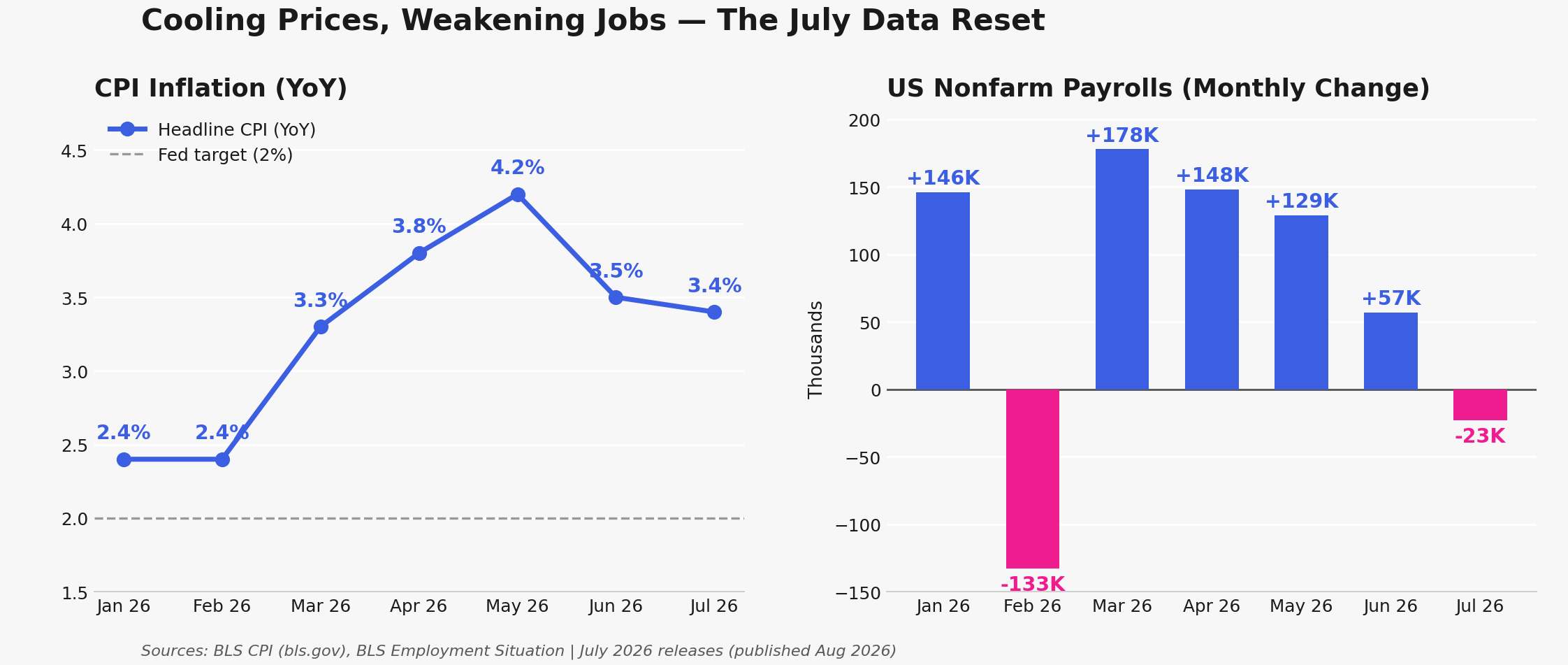
Nonfarm payrolls fell by 23,000 in July, against a consensus estimate of a 80,000 gain – a miss that came in below every single forecast tracked by Bloomberg’s panel of economists. May and June payrolls were revised down by a combined 103,000, taking the net three-month change to roughly negative 126,000. The unemployment rate ticked down to 4.1%, but the labour force itself contracted by 264,000, and government employment fell 53,000, driven by a 50,000 drop in local government education jobs. Healthcare and construction each added 22,000, the lone bright spots in an otherwise soft report.
July CPI: Cool Enough to Set a Record (Released August 12)
Headline CPI rose just 0.1% month-over-month in July, pulling the year-over-year rate down to 3.4% from June’s 3.5%. Core CPI rose 0.2% on the month and 2.5% year-over-year, also a touch cooler than June. Shelter costs, up 0.1% on the month, accounted for roughly two-thirds of the headline increase. Energy fell 1.5% in July but remained up a striking 14.7% year-over-year, with gasoline prices up 24.6% over twelve months – a reminder that the spring’s Iran-driven oil spike was still working its way through the annual comparison. The cooler print helped send the S&P 500 to its first-ever close above 7,800 the same day.
The Bond Market’s Own Warning (August 18–19)
As the Iran ceasefire expired without renewal in mid-August, the 30-year Treasury yield climbed to its highest level since June 2007, and the Dow fell more than 270 points on August 17 alone as oil prices jumped and investors weighed energy-driven inflation risk against a weakening labour market. Yields spiked further on August 19 before the Treasury Department announced it would more than double the maximum size of its debt buyback operations, from $2 billion to at least $4 billion, targeting the pressured 10-to-30-year portion of the curve. One market strategist pinned the underlying tension on a simple structural story: “Big government spending and the AI investment boom are driving competition for resources, creating greater scarcity, inflationary risks and higher cost of capital.”
Jackson Hole: Warsh’s First Big Test (August 28)
Fed Chair Kevin Warsh used his keynote address at the 2026 Jackson Hole Economic Policy Symposium to draw a hard line on inflation, noting that PCE inflation was running at 3.7% on a 12-month basis and 4.1% over six months, and that the Fed bears responsibility for inflation expectations after 65 straight months above target. He acknowledged real economic strength – business capital expenditure growth near 9%, corporate profit growth above 20%, resilient consumer spending – but said fighting inflation remains “the predominant focus” regardless. Warsh also confirmed he is moving away from traditional forward guidance, which he argued “risks creating ambiguity in the name of clarity,” in favour of a data-dependent approach he described as a commitment to “discipline, not to a decision” ahead of September’s meeting.
A Fed chair facing a jobs report that missed every forecast on Wall Street would, in an ordinary cycle, be expected to lean dovish. Warsh did the opposite, and money markets took notice: by the following Monday, a September rate hike was being priced as more likely than a cut. Combined with the July dissents in favour of tightening flagged at the end of July, the signal is consistent – a meaningful bloc of the Fed, now led by its chairman, sees inflation as the bigger and more persistent risk, even as the labour market sends an increasingly clear signal in the other direction.
The Geopolitical Backdrop
US-Iran: The Ceasefire That Finally Broke For Good
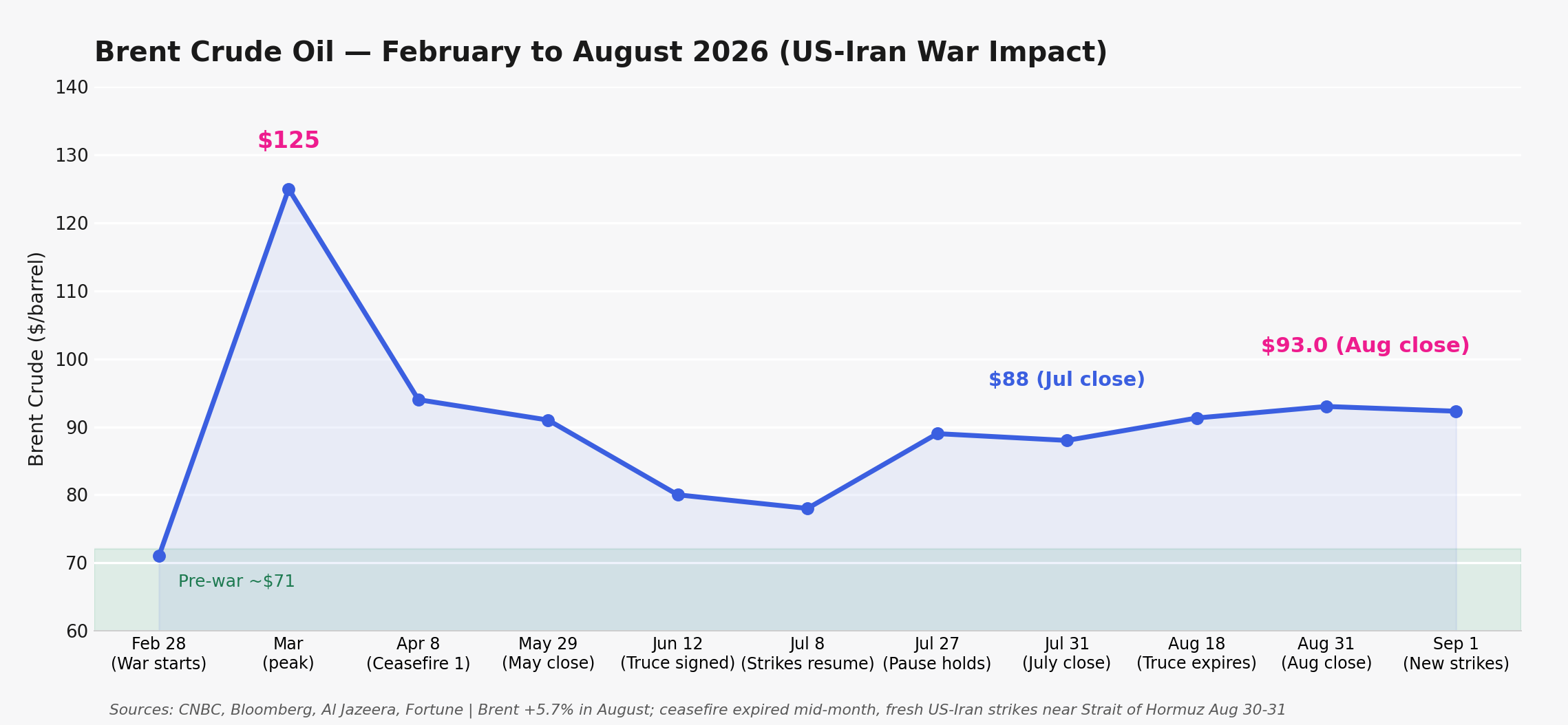
The 60-day truce signed in mid-June, the one whose mid-August expiration July’s report flagged as the next test, did not survive it. Talks stalled through the middle of the month, Iran warned it “could shift to an offensive posture” if diplomacy failed, and the ceasefire lapsed without renewal around August 18, sending Brent crude above $91 and the 30-year Treasury yield to an almost two-decade high. Oil drifted in the high-$80s to low-$90s for the rest of the month before the conflict reignited outright over the August 29–31 weekend: US forces struck Iran’s Larak Island in the Strait of Hormuz, and Iran hit two US bases in Jordan, King Hussein and Al Azraq. President Trump vowed to “hit them hard” in response. Brent closed August near $93, up roughly 5.7% for the month, and continued climbing into early September. Shipping through the Strait, which carries about a fifth of global oil supply, has already thinned – 107 crossings in the week of August 24–30 versus 121 the week before, with a growing number of vessels disabling their identification systems to avoid becoming targets. One analyst described the outlook as a “no war, no peace” standoff that could extend well into 2027.
US-China Trade: A New Tariff, Timed Around a Coming Summit
The Trump administration is weighing a new 7.5% tariff on Chinese goods tied to industrial overcapacity, layered on top of the 10% to 12.5% Section 301 tariffs that took effect in July. Officials reportedly believe this incremental level would not endanger the broader one-year US-China trade truce, and the timing is not incidental: a Trump-Xi summit at the White House is expected in late September, and the administration appears to be calibrating pressure ahead of it rather than escalating outright.
Major Corporate Activity
M&A Pace Holds Even as Deal Values Cool Month to Month
Global M&A remains on pace for a record year – PwC has put 2026’s full-year deal value on track to approach $4 trillion, up from the $2.8 trillion logged in the first half alone. The pipeline heading into August was still working through July’s activity, led by industrials and healthcare: the month’s largest strategic deal, Solstice’s $14.5 billion acquisition of Element Solutions, and its largest sponsor-backed deal, Brookfield’s roughly $7 billion purchase of Aypa, even as aggregate monthly deal value cooled about 39% from June’s pace to roughly $410 billion.
Tesla and SpaceX: Still Just a Rumor
The Tesla-SpaceX merger speculation that closed out July carried straight through August without resolution. Musk has continued to deny an active deal is in the works, but prediction markets are still actively pricing the odds of one happening, and reports that Tesla could exit its China business alongside a potential combination have not gone away. Nothing formal emerged in August; the question heads into September exactly as unresolved as it was a month ago.
Key Themes that Shaped Markets in August
Critical Minerals had its best month of the year as China leaned on its dominant position in rare earths and Washington kept writing checks to build an alternative supply chain. Prices for erbium, holmium, and ytterbium jumped 40% to 50% as buyers stockpiled ahead of a November tightening of China’s export-control regime, while Beijing simultaneously detained Japanese executives in a dual-use-technology export probe, raising the operating risk for multinational manufacturers that rely on Chinese supply. New Chinese export prohibitions on lithium-ion battery black mass and tungsten scrap took effect August 27.
The US response kept scaling: the government has now backed roughly $40 billion in mineral transactions since January 2025, with an August package alone including a $1.4 billion conditional loan to Sila Nanotechnologies, $400 million for Sunrise Energy Metals’ scandium project, and $150 million for Niron Magnetics. MP Materials, a repeat beneficiary of Washington’s price-protection programs, has now received $110.9 million in cumulative federal support. Demand kept broadening too – Lockheed Martin is negotiating scandium and germanium supply contracts of its own, and the same erbium in short supply for fiber optics is a direct input into the AI data-center buildout that dominated the rest of the month’s headlines.
Cloud Computing rode the same AI-infrastructure wave that lifted Nvidia, Salesforce, and CrowdStrike to a big August. Synergy Research put Q2 2026 cloud infrastructure revenue at $143.4 billion, up 43% year-over-year, the fastest growth rate the market has posted in eight years and the eleventh consecutive quarter of acceleration. GenAI-specific cloud services grew 165% year-over-year within that total, and the three largest providers – AWS, Azure, and Google Cloud – now control 67% of the public cloud market between them, with Microsoft and Google both growing meaningfully faster than market leader AWS.
Nvidia’s $89 billion data-center quarter and Salesforce’s Agentforce-driven beat were both, in effect, evidence for the same thesis: enterprise demand for cloud infrastructure and the AI tools built on top of it is still outrunning supply, even after more than a year of aggressive hyperscaler capital spending. The combined cloud giants poured close to $600 billion into capex over the period, and the market kept rewarding the companies that can show that spending converting into revenue rather than just server orders.
Defense and Security was the month’s outlier: a sector that, on paper, should have caught a geopolitical-risk bid as the Iran ceasefire collapsed instead spent August giving ground. Lockheed Martin, the sector’s bellwether, remained roughly 15% below its 52-week high of $687.50, weighed down by a first-quarter miss, segment operating margin that compressed from 11.6% to 10.1% on charges tied to the F-16, C-130, CH-53K, and Seahawk programs, and F-35 deliveries that fell to just 19 units in the second quarter from 50 a year earlier. Investors increasingly treated the execution problems as structural rather than one-off, layering on top of $950 million in classified-program charges in 2025 and $1.7 billion in the fourth quarter of 2024.
The one pocket of volatility came from Palantir, whose stock surged roughly 30% on August 4 earnings, wiping out an estimated $3 billion in mark-to-market losses for short sellers, before giving back ground later in the month, falling 3.34% on August 24 alone. Rather than a clean flight to safety, defense and security stocks spent August looking like capital was rotating past them entirely, toward AI infrastructure and critical minerals plays that offered a clearer growth story even as the headlines around Iran got louder.
Looking Ahead: What to Watch in September
The September FOMC Meeting: Does “Discipline, Not a Decision” Mean a Hold or a Hike?
Warsh spent Jackson Hole deliberately avoiding a pre-commitment, but money markets moved to price a September hike as more likely than not almost immediately after his speech. With July’s dissents already on record in favour of tightening, the September meeting will show whether that bloc has gained ground since, or whether a labour market now unambiguously weakening pulls the committee back toward a hold.
August Jobs Report and August CPI: Does the Labour Market Keep Deteriorating?
The August jobs report, due the first Friday of September, will be the first real test of whether July’s shock miss was a one-off or the start of a trend, especially after May and June were both revised down materially. August CPI, due mid-month, will show whether the energy-driven inflation risk reintroduced by the Iran conflict’s collapse is starting to show up in the headline number.
The Trump-Xi Summit: Tariffs, Timing, and the Trade Truce
A White House meeting between Trump and Xi Jinping expected in late September will be the backdrop for whatever happens with the proposed 7.5% overcapacity tariff, and a test of whether the broader US-China trade truce holds through the meeting or comes under fresh pressure beforehand.
The Strait of Hormuz: How Long Can “No War, No Peace” Last?
With the ceasefire framework now fully collapsed and shipping through the Strait already thinning, the question for September is less whether tensions will fully resolve and more whether they stay contained to periodic strikes or escalate into something that meaningfully disrupts the fifth of global oil supply that moves through the Strait each day.
Three things will define the next few weeks: whether the Fed follows Warsh’s hawkish Jackson Hole tone into an actual September rate move even as the labour market keeps softening, whether the Iran conflict stays a periodic shock or becomes something that structurally disrupts the Strait of Hormuz, and whether the AI trade’s winners – Nvidia, Salesforce, CrowdStrike, the broader cloud and critical-minerals complex – keep separating from the sectors capital is rotating away from, defense chief among them. August showed a market willing to set new highs and absorb a geopolitical shock in the same month. September will test how much further that resilience can stretch.
Conclusion
August 2026 was the month the market’s AI dispersion story kept compounding, and a new Fed chair made his priorities unmistakably clear.
The numbers still make an extraordinary case in aggregate. Q2 blended earnings growth finished at 52.0%, the strongest since 2021. Nvidia’s data-center business alone did $89 billion in a single quarter. Cloud infrastructure spending grew at its fastest pace in eight years. None of that happened by accident, and none of it slowed down in August.
But the dispersion inside those aggregate numbers, the theme July’s report closed on, only got sharper. Nvidia, Salesforce, and CrowdStrike proved the AI trade still has room to mint new winners in a single earnings day. Walmart proved that a headline beat means little if the market can see the sugar high was borrowed from next quarter. Defense and security stocks proved that even a reigniting war doesn’t guarantee a sector a bid if capital has better places to go. That is not a market moving on sentiment. It is a market that, month after month, keeps learning to price every story on its own specific merits.
The macro backdrop, if anything, got less resolved. A jobs report that missed every forecast on Wall Street would ordinarily argue for a dovish Fed; instead, the new chairman used his biggest platform yet to double down on inflation as the predominant risk, and a ceasefire that had already broken down twice in July finally collapsed for good in August, reintroducing the energy-driven inflation risk the Fed has spent months trying to talk down.
Which is why the read on August lands close to where July left it, just louder: stay disciplined, let each company’s actual numbers, not the sector narrative, drive position sizing, and treat a record aggregate earnings season as a description of dispersion, not an all-clear signal. The Fed’s hawkish turn, the Iran conflict’s collapse, and the gap between the AI trade’s winners and the sectors being left behind all head into September unresolved.
Disclaimer: This article draws from sources such as the Financial Times, Bloomberg, CNBC, Reuters, and other reputed media houses. Please note, this blog post is intended for general educational purposes only and does not serve as an offer, recommendation, or solicitation to buy or sell any securities. It may contain forward-looking statements, and actual outcomes can vary due to numerous factors. Past performance of any security does not guarantee future results. This blog is for informational purposes only. Neither the information contained herein, nor any opinion expressed, should be construed or deemed to be construed as solicitation or as offering advice for the purposes of the purchase or sale of any security, investment, or derivatives. The information and opinions contained in the report were considered by VF Securities, Inc. to be valid when published. Any person placing reliance on the blog does so entirely at his or her own risk, and does not accept any liability as a result. Securities markets may be subject to rapid and unexpected price movements, and past performance is not necessarily an indication of future performance. Investors must undertake independent analysis with their own legal, tax, and financial advisors and reach their own conclusions regarding investment in securities markets. Past performance is not a guarantee of future results.