





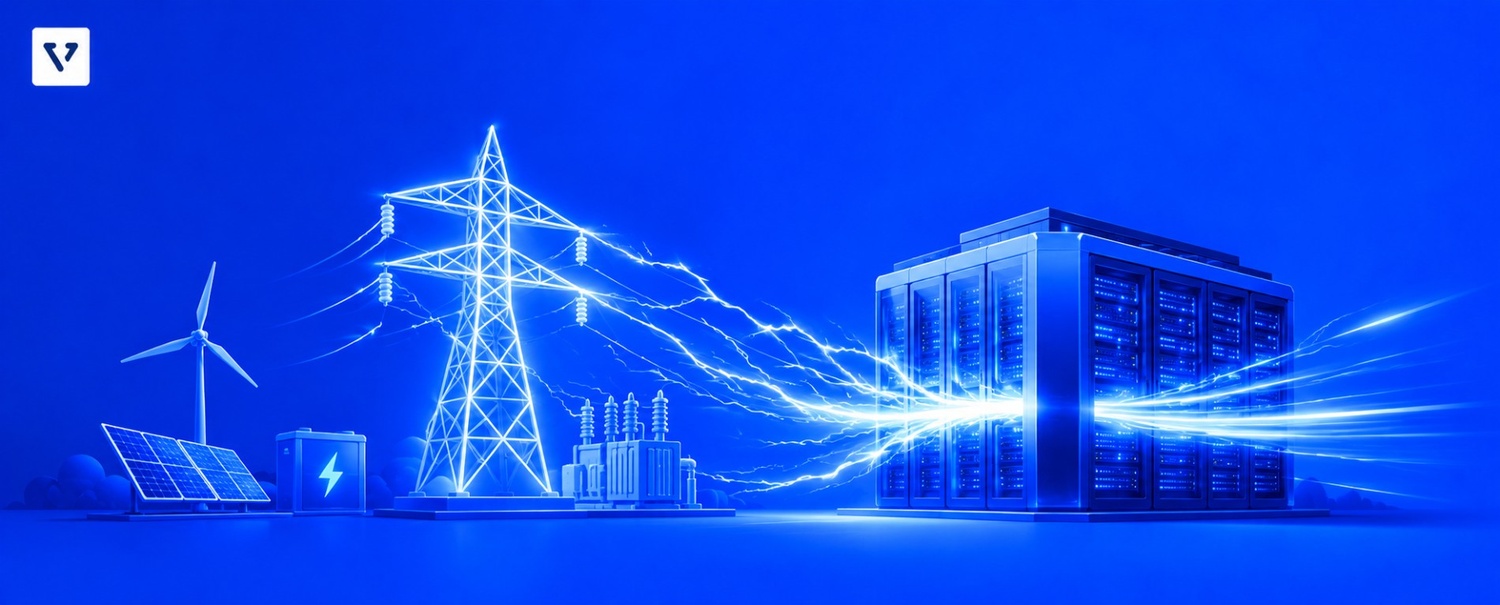
Electricity demand in the United States is rising faster than at any point in decades, and the reason has very little to do with how anyone feels about climate change.
Somewhere in Virginia, Texas, or Ohio right now, a single building is pulling as much electricity as an entire city. Not a factory. Not a steel plant. A data centre, training the next generation of AI. Multiply that one building by the hundreds being built or planned across the country, and you start to see why America’s power grid, stable and predictable for twenty years, suddenly cannot keep up. This is not a distant, decades-away transition. It is happening in real time, and it is creating one of the most concrete, demand-backed investment opportunities clean energy has ever offered.
Why electricity demand is suddenly the story
That is not an exaggeration. Multiply one data centre by the hundreds already under construction or announced, and the arithmetic becomes hard to ignore. The International Energy Agency expects global data centre electricity consumption to roughly double by 2030, with AI workloads doing most of that lifting.

Figure 1: Global data centre electricity demand, actual and projected
This is not a forecast built on sentiment or policy goodwill. It is a forecast built on physics and contracts. Hyperscalers are signing power purchase agreements that run ten to twenty years, and utilities are responding to demand that is already on their books, not demand they hope will materialise.
The capital is already moving
Utilities do not commit capital on hope. The fact that aggregate US energy utility spending is forecast to reach roughly 1.3 trillion dollars between 2026 and 2030, a record, and a meaningful step up from estimates made only months earlier, says something about how seriously this demand is being taken inside the industry that has to actually deliver the electrons.

Figure 2: US energy utility capital expenditure, actual and forecast
Individual utilities are putting specific numbers behind this rather than speaking in generalities. Several major US utilities have doubled or raised their firm contracted load additions over the past year, driven specifically by hyperscaler and large industrial demand. Three-year capital plans that once moved in single digits are now being revised upward by double-digit percentages, in the same breath as management teams cite AI and data centre customers as the reason.
This is not the clean energy story of 2020 and 2021
It is worth being direct about why the clean energy theme earned some scepticism in recent years. The version that ran hottest in 2020 and 2021 was, underneath the enthusiasm, largely a sentiment and subsidy trade. Stimulus-era optimism and historically low borrowing rates pulled forward demand for things like home solar installations and electric vehicles. When sentiment cooled and interest rates rose, a meaningful share of that trade unwound. Even federal policy support for several of those consumer-facing categories has since been reduced.
A trade that depends on subsidies unwinds the moment policy support changes.
A trade that depends on contracted electricity demand only unwinds if the demand itself disappears.
What is happening now runs on a different mechanism entirely. The demand pulling capital into grid infrastructure, generation, and storage is not waiting on a tax credit. It is being paid for directly by the companies that need the power, through contracts that are already signed. That does not mean every part of the broader energy transition is equally insulated from policy, some categories clearly are not, but it does mean the part of the story driving this buildout is standing on different, and arguably firmer, ground than the version of clean energy that struggled three years ago.
What this means for how to think about the opportunity
The honest way to think about this theme is as a multi-year infrastructure build, not a momentum trade tied to any single quarter’s headlines. The demand driver, AI and data centre electricity consumption, is still in its early stages relative to where forecasters expect it to be by the end of the decade. The capital response from utilities, equipment makers, and power generators is following that demand, not leading it on speculation.
Explore Clean Energy Portfolio
That said, the picture is not without real risk. The single largest swing factor is whether AI infrastructure spending continues at its current pace. If enterprise demand for AI services disappoints and that capital spending slows, the effect would move directly through utility growth forecasts, equipment orders, and power generation plans. Separately, the grid itself remains a genuine physical bottleneck. Even fully funded, fully contracted projects can be delayed for years by interconnection queues, transformer shortages, and permitting backlogs. Capital committed today is not the same as power delivered on schedule.
It is also worth being clear that not every corner of the broader clean energy and climate technology universe is exposed to this story in the same way. Categories that depend more heavily on consumer subsidies or specific tax credit structures face a different, more policy-sensitive set of risks than the infrastructure and generation side of the buildout described here. An investor approaching this theme is well served by understanding which part of the story a given exposure is actually tied to, rather than treating the whole label as one undifferentiated trade.
The bigger picture
Vested’s Clean Energy Portfolio is built around this distinction, with the bulk of its positioning tied to the side of the theme described above: businesses whose growth is linked to the physical buildout of grid infrastructure, power generation, and storage capacity that the AI era now requires, rather than to consumer subsidy cycles. The portfolio has performed strongly since launch, and the more important point for anyone considering it is the one this piece has tried to make plainly: the case for owning it rests on a structural shift in how the country generates and delivers electricity, not on any single quarter’s number.
Electricity demand does not care about market sentiment, and neither does a transformer backlog. That, more than anything else, is what makes this buildout different from the clean energy story that came before it.