


Key Takeaways
- Alibaba grew revenue 10% to RMB271.5 billion (US$40.5 billion) in the September quarter.
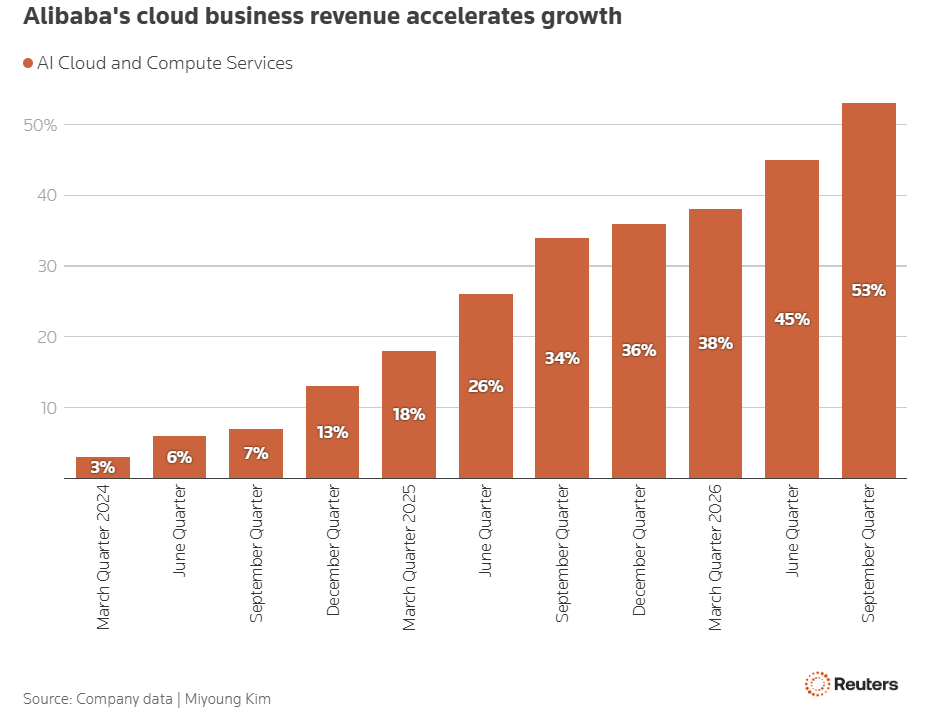
- AI Cloud and Compute Services revenue grew 53%, and AI-related product revenue posted a 13th straight quarter of triple-digit growth.
- Income from operations jumped 443% to RMB29.1 billion, helped by better results at Taobao Instant Commerce and the cloud business.
- Non-GAAP net income rose 92% to RMB19.9 billion, and non-GAAP diluted earnings per ADS rose 86% to RMB8.10 (US$1.21).
- Free cash flow showed an outflow of RMB34.5 billion as capital spending reached RMB50.5 billion.
- Alibaba still held RMB487.9 billion (US$72.8 billion) in cash and liquid investments.
Alibaba Group (NYSE: BABA) reported its September quarter 2026 results on November 19, 2026. The company delivered 10% revenue growth, while net income more than tripled from the year-ago quarter. Strong demand for AI and cloud services, along with improved profitability in its e-commerce business, supported the results.
Alibaba’s AI Cloud and Compute Services business continued to lead growth, with revenue increasing 53% year-over-year. However, the company also reported higher spending on AI infrastructure and a larger free cash flow outflow as it expanded its computing capacity.
Here is a closer look at Alibaba’s Q3 2026 earnings, business performance, and key developments investors should know.
Results at a glance (July–September)
| Metric | 2025 (RMB bn) | 2026 (RMB bn) | Change |
| Revenue | 247.8 | 271.5 | +10% |
| Income from operations | 5.4 | 29.1 | +443% |
| Adjusted EBITA | 9.1 | 32.6 | +260% |
| Net income | 20.6 | 64.4 | +213% |
| Non-GAAP net income | 10.4 | 19.9 | +92% |
| Capital expenditure | 31.5 | 50.5 | +60% |
| Free cash flow | −21.8 | −34.5 | Bigger outflow |
Source: Reuters
What management said
CEO Eddie Wu said Alibaba’s full-stack AI capabilities keep improving commercialisation. He highlighted 67% growth in recurring cloud revenue from external customers and major upgrades across chips, supernodes, cloud infrastructure, models and agents. He also noted that the e-commerce group became much more profitable, while quick commerce cut its losses and kept its market share.
CFO Toby Xu credited the strong quarter to two priorities: AI and cloud growth, and sustainable profit in e-commerce. He said the cloud segment’s EBITA margin rose to 14.5%. He also said Alibaba will keep AI spending disciplined, focus on return on invested capital, and aim for positive free cash flow.
How did each business perform?
| Segment | Revenue (RMB bn) | Revenue change | Adjusted EBITA (RMB bn) | EBITA a year ago (RMB bn) |
| Alibaba E-commerce Group | 197.2 | +2% | 38.9 | 11.3 |
| AI Cloud and Compute Services | 61.0 | +53% | 8.8 | 4.0 |
| AI Labs and Applications | 4.4 | +51% | −10.5 | −3.4 |
| All others | 27.7 | −5% | −3.3 | −1.0 |
Segment figures exclude inter-segment eliminations and unallocated costs.
AI cloud is now Alibaba’s growth engine
The AI Cloud and Compute Services unit, which combines Alibaba Cloud with the T-Head chip business, earned RMB61.0 billion (US$9.1 billion). That is 53% more than a year ago. Based on Alibaba’s six-month figures, growth also sped up from about 45% in the June quarter.
| Cloud revenue source | 2025 (RMB bn) | 2026 (RMB bn) | Change |
| Total | 40 | 61 | +53% |
| External customers | 29 | 47 | +64% |
| – Recurring revenue | 22 | 37 | +67% |
| – Compute equipment solutions | 7 | 10 | +55% |
| Internal customers | 11 | 14 | +23% |
The quality of that growth matters even more than its speed:
- Outside customers drove it
Recurring revenue comes from pay-as-you-go and subscription services, so it tends to repeat.
- AI products led the way
AI-related products brought in RMB17.9 billion and grew at triple-digit rates for the 13th quarter in a row.
- Profit grew faster than sales
The unit’s adjusted EBITA more than doubled to RMB8.8 billion.
Demand now reaches far beyond AI labs. Companies in the internet, automotive, embodied AI, financial services and biotech sectors are all using more of its cloud services. Gartner also named Alibaba Cloud a Leader in its 2026 Magic Quadrant for Strategic Cloud Platform Services, the first and only Asia-Pacific provider to earn that spot.
The weak spot sits next door. The AI Labs and Applications unit, home to the Qwen models and app, lost RMB10.5 billion, about three times its loss a year ago. Alibaba blames higher AI investment and rising inference costs for the Qwen app.
E-commerce stops the bleeding
The Alibaba E-commerce Group delivered the biggest profit jump of the quarter. Its adjusted EBITA rose 243% to RMB38.9 billion, mainly because China Quick Commerce lost far less money.
Quick commerce revenue rose 22% to RMB58.8 billion, led by Freshippo. Taobao Instant Commerce improved its unit economics by focusing on higher-value food and non-food orders. Alibaba kept its market share while spending far less: sales and marketing costs fell from 26.8% of revenue to 15.2%. Part of that drop came from more efficient spending at Taobao Instant Commerce. The rest reflects an accounting change: under a new business development program, Alibaba now books some subsidies as reduced revenue rather than as marketing costs.
One number looks worse than it is. Customer management revenue, the fees Alibaba earns from merchants, fell 5%. Without that same accounting change, the figure would have grown 1%.
Other businesses showed mixed results:
- 88VIP grew by double digits to about 66 million premium members.
- Xianyu, the second-hand marketplace, grew daily active users 23% and paid orders 29%.
- International e-commerce slipped 8% because EU customs reform hurt AliExpress, though Trendyol kept growing.
- Global Wholesale grew 6%, helped by cross-border value-added services.
Why the profit numbers tell two stories
Alibaba reported net income of RMB64.4 billion, more than triple last year’s figure. However, most of it came from outside the core business. The value of Alibaba’s equity investments rose sharply, and those mark-to-market gains lifted interest and investment income to RMB73.3 billion.
Alibaba strips out these gains in its non-GAAP figures, which show the business more clearly. On that basis, net income rose 92% to RMB19.9 billion.
The six-month view adds context. For April to September, non-GAAP net income fell 7% because the June quarter was much weaker.
The price of the AI race: heavy cash burn
Alibaba spent RMB50.5 billion (US$7.5 billion) on capital projects this quarter, 60% more than a year ago. The company gave four reasons: faster scaling of compute capacity, higher prices for chip components, more CPU capacity for AI agents, and shifts in procurement timing. Based on six-month figures, spending eased from about RMB67.7 billion in the June quarter.
Operating cash flow improved 55% to RMB15.7 billion, but it could not cover that bill. As a result, free cash flow showed an outflow of RMB34.5 billion this quarter and RMB79.1 billion over six months.
To fund the build-out, Alibaba raised HK$80 billion by placing new shares and added RMB14.8 billion in net bank borrowings over six months. It still holds RMB487.9 billion in cash and liquid investments, down from RMB520.8 billion in March.
Alibaba also kept returning cash to shareholders. It paid RMB16.6 billion in dividends and bought back 17.95 million shares (about 2.24 million ADSs) for US$221 million. Management argues that scale gives it cost and efficiency advantages, so it is investing now to strengthen its long-term position.
Building its own chips, models and agents
Alibaba wants to own every layer of AI, and this quarter brought several launches:
- Zhenwu V900 chip
T-Head unveiled its next AI chip for training and inference, due in the first quarter of 2027. Alibaba also open-sourced SAIL, the software stack for Zhenwu chips.
- Supernode systems
It launched China’s first supernode setup able to serve models with more than two trillion parameters. A next-generation version built on the V900 is due in Q1 2027.
- Qwen4-Max
Its new flagship model uses 2.4 trillion backbone parameters and handles long, multi-step tasks.
- AI agents
QwenWork now offers Enterprise Context for company knowledge and QwenWork E-commerce for merchants. The Qwen app added Qwen Go!, a personal agent that completes multi-step tasks.
Home-grown chips also reduce Alibaba’s reliance on outside suppliers. That matters because Alibaba lists export controls and trade sanctions among the key risks in its results statement. That risk became concrete days before the results. On November 16, 2026, the U.S. Commerce Department’s Bureau of Industry and Security issued an interim final rule tightening controls on remote access to advanced semiconductors. Alibaba says the rule, as written, will affect its ability to access compute from certain providers outside China. The company is still evaluating the impact, notes that the rule may change, and says it cannot yet estimate the financial effect.
What to watch next
Five questions will shape Alibaba’s next few quarters:
- Can cloud keep growing above 50%? External demand must stay strong to justify the spending.
- Will capex peak? Watch whether quarterly spending keeps falling from the June high.
- Can AI apps make money? The Qwen app and QwenWork need to narrow a RMB10.5 billion quarterly loss.
- Will Zhenwu V900 ship on time? A Q1 2027 launch would cut Alibaba’s reliance on foreign chips.
- How much will the new U.S. chip rule hurt? Alibaba has not yet put a number on how the November 16 rule on remote access to advanced semiconductors will affect its compute supply.