


Key takeaways
- Google Cloud revenue rose 103% to $30.7 billion, and its operating income more than tripled to $11.1 billion.
- Search is improving. Query growth hit a five-year high, and Search revenue grew 12%.
- Adjusted EPS of $2.67 trailed estimates of about $3.02 (GAAP EPS was $2.12)
- An $8.7 billion investment loss hit EPS. Management linked it mainly to a lower SpaceX valuation.
- Free cash flow turned negative for the second straight quarter. The company covered its funding needs by taking on new debt and selling shares.
Alphabet’s business is booming, but its cash flow tells a different story. Revenue climbed 25% to $127.6 billion in Q3 2026, and Google Cloud more than doubled its sales. Yet, heavy AI spending pushed free cash flow to a negative $9.1 billion for the quarter.
The big question for investors is whether Alphabet can turn its AI growth into lasting profits without putting too much pressure on its finances. Let’s look at what the latest numbers mean for investors.
Alphabet Q3 2026 earnings highlights
Alphabet’s revenue grew 25%, marking its 13th straight quarter of double-digit growth. Operating income grew even faster, rising 30%.
| Metric (Q3) | 2025 | 2026 | Change |
| Revenue | $102.3B | $127.6B | +25% |
| Operating income | $31.2B | $40.6B | +30% |
| Operating margin | 30.5% | 31.8% | +1.3 pts |
| Other income (expense) | +$12.8B | –$8.2B | Swing of $21B |
| Net income to common | $35.0B | $26.2B | –25% |
| Diluted EPS | $2.87 | $2.12 | –26% |
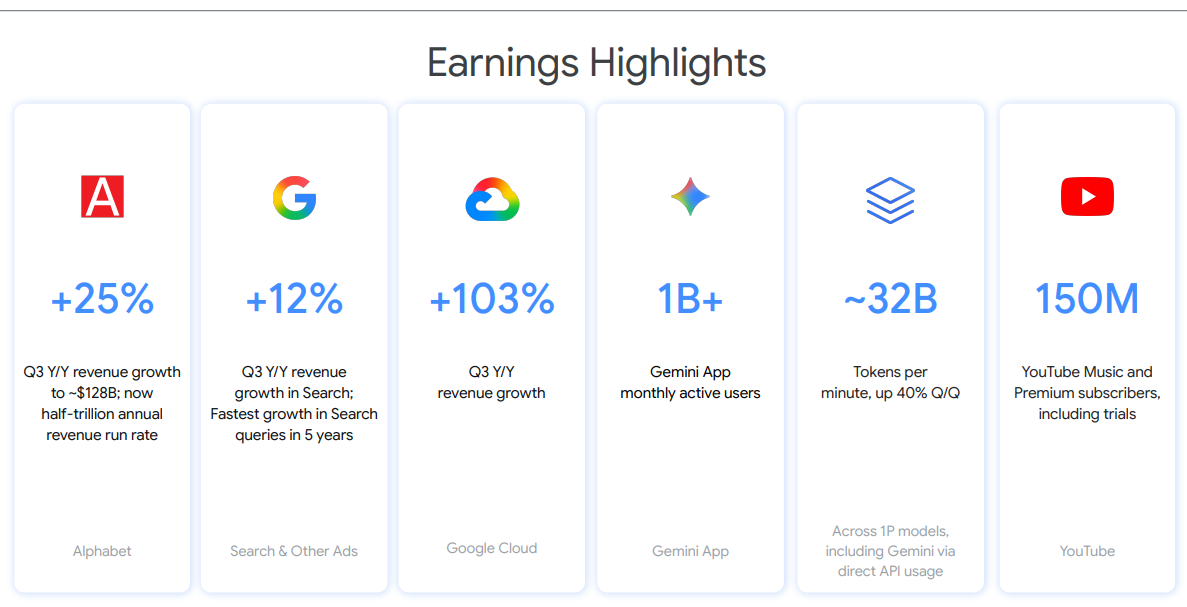
Sundar Pichai, CEO of Google and Alphabet, said, “We had a strong quarter and are now on a half-trillion-dollar revenue run rate. Our deep full stack approach is driving momentum across the business, with Alphabet revenues growing 25% year-over-year. Our AI investments are driving overall Search query growth, including commercial queries.”
He further added, “In fact, our year-over-year query growth rate is the highest it’s been in the last five years. Google Cloud revenues grew 103%, powered by huge demand for our AI infrastructure and AI solutions. We’re also seeing strong demand for our TPU systems across a wide range of customers. Gemini 4 Argon and Carbon are now leading at the frontier. ”
Google Cloud: the star of the quarter
Google Cloud revenue jumped 103% to $30.7 billion, marking its fastest growth ever. Strong demand for AI infrastructure, AI solutions, and cloud services drove this increase. Google also boosted revenue by selling its Tensor Processing Units (TPUs), chips it designs specifically for AI tasks.
Google Cloud now contributes about 24% of Alphabet’s total revenue, up from 15% a year ago. The business has also become more profitable, making it a key driver of Alphabet’s growth.
| Google Cloud (Q3) | 2025 | 2026 |
| Revenue | $15.2B | $30.7B |
| Operating income | $3.6B | $11.1B |
| Operating margin | 23.7% | 36.2% |
Google Cloud’s profit tripled while its revenue doubled, showing that Alphabet is turning its AI investments into strong earnings. The company also increased its inventory from $2.4 billion at the end of 2025 to $13.3 billion, suggesting that it is building up its supply of TPU hardware to meet growing demand.
Search and YouTube: the core still grows
Google Services revenue grew 11% to $96.3 billion. AI is also helping Google Search grow, easing investors’ fears that chatbots could take users away from traditional search.
| Google Services line (Q3) | 2025 | 2026 | Growth |
| Search & other | $56.6B | $63.4B | +12% |
| Subscriptions, platforms & devices | $12.9B | $14.3B | +11% |
| YouTube ads | $10.3B | $11.2B | +9% |
| Google Network | $7.4B | $7.5B | +1% |
| Services total | $87.1B | $96.3B | +11% |
Services operating margin increased to 40.7% from 38.5%, so the ad business is getting more efficient as it grows. Traffic acquisition costs, the fees Google pays partners like Apple and Samsung, increased only 10%, slower than ad revenue.
Google continues to attract more users to its consumer products. The Gemini app achieved one billion users, becoming the fastest-growing product the company has ever launched.
YouTube Music and Premium also crossed 150 million subscribers, including trial users. However, Google Network remains a weak spot, with little revenue growth and a continued loss of market share.
Why EPS fell while profits rose?
Investment losses, rather than weaker business performance, explain most of Alphabet’s drop in earnings per share (EPS). Alphabet invests in other companies and adjusts the value of those investments every quarter. Last year, these investments generated a $10.7 billion gain. This quarter, they resulted in an $8.7 billion loss.
Alphabet said the investment loss reduced EPS by $0.55. Without that loss, EPS would have been around $2.67. However, that figure would still fall short of last year’s $2.87, which benefited from a large investment gain. Meanwhile, Alphabet’s core business continued to perform well, with operating income rising 30%.
Other factors also affected earnings:
- Higher interest costs: Interest expense rose to $967 million from $143 million as Alphabet’s debt increased.
- More shares outstanding: Alphabet’s diluted share count grew by about 1.4% as the company issued new shares, reducing each share’s portion of earnings.
- Preferred stock payments: Alphabet allocated $298 million to holders of its new convertible preferred stock before distributing earnings to common shareholders.
So far this year, investment gains have added $127.5 billion to Alphabet’s other income. These gains helped push its net income for the first nine months to $201 billion.
The cost of the AI race: capex and cash flow
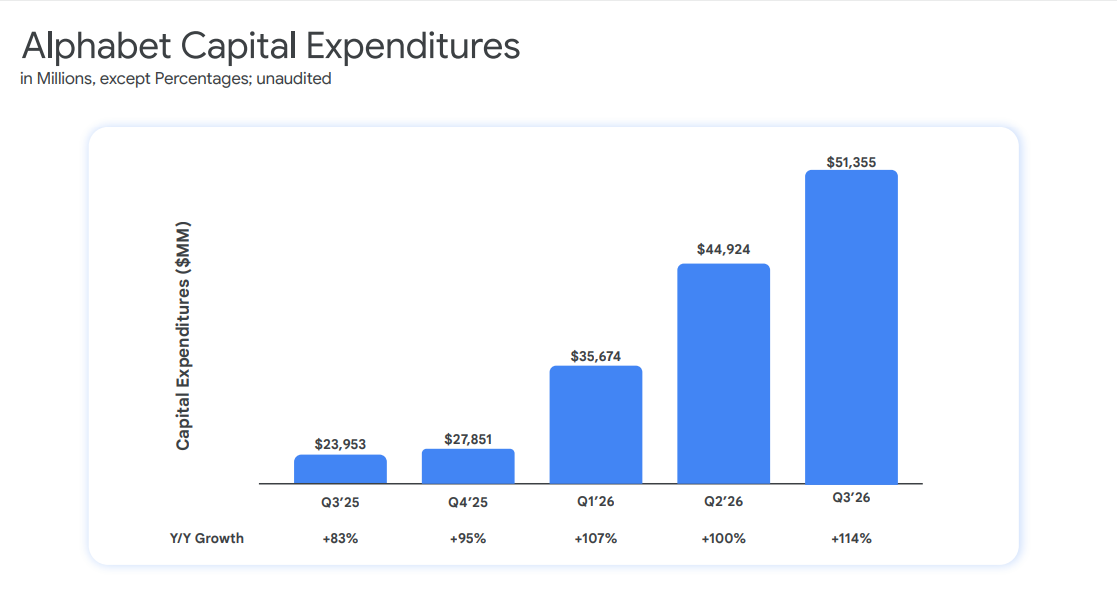
Alphabet spent $51.4 billion on property and equipment in Q3, more than double the $24 billion it spent a year earlier. The company is investing heavily in data centres, servers, and TPUs to support its growing AI business. However, operating cash flow fell 13% to $42.3 billion, pushing free cash flow into negative territory. Operating cash flow was also hurt by a TPU inventory build and a one-time $5.2 billion payment for a 2018 European Commission fine.
| Quarter | Operating cash flow | Capex | Free cash flow |
| Q3 2026 | $42.3B | $51.4B | –$9.1B |
| Q2 2026 | $39.1B | $44.9B | –$5.9B |
| Q1 2026 | $45.8B | $35.7B | $10.1B |
| Q4 2025 | $52.4B | $27.9B | $24.6B |
Capex has risen every quarter for two years, from $13.1 billion in Q3 2024, and trailing twelve-month free cash flow has shrunk to $19.7 billion. For a company once known as a cash machine, that is a big shift.
Where did the growth come from?
| Region (Q3) | 2025 | 2026 | Growth | Constant currency |
| United States | $48.8B | $67.7B | +39% | +39% |
| EMEA | $29.9B | $32.7B | +9% | +10% |
| APAC | $17.8B | $19.9B | +12% | +15% |
| Other Americas | $6.1B | $7.1B | +17% | +15% |
What investors should watch next?
Here’s what you should keep an eye on over the next few quarters.
- Google Cloud grew 103% this quarter with a 36.2% operating margin. If it can stay near that pace with margins above 35%, the heavy spending looks justified. If growth cools while capex keeps climbing, returns will suffer.
- Two straight quarters of negative free cash flow are unusual for Alphabet, so the next couple of reports will show whether this is a temporary dip or a lasting shift.
- About $27.6 billion remains in Alphabet’s at-the-market stock sale program, and the company bought back no shares this quarter. Every new share means a thinner slice of profit for existing holders.
- Alphabet-level costs, mostly shared AI research, jumped 71% to $7.7 billion, while Other Bets lost $2.0 billion. Both weigh on overall profit.
- Selling TPU systems gives Alphabet a valuable new revenue stream, but hardware sales tend to be lumpy and less profitable than software and services.
- Gains and losses on stakes like SpaceX will keep making EPS jumpy from quarter to quarter, so operating income is a better gauge of the core business.
Source: https://s206.q4cdn.com/479360582/files/doc_financials/2026/q3/2026q3-alphabet-earnings-release.pdf
https://s206.q4cdn.com/479360582/files/doc_financials/2026/q3/2026q3-alphabet-earnings-slides.pdf