





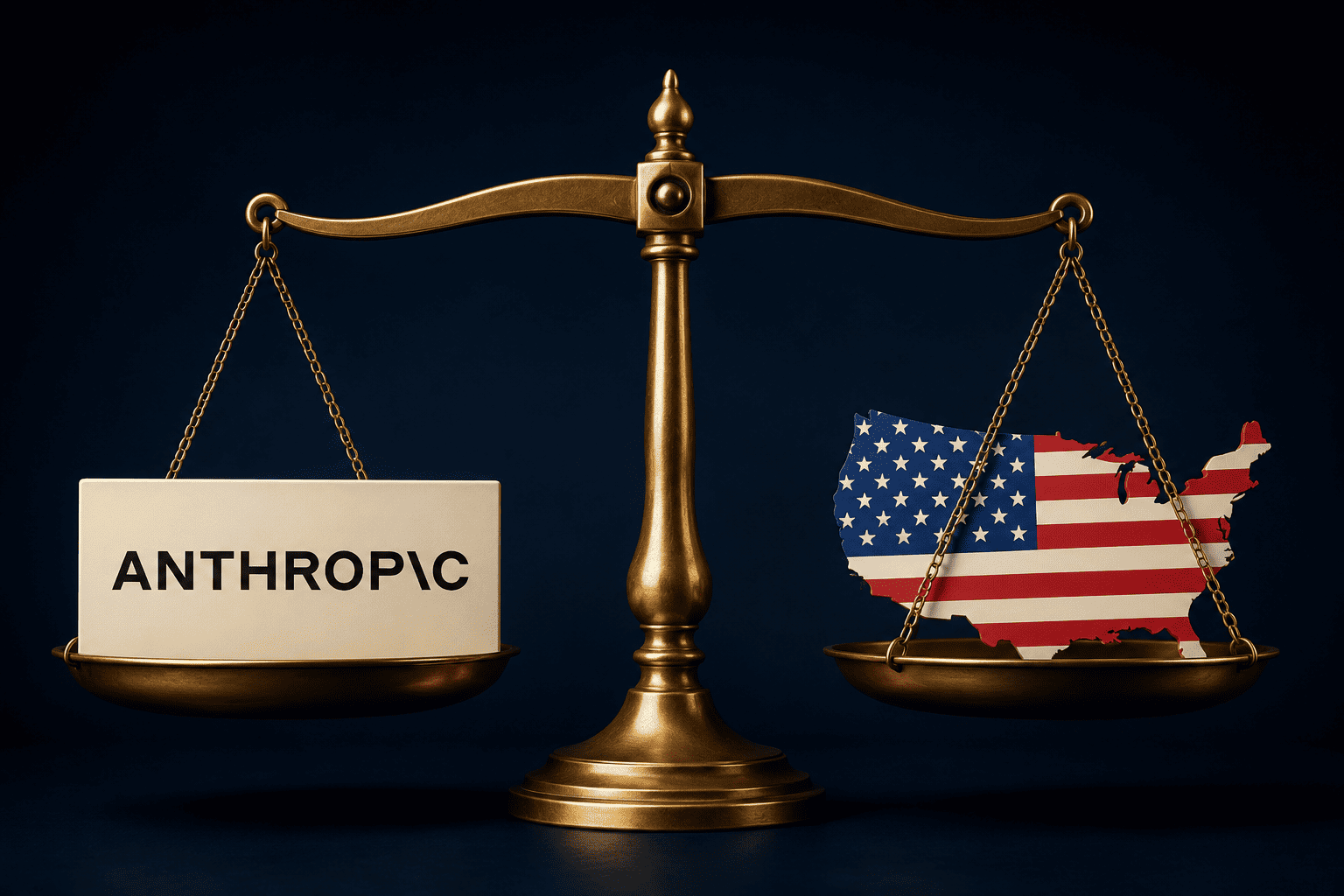
Anthropic is about to tell stock market investors that the work it could sell into is worth more than $30 trillion a year.
For context, the US GDP is about $32.4 trillion. Which means if you add up a full year of output from every factory, farm, hospital, law firm, bank and corner shop in America, you get roughly $32 trillion.
Anthropic, the company that makes Claude, is walking into the biggest stock market listing in history holding a slide that says its annual opportunity is nearly that big.
In fact, that figure is almost a fourth of the World GDP.
The Wall Street Journal reported the figure on 25 August. Within a day, it was meme material.
One post that went round summed it up in four words: “they’re selling a country.”
Fair enough. But the jokes stopped one step too early.
Anthropic’s own revenue plan does not need $30 trillion, not even close to it. And once you see how little of that number the company is actually counting on, the whole pitch reads differently.
What is actually inside that $30 trillion
Anthropic is reportedly looking to sell up to $100 billion of shares at a price that would value the whole company at around $2 trillion.
SpaceX sold a reported $86 billion of shares at a $1.77 trillion valuation in June, so Anthropic would raise more money than any company has ever raised on a stock market.
The $30 trillion is the story that has to justify it.
For starters, a number like this is called a total addressable market (TAM). It is a ceiling, not a forecast: the most a company could possibly earn in a year if it won every single customer on the planet and no rival got a cent.
Most companies build that ceiling by adding up sales in a software category. Anthropic reportedly counted the work itself: legal work, accounting, engineering, back office.
Which makes the $30 trillion closer to a payroll than a market. Almost all of that money is paid to people right now, as annual salaries, for doing exactly those jobs.
Want a sense of the gap?
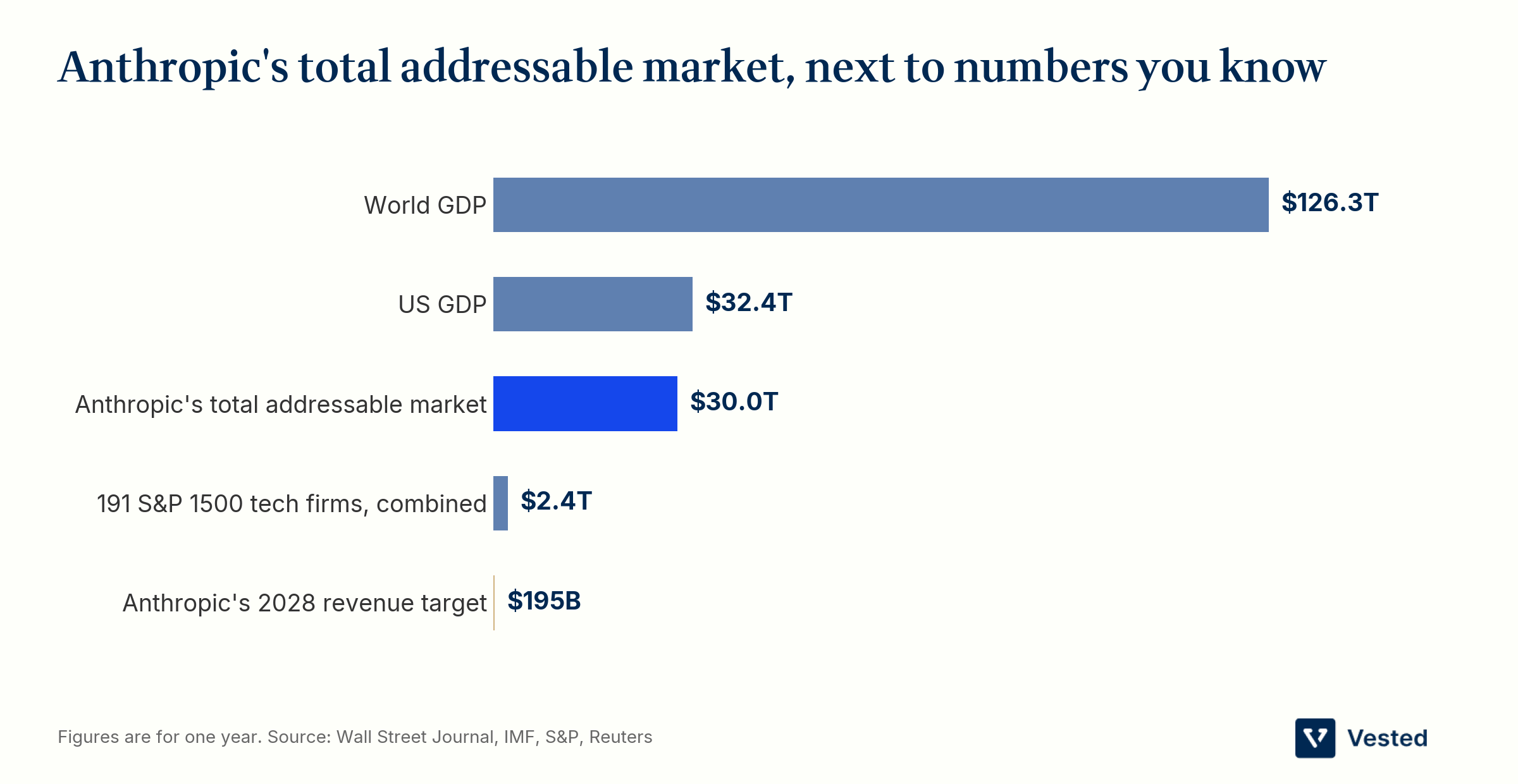
Take all 191 technology companies in the S&P 1500 index, add up everything they sold last year, and the total is about $2.4 trillion. Anthropic’s claimed opportunity is roughly twelve times the combined annual revenue of the entire American technology industry.
Now here is the part worth understanding.
Anthropic is reportedly telling investors it expects to earn roughly $190 billion to $200 billion of revenue in the year 2028.
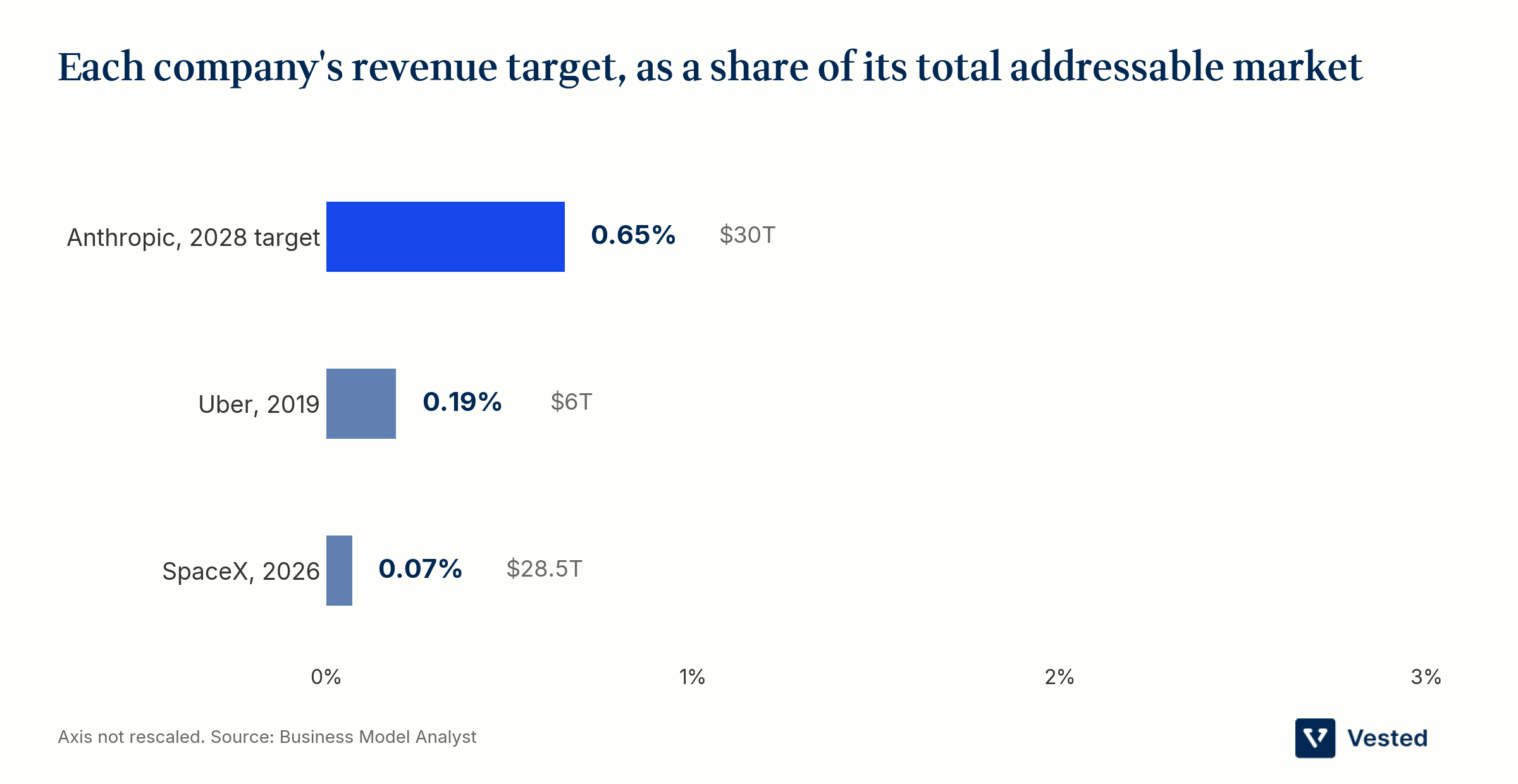
Divide one year of that revenue by one year of that $30 trillion ceiling and you get about 0.65%.
That is the slice of its own claimed market that the company’s own plan depends on.
So, then why show $30T?
Why Anthropic is showing you a number 150X bigger than its own plan
Ask “can this company grow revenue tenfold in two years” and you start pulling the assumptions apart.
Ask “can this company win two thirds of one percent of something enormous” and you shrug and move on.
This is not new, and it is not an AI thing.
Uber told investors in 2019 that its market was worth $6 trillion a year, then forecast revenue equal to 0.19% of it. SpaceX claimed $28.5 trillion in May, called it the largest actionable market in human history, and forecast 0.07% of it.
Notice the direction of travel.
SpaceX set the bar, Anthropic cleared it by $1.5 trillion, and whoever files next has to beat $30 trillion. These numbers have stopped competing with reality and started competing with each other.
Aswath Damodaran, the NYU professor most of Wall Street reads on valuation, said of SpaceX’s smaller claim that it was “reaching the end of what’s plausible and pushing beyond”.
This one is bigger than the number he was complaining about.
Make of it what you will, because it doesn’t turn out that well every time.
The SEC fined a company over a number like this
It is tempting to file all this under marketing. Once a market estimate goes into a filing with the US securities regulator, it becomes a legal statement.
And the regulator has acted on one such before.
In September 2024, the SEC fined a biotech company called Zymergen $30 million for misleading its IPO investors. Part of the case was a market opportunity built on assumptions the regulator called unreasonable.
Zymergen had listed in April 2021, sold about $530 million of shares, and went bankrupt two years later.
Here is the detail that sticks.
Zymergen’s entire claimed market was $1 billion a year. Anthropic’s claimed market is thirty thousand times bigger than the one the regulator took action over.
That is not an accusation, and should not be read as one. It does mean the $30 trillion sits in a document a regulator can read, not on a slide that disappears when the roadshow ends.
The money that is genuinely landing in Anthropic’s account
None of this makes the business small.
Anthropic’s run rate was about $9 billion at the end of 2025. By late July 2026, it had reached roughly $65 billion, according to Bloomberg.
Run rate is not annual revenue. It takes the most recent month of sales and multiplies it by twelve, so it moves fast in both directions and nobody has actually banked that amount yet.
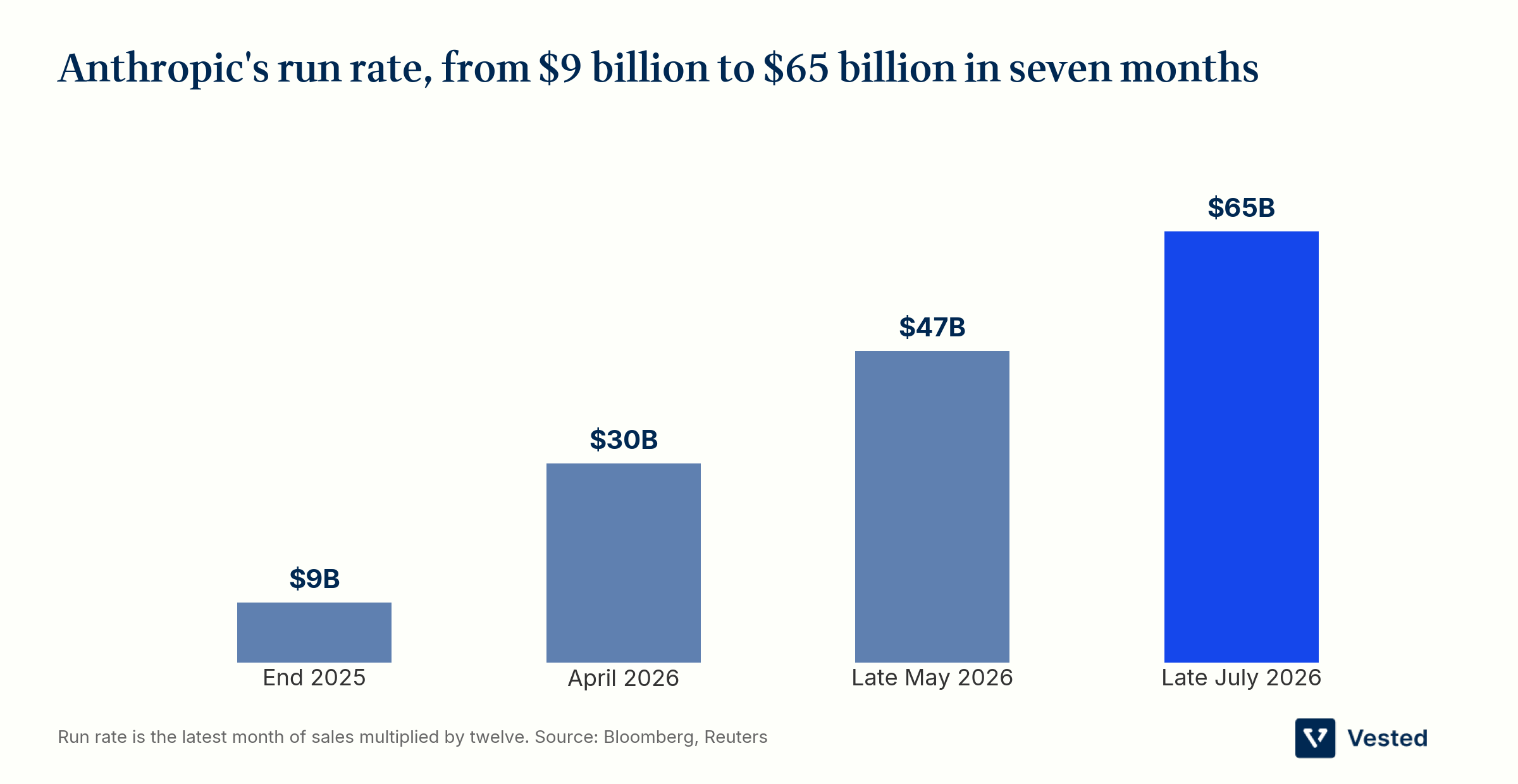
OpenAI’s reported run rate over the same stretch was about $40 billion. Do not read those two side by side, though, because most headlines do and they are wrong to.
When Claude is sold through a cloud marketplace such as Amazon’s Bedrock, Anthropic records the entire amount the customer paid as its own revenue, then records Amazon’s share as one of its costs.
OpenAI does the opposite with Microsoft and records only the portion it keeps.
This might result in some differences, although both methods are legal.
Anyways, here is something really important. And I would want it explained before making any conclusion.
Google and Amazon: Anthropic’s biggest investors or biggest bills?
Anthropic’s largest shareholders are also its largest suppliers, and for Google and Amazon they are a sales channel too.
What has gone in, reportedly:
Google has committed up to $40 billion and holds about 14% of the company in ordinary shares, contractually capped at 15%.
Amazon has paid in $13 billion, with up to $20 billion more still tied to milestones it has not hit yet.
Microsoft and Nvidia together put in $15 billion in November 2025.
What Anthropic has promised back, reportedly: about $200 billion of spending with Google Cloud and its chips over five years, more than $100 billion with Amazon’s AWS over ten years, and roughly $30 billion with Microsoft’s Azure.
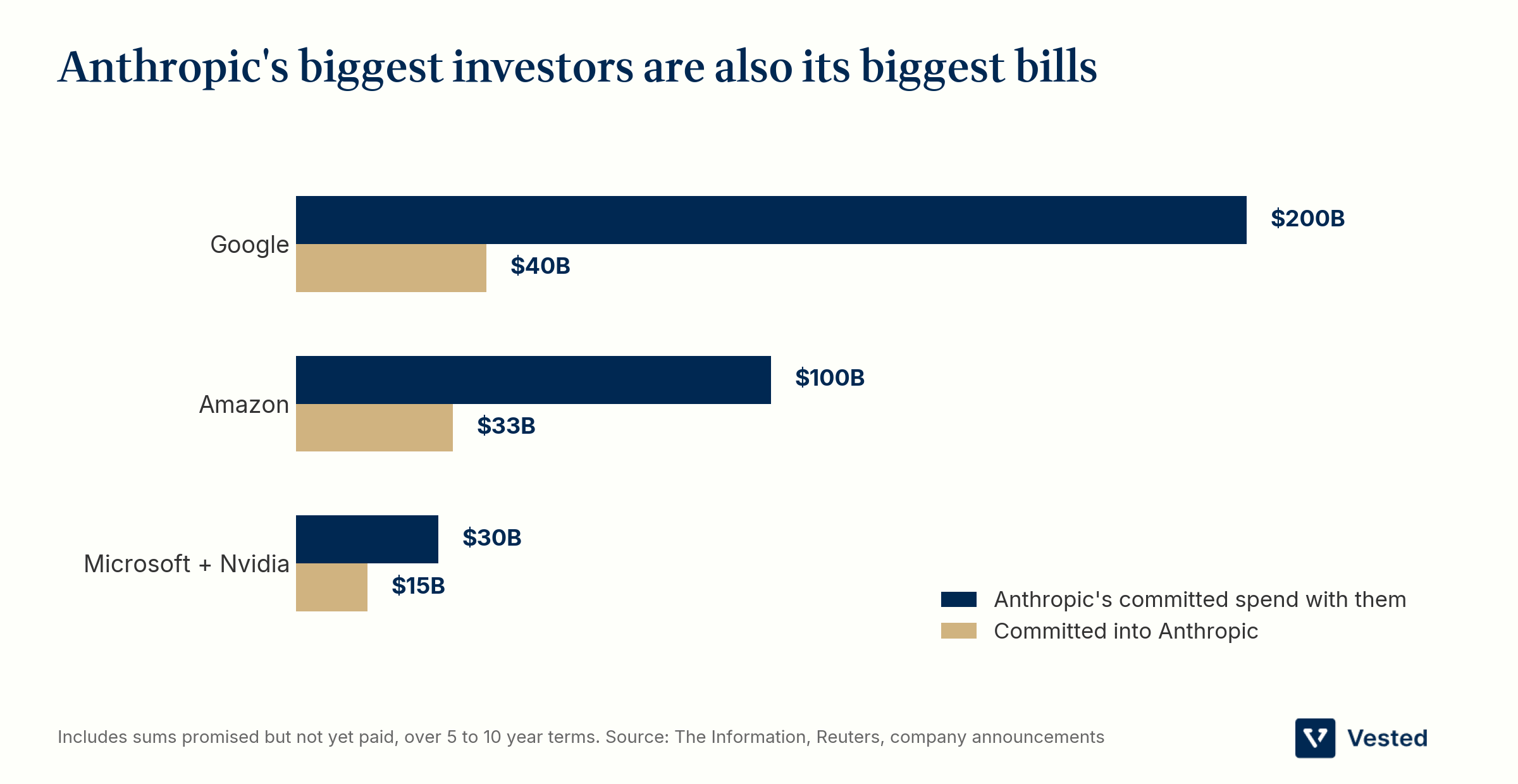
Add it up: roughly $88 billion committed in, roughly $330 billion committed out.
Both totals include money promised but not yet paid, and the two sides run over very different periods, so treat the ratio as a shape rather than a measurement.
The gist: for every dollar these companies have promised Anthropic, Anthropic has promised several dollars straight back to them.
It is now big enough to move their own accounts.
Amazon, Microsoft, Google and Oracle have together signed about $2 trillion of future cloud contracts, and roughly half of that involves Anthropic or OpenAI, according to The Information.
UBS analyst Stephen Ju estimates Anthropic alone will pay Google about $76 billion during 2027, which Google will record as cloud revenue.
Put those two numbers side by side. In 2027, Anthropic expects to pay Google $76 billion, more than the roughly $65 billion its entire business is running at today, and Google is one of its biggest shareholders.
It owns almost none of the hardware either. It has lined up more than 15 gigawatts of data centre capacity, a scale normally used to describe power stations, and it rents all of it.
What could make the $30T pitch look like a joke
While Anthropic was preparing a $30 trillion pitch, one of its own enterprise customers went and did the sums differently.
Thomson Reuters, the legal and news information company, built its own model on top of Qwen, a model Alibaba gives away free for anyone to build on. The whole programme cost roughly $40 million over two years. The final training run, meaning the computing bill for the last pass that produces the finished model, reportedly cost $450,000.
Its chief technology officer Joel Hron summed up the logic in five words: “renting a house versus buying a house”.
Hron is not predicting anything about AI. In fact, he is describing a purchase his company made after two years of paying a frontier lab, which is exactly the decision the $30 trillion assumes millions of other firms will make… only, the other way.
To be fair to Anthropic, Thomson Reuters said out loud that its CoCounsel product is still multi-model and still runs mostly on Claude… that’s technically a change of direction, not a divorce.
It is still the question the ceiling cannot answer.
That ceiling assumes work moves off human payroll and onto a frontier lab. It does not price what happens if the work moves onto a good-enough open model a customer trains once and owns forever.
Anthropic seems alive to how wide the range of outcomes is.
In August, Axios reported that the company asks job candidates how they would feel if a safety decision sent the stock to zero.
There is better news in the file too. On 28 August, a US federal judge ruled the Pentagon’s designation of Anthropic as a supply chain risk unlawful, clearing a real problem days before a filing.
Uber’s $6 trillion market did not stop Uber becoming a genuinely large business. It also did not stop the stock spending years below its listing price.
The ceiling doesn’t really tell a lot.
What this means for you
If you use Claude, you are already inside this number. Anthropic says India is its second largest market for Claude.
It opened a Bengaluru office in February 2026 and said its India run rate revenue had doubled between October 2025 and that month. Air India, CRED and Cognizant were among the launch partners.
Your subscription is part of the revenue being valued at $2 trillion. You just cannot own the company yet.
What you can own are Alphabet and Amazon, the two listed companies on both sides of that circle. Google holds around 14% of Anthropic. Amazon booked $16.8 billion in paper gains on its stake in the first quarter of 2026 alone. Both also collect the cloud spending described above.
Alphabet (GOOGL) and Amazon (AMZN) are available on Vested from $1 with fractional shares.
If you want to sit closer to the source, Vested Private Markets offers access to pre-IPO companies before they list, subject to availability and minimums. Companies like Figure AI and Reflection AI are available as of today, we also expect Anthropic to be available in the coming time, check Anthropic IPO and pre-IPO routes
With Vested, you can also build exposure to Anthropic from now, through ETFs of which it could likely be a part of, like QQQ and SMH.
Disclaimer: Past performance is not indicative of future returns. This article is for information only and is not a recommendation to buy or sell any security.
