



In 2023, Anthropic reported $41 million in revenue. In just the three months to September 2026, it made about $16.8 billion, 400 times higher than in 2023.
That’s the kind of growth that makes a company a hot IPO candidate, and on Monday, Anthropic filed its prospectus to list on Nasdaq under the ticker ANT.
If things go as planned, it could raise up to $100 billion, which is more than any IPO in history.
But before getting to the IPO, it helps to understand how Anthropic actually makes this money.
You see, Anthropic doesn’t just build an AI model and sell access to it.
It has built layers around Claude. There are the models themselves like Claude.
Then there’s the Claude Platform, where businesses build their own products on top of Claude.
And then there are ready-to-use apps like Claude Code, which helps people write software, and Claude Cowork, which handles research and analysis.
The idea is simple. A company might start using Claude for one small task. Then it builds a product on top of it.
Eventually, it hands over entire workflows.
And every step of the way, it spends more. That gives Anthropic more money and more insight into how its products are used, which helps it build better ones, which in turn attracts more users. It’s a flywheel.
Most of this revenue, about 80%, comes from usage.
Customers pay based on how many tokens Claude processes, which are small chunks of text. The more work Claude does, the bigger the bill. The remaining 20% comes from subscriptions.
And some of those customers matter a lot more than others.
In the first half of 2026, roughly 20% of Anthropic’s revenue came from just two customers.
The filing doesn’t name them. Industry chatter points to AI coding tools like Cursor and GitHub Copilot, both of which run on Claude, but neither has been confirmed as one of the two.
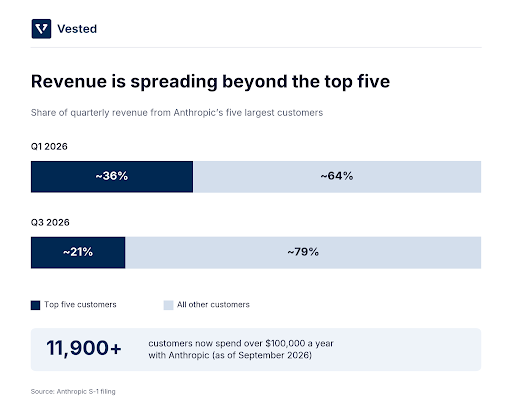
The good news is that this is gradually improving. In Q1 2026, the top five customers brought in about 36% of quarterly revenue. By Q3, that had dropped to around 21%. Over the nine months to September, no single customer contributed more than 10% of revenue.
That’s because the customer base is getting much wider.
As of September, more than 11,900 customers were spending over $100,000 a year with Anthropic, and nearly 1,900 were spending over $1 million.

Big enterprise clients now drive most of the business: in 2025, customers spending over $100,000 a year accounted for 76% of total revenue.
Still, when a fifth of your revenue comes from two customers who pay as they go, losing even one of them would hurt. And unlike Anthropic’s computing bills, those customers aren’t locked in.
And clearly, the flywheel is spinning. Revenue went from $386 million in 2024 to $4.6 billion in 2025, and then to $16.3 billion in just the first half of 2026.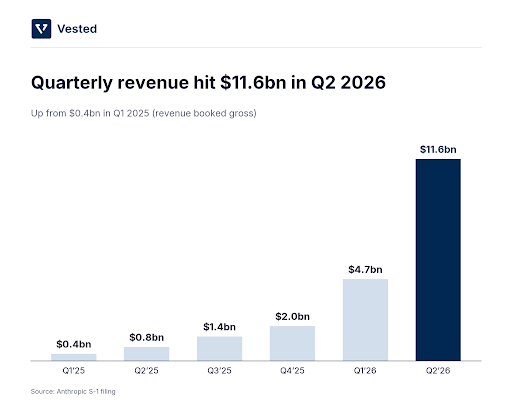
So you’d think a company growing this fast would be minting profits, right?
Not quite. In the first six months of 2026, Anthropic reported a net loss of $81 billion.
Now, that number sounds alarming, but most of it isn’t a real loss in the sense of money leaving the company.
Over the years, investors put money into Anthropic through convertible notes, which are basically loans that turn into shares later.
When those deals were signed, Anthropic was worth much less.
But its valuation then shot up from $183 billion to $965 billion in about a year. That meant the shares those investors would eventually get became far more valuable, and accounting rules require Anthropic to record that jump as an expense.
That alone accounted for over $72 billion of the loss.
The better number to look at is the operating loss, which reflects how the actual business is doing.
That came in at $693 million for the first half of 2026, down from $2.1 billion a year earlier. In the second quarter, Anthropic even made $1 billion in operating profit.

And that’s why Wall Street liked what it saw.
AI stocks had been beaten down for two weeks over fears about debt-fuelled data centre spending, but on the day of the filing, the Nasdaq 100 rose 1.1% and chip stocks jumped 2.8%.
Investors pointed out that Anthropic had $131.7 billion in cash after raising $141.1 billion over its lifetime.
In other words, it has spent only about $9 billion to build a business that now earns $16 billion a quarter.
But not everyone is convinced. And to understand why, you have to look at what it costs Anthropic to run Claude.
In the first half of 2026, Anthropic spent nearly $9 billion on computing and infrastructure.
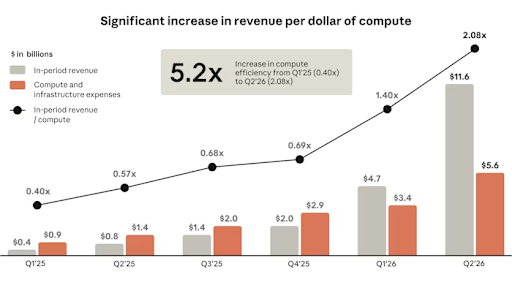
That’s roughly 55 cents of every dollar it earned, before it paid a single employee.
Compare that to a regular software company like Microsoft. Selling one more Office licence costs it almost nothing.
But every time Claude answers a question, Anthropic has to pay for the computing power behind it.
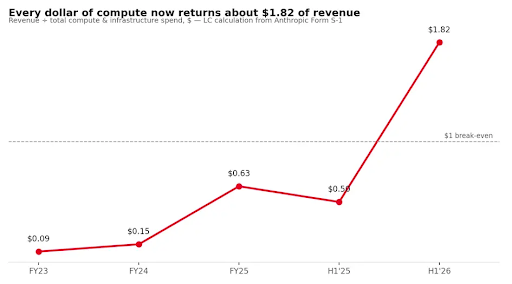
To be fair, this is getting better fast. In early 2025, Anthropic spent over $2.50 on computing for every dollar of revenue. By mid-2026, that was down to under 50 cents.
The problem is what comes next.
The AI industry is betting big on agents, which are AI systems that can work on tasks for hours, use tools and make decisions on their own.
And Anthropic itself admits in the filing that serving agents could need computing power that grows “disproportionately” to the revenue they bring in.
So the very product that’s supposed to drive its future could also be the most expensive one to run.
That brings us to the biggest worry of all.
To make sure it has enough computing power, Anthropic has signed deals worth more than $800 billion, some stretching all the way to 2045.
Its deals with chipmaker Broadcom alone are worth $161 billion. Its deals with SpaceX could cost about $3.1 billion every month once fully up and running.
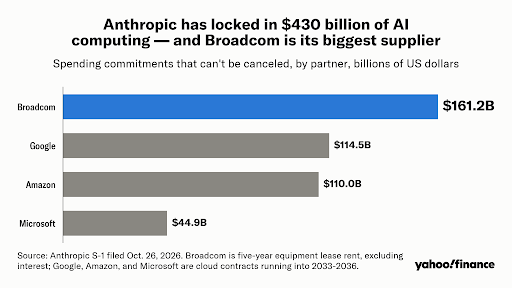
Many of these contracts are take-or-pay, which means Anthropic has to pay whether it uses the capacity or not. Its customers, on the other hand, mostly pay as they go. They can cut back, switch to OpenAI or Google, or move to a cheaper open-source model whenever they like.
So Anthropic has locked itself into decades of bills, while its customers haven’t locked themselves into anything.
And the companies it owes much of this money to make things even more complicated. Amazon, Google and Microsoft supply Anthropic’s computing power.
They’re also major investors in Anthropic. They also sell Claude through their cloud platforms, which brought in 48% of Anthropic’s revenue in the first half of 2026. And they build their own competing AI models.
That creates an awkward situation.
When computing power is scarce, these companies could prioritise their own AI over Claude. In fact, Anthropic admits it has asked some partners for more capacity than they were willing to give.
And since a chunk of the money they invest in Anthropic flows right back to them as payments for computing, it’s harder to tell how much of Anthropic’s growth comes from real customer demand.
Then there’s the question of who actually controls Anthropic.
If you buy Anthropic shares, you won’t get much of a say in how the company is run.
Its seven co-founders, including CEO Dario Amodei and his sister Daniela, will hold a special class of shares that gives them 50.1% of the voting power.
On top of that, a Long-Term Benefit Trust, which includes former US Fed chair Ben Bernanke, gets to appoint four of the seven board members.
Anthropic says this setup lets it focus on building AI safely over the long term, without being pressured by shareholders chasing quick profits. Say Anthropic decides to spend billions on AI safety research instead of new products. Shareholders might not like it, but they can’t do much about it.
That could work well if the founders keep making the right calls. But if they don’t, public investors have very few ways to push back.
So what is all of this worth?
Well, the filing doesn’t say yet. The price range and the number of shares on offer are still blank. But existing investors reportedly expect a valuation of $1.5 to $1.75 trillion, down from the $2 trillion-plus that was being discussed in August. At $1.5 trillion, investors would be paying about 22 times Anthropic’s current annual revenue pace.
Interestingly, Anthropic’s founders wrote in the filing that they’d been given one piece of advice: never let your company be worth a dollar more than it actually is. We’ll find out in the coming weeks whether the market agrees, with the listing expected after the US midterm elections on November 3 and before Thanksgiving.
Either way, this IPO is bigger than Anthropic. It’s the first real test of whether public markets believe the AI boom can pay for itself. And the rest of the AI industry will be watching closely, because they’re likely next in line.
Don’t forget to share this story with your friends, family or even strangers on WhatsApp, LinkedIn and X.