


Anthropic filed its Form S1- registration statement with the SEC on 26th October 2026, moving it closer to the launch of an IPO. What attracted most investors is its extraordinary growth run.
Revenue reached $16.3 billion in the first half of 2026, compared with $1.1 billion in the same period a year ago. In the third quarter, revenue exceeded entire first-half earnings, reaching $16.8 billion.
This kind of growth trajectory is rare, even by the standards of the technology sector. As more enterprises are moving beyond the experimentation phase to integrating AI into core business operations, demand for Claude is accelerating. Its current numbers may only represent the beginning of a much larger opportunity.
Players behind the extraordinary growth run
At a reported valuation of nearly $2 trillion, investors are betting that Anthropic can sustain this growth momentum in the near term. But revenue growth alone does not tell the full story. An equally important question is how they are generating this growth.
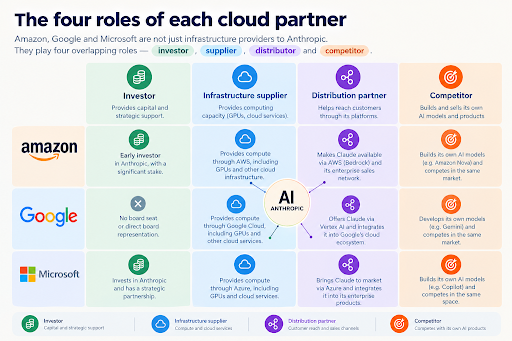
Anthropic’s S1 filing mentions three companies that are behind the recent growth: Amazon, Google, and Microsoft. Yes, you heard that right. Through their cloud marketplaces, they bundle and distribute Claude to enterprise customers.
Nearly half of revenue comes through cloud marketplaces
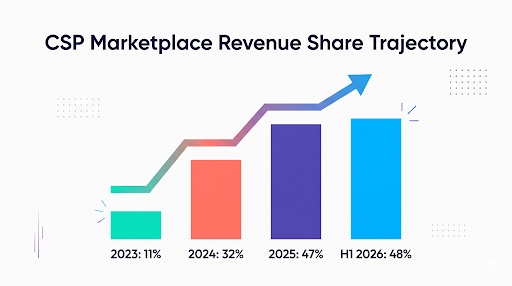
In the first half of 2026, sales through these marketplaces accounted for 48% of revenue, compared with just 11% in 2023.
Sales through this arrangement have certain benefits. Large enterprises can purchase Claude through existing cloud contracts and use their already approved technology budgets rather than onboarding another vendor. This reduces friction in the sales process and helps reach enterprise customers faster.
However, the role of these three big tech companies goes beyond distribution. They also provide the computing infrastructure to Anthropic for running its AI models. At the same time, with their own AI models, they are competing directly with Claude.
This creates an unusual business dynamic: Anthropic’s biggest partners are also its suppliers, competitors, and investors.
Cost of distribution is rising faster than revenue
While cloud service providers have helped Anthropic post record revenue growth, the company also has to share a portion of that revenue with them as commissions.
Sales, marketing, and partnership expenses in the first half of 2026 rose to $3.17 billion, compared to just $120 million a year ago. The expenses rose almost 26 times faster than the revenue growth rate of around 15 times.
Some of the increase is on the expected line as rapid expansion requires more sales personnel, enterprise relationships and marketing expenses. But the partnership angle is worth a closer look, especially as marketplace sales are growing to be a larger piece of the revenue share. Although these costs may drive up sales, they can affect the economics of acquiring customers.

A massive infrastructure commitment that one cannot ignore
Unlike traditional software companies, AI models require massive computing capacity to operate smoothly, and that capacity can’t be built easily.
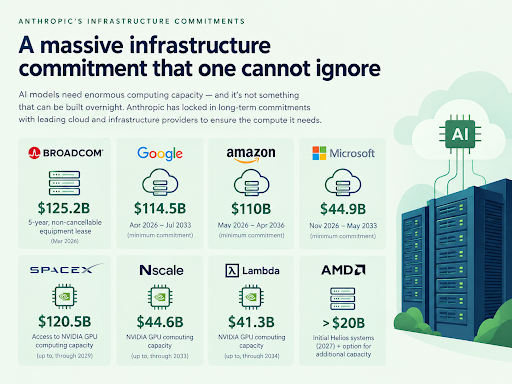
Anthropic relies on Amazon, Microsoft, Google, and several other computing infrastructure providers. It has also locked up massive long-term financial commitments with them. The S-1 highlights the scale of financial commitments.
-
- Broadcom: A five-year, non-cancellable equipment lease signed in March 2026, involving aggregate rent payments of $125.2 billion, excluding interest.
- Google: A commitment to spend at least $114.5 billion between April 2026 and July 2033, regardless of actual usage.
- Amazon: A minimum spending commitment of $110 billion between May 2026 and April 2036, irrespective of actual usage.
- Microsoft: A minimum commitment of $44.9 billion between November 2026 and May 2033, regardless of actual usage.
- SpaceX: Up to $120.5 billion for access to NVIDIA GPU-powered computing capacity, with agreements extending into 2029.
- Nscale: Up to $44.6 billion for NVIDIA GPU-powered computing capacity, with agreements extending into 2033.
- Lambda: Approximately $41.3 billion for NVIDIA GPU-powered computing capacity, with agreements extending into 2034.
- AMD: Anthropic has committed to procure an initial tranche of AMD-powered Helios rack-scale computing systems in 2027. The agreement does not specify a fixed dollar commitment, but Anthropic expects expenditure to exceed $20 billion, with an option to procure additional capacity of up to the same amount
The aggregate value of these disclosed arrangements could exceed $620 billion. Although these spending commitments are spread over years, the amount is several times Anthropic’s current Anthropic’s revenue run rate.
The challenge for Anthropic will be to convert its rapidly growing revenue into sufficient cash flows to support these long-term commitments without leveraging its balance sheet.
When suppliers, distributors, competitors, and investors are same company
What makes Anthropic’s business model unusual is the multiple roles played by its three major cloud partners.
Amazon, Google and Microsoft are investors, infrastructure providers, distribution partners and competitors all at once. They have a financial interest in Anthropic. They make money from its computing needs. They help sell Claude to enterprise customers and compete with it.
According to the S-1, Amazon and Google will each hold more than 5% of Anthropic’s capital after the conversion of outstanding preferred shares and notes. Amazon’s ownership is capped at 12%, while Google’s is capped at 14.99%, subject to their respective rights to waive these limits. On the other hand, Microsoft’s 27% stake in OpenAI should also need to be kept in mind.
The key risk of having these overlapping relationships is that they work in Anthropic’s favour as long as commercial interests remain aligned. However, the relationship can get more complicated as competition intensifies.
Anthropic’s prospectus itself flags computing capacity as an emerging constraint. Computing resources are increasingly becoming scarce as demand for AI infrastructure surges. Supply chain bottlenecks, environmental concerns, and rising costs are adding to the pressure.
In such a scenario, if cloud service providers prioritise and allocate more computing capacity to their own AI models over Anthropic, this could potentially weaken its competitive position.
Three operational metrics worth tracking
Rather than focusing exclusively on quarterly revenue growth and net revenue run rate, investors should monitor three operating metrics to understand how Anthropic is progressing.
- Cloud marketplace costs: The share of revenue paid to distribution partners will help establish how much of Anthropic’s growth is translating into retained earnings. If partnership costs rise faster than marketplace revenue, that needs to be closely analysed. A rising rate may still be justified only if it brings faster sales.
- Marketplace revenue contribution: Marketplace sales accounted for 48% of revenue in the first half of 2026. If this proportion continues to increase, Anthropic’s growth dependence will deepen. If it does, you need to analyse the sales growth from direct channels as well.
- Computing capacity and utilisation: Anthropic’s large computing capacity commitments create a fixed costs burden, making capacity utilisation critical to profitability. For investors, the key metric to watch is whether the incremental revenue from Claude is growing faster than the cost of securing and running the computing infrastructure.
The $2 trillion valuation will depend on more than growth
Anthropic has demonstrated that demand for its AI models can translate into fast revenue growth. But scaling the business is one thing, growing it profitably is another. Its reliance on cloud providers for distribution, and the large fixed infrastructure commitments, could all impact margins as the business grows.
Right now, Anthropic’s business economics are highly reliant on Amazon, Google and Microsoft.
A valuation of nearly $2 trillion suggests the company can continue its growth while slowly reducing these dependencies. That could mean selling more directly to businesses, diversifying its vendors for infrastructure and making its cloud partnerships more economical.
For investors, the key monitorable will not just be quarterly revenue run rate, but how much of that revenue is converted into profit and sustainable cash flows.