





The story
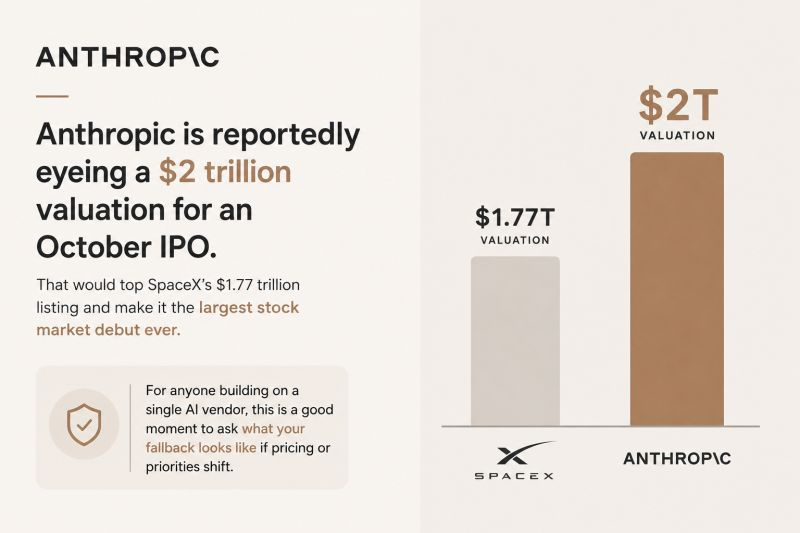
It’s peak August, the month when Wall Street usually empties out for the Hamptons. But this year, bankers are staying glued to their phones. Word is out that Anthropic, the company behind the Claude chatbot, is prepping for an IPO in October. And investors think it could be valued at $2 trillion or more.
To put that number in perspective, that’s bigger than SpaceX’s $1.77 trillion valuation from earlier this summer, which currently holds the record for the largest IPO ever. It’s more than double what Anthropic itself was worth just three months ago, when it raised money at a $965 billion valuation in May.
So what changed in three months to justify doubling a company’s worth? Let’s dig in.
The math behind the madness
Anthropic’s revenue has been on an absolute tear. In May, the company said its annualised revenue (that’s the amount it would earn in a year if the current month’s pace held up) crossed $47 billion. Investors now expect that number to hit somewhere between $100 billion and $120 billion by December.
That’s more than 10x growth in a single year. For a company that was doing roughly $1 billion in annualised revenue at the end of 2024, this is Silicon Valley’s fastest climb in recent memory.
Here’s where it gets interesting. The company growing at 800% a year deserves at least a 30x revenue multiple. Apply that to Anthropic’s expected $100 billion run rate, and you get $3 trillion, not $2 trillion.
For comparison, AI-linked stocks like Palantir and Nebius currently trade at around 55 times revenue. Against that yardstick, even $2 trillion starts to look conservative.
Of course, “the market will pay 55x for other AI names” is not the same as “the market will pay 55x for Anthropic.” Revenue multiples are backward-looking justifications dressed up as forward-looking logic. They tell you what people were willing to pay, not what they should pay.
But here’s the catch
A $2 trillion price tag assumes Anthropic can keep growing at this pace forever. That’s a big assumption, and Fortune ran the numbers to show just how big.
At valuation multiples typical for large, mature Nasdaq companies, Anthropic would need annual profits of roughly $59 billion to $79 billion to justify a $2 trillion price tag.
For scale, Amazon, a company nearly three decades old with a retail empire, a cloud business, and an advertising arm, earned $62.6 billion in net income on $200.6 billion of quarterly revenue. Anthropic isn’t there.
Reports suggest its second quarter revenue was closer to $10.9 billion, and this was the first quarter it posted an operating profit at all, which is still a long way from net income.
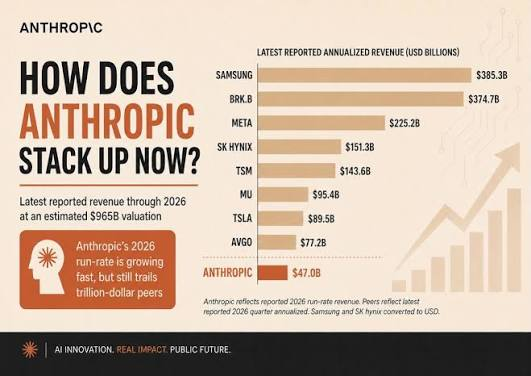
In other words, Anthropic is being asked to price like Amazon while still looking, financially, like a five-year-old startup.
The competition problem
Anthropic’s biggest challenge isn’t proving that AI works. Everyone already believes that. The harder question is whether Anthropic specifically can keep charging what it charges.
Its flagship model costs more than two and a half times as much to run as OpenAI’s best offering.
Meanwhile, Chinese open-weight models have gotten dramatically better this year, and they’re available for a fraction of the price. Payments company Ramp, which tracks business spending, found that companies are already “hitting their limit” on AI budgets and shifting toward cheaper alternatives, even as Anthropic gained market share overall.
This is the classic innovator’s dilemma. You built the best product, but “best” isn’t always what wins when a “good enough and much cheaper” option shows up.
Add some politics
Anthropic hasn’t had the smoothest relationship with Washington. It’s currently in litigation with the US Department of Defense, which labelled the company a supply chain risk earlier this year. In June, the Commerce Department briefly banned exports of Anthropic’s leading models, Fable 5 and Mythos 5, over national security concerns. The ban was lifted by the end of the month, but the episode spooked some customers who depend on Anthropic’s models for critical work, and it’s a reminder that AI companies now sit at the intersection of technology and geopolitics, whether they like it or not.
The Facebook parallel
If you want a reality check on what happens after a hyped listing, look no further than Facebook’s 2012 IPO. It priced at $38 a share, valuing the company at $104 billion, the most anticipated listing of its era. Within four months, the stock had fallen below $18. It took 15 months to climb back to its IPO price.
The business itself never stopped growing. What collapsed was market sentiment, the gap between what investors hoped for and what the company could show quarter to quarter. Facebook eventually proved the doubters wrong. Today it books over $200 billion a year and reaches 3.58 billion people daily. But getting there took patience that a lot of IPO-day investors didn’t have.
Why this IPO matters beyond Anthropic
This listing isn’t just about one company’s stock price. It’s shaping up to be a referendum on the entire AI infrastructure boom.
Hundreds of billions of dollars have gone into data centres, chips, and power capacity on the bet that AI demand will keep compounding. If Anthropic lists at or above $2 trillion and the stock holds up, it tells every hyperscaler, chipmaker, and utility company that the market still believes in the story. Capital keeps flowing.
If it stumbles instead, expect a much harder look at every valuation across the AI supply chain, not just Anthropic’s.
Worth noting too that OpenAI is watching just as closely. The rival lab recently completed a $7 billion share buyback from employees ahead of its own eventual listing, while keeping its valuation steady at $852 billion. Whichever lab goes public first, and however that debut is received, will set the benchmark the other gets measured against.
The takeaway
Anthropic’s growth is real. Going from roughly $1 billion to a possible $120 billion in annualised revenue within two years is a number that would have sounded absurd for almost any other kind of business.
But growth and valuation are two different questions. The first is about how fast a company is moving. The second is about how much someone should pay today for however fast it keeps moving tomorrow, against cheaper competitors, tighter enterprise budgets, and a regulatory environment that can turn overnight.
Come October, we’ll find out which story the market believes, Anthropic IPO timeline
